

Key takeaways
- Fintech content has a short operational half-life in regulated, fast-moving markets.
- Modular architecture makes targeted curriculum changes faster, safer, and easier to audit.
- Every change needs a named owner, evidence trail, version number, and release note.
- Learning analytics should reveal which modules need revision before risk or confusion spreads.
A fintech curriculum is no longer a fixed asset that can be reviewed once a year. It is a live product operating across changing payment rails, AI use cases, digital-asset practices, security threats, and regulatory expectations. When learning teams treat it as a static course catalogue, learners receive content that may still look polished but no longer reflects the work they do.
Fintech knowledge now decays in production
The Global Fintech Institute’s 10 July 2026 relaunch of its Chartered Fintech Associate curriculum reflects the breadth of this problem. Its updated coverage spans digital payments, decentralised finance, regtech, AI in financial services, and policy frameworks. Those topics do not move in sync. A change in one area can alter examples, controls, assessments, and role-specific guidance elsewhere in the learning journey.
The issue becomes harder when content travels. GFI’s 13 July 2026 agreement with SolusFutura expanded certification and education activity across Hong Kong, Macau, and the Greater Bay Area. Cross-market delivery does not mean copying one master course into another language. It requires clear control over which content is global, which is locally adapted, and which legal or policy assumptions apply in each market.
For an HR or L&D lead, the operational risk is plain. A stale onboarding module can normalise an outdated process. An old compliance scenario can teach the wrong escalation path. An untracked translation can drift from the approved source. This is why fintech curriculum management belongs closer to product operations than to an annual editorial project.
Release management replaces the annual rewrite
Curriculum release management applies familiar software discipline to learning content. Each meaningful change has a scope, an owner, supporting evidence, a review path, a release date, and a record of what changed. The aim is not to turn every wording edit into bureaucracy. It is to make regulated content operations controlled where they need to be controlled and fast where they can be fast.
- Break curricula into independently maintainable modules rather than long, locked courses.
- Assign a business owner, learning owner, and compliance or subject-matter reviewer for each high-risk module.
- Maintain curriculum versioning for content, assessments, translations, and policy references.
- Publish concise release notes that explain the change, affected audiences, and required learner action.
- Set review cadences by risk and volatility instead of placing every module on the same annual cycle.
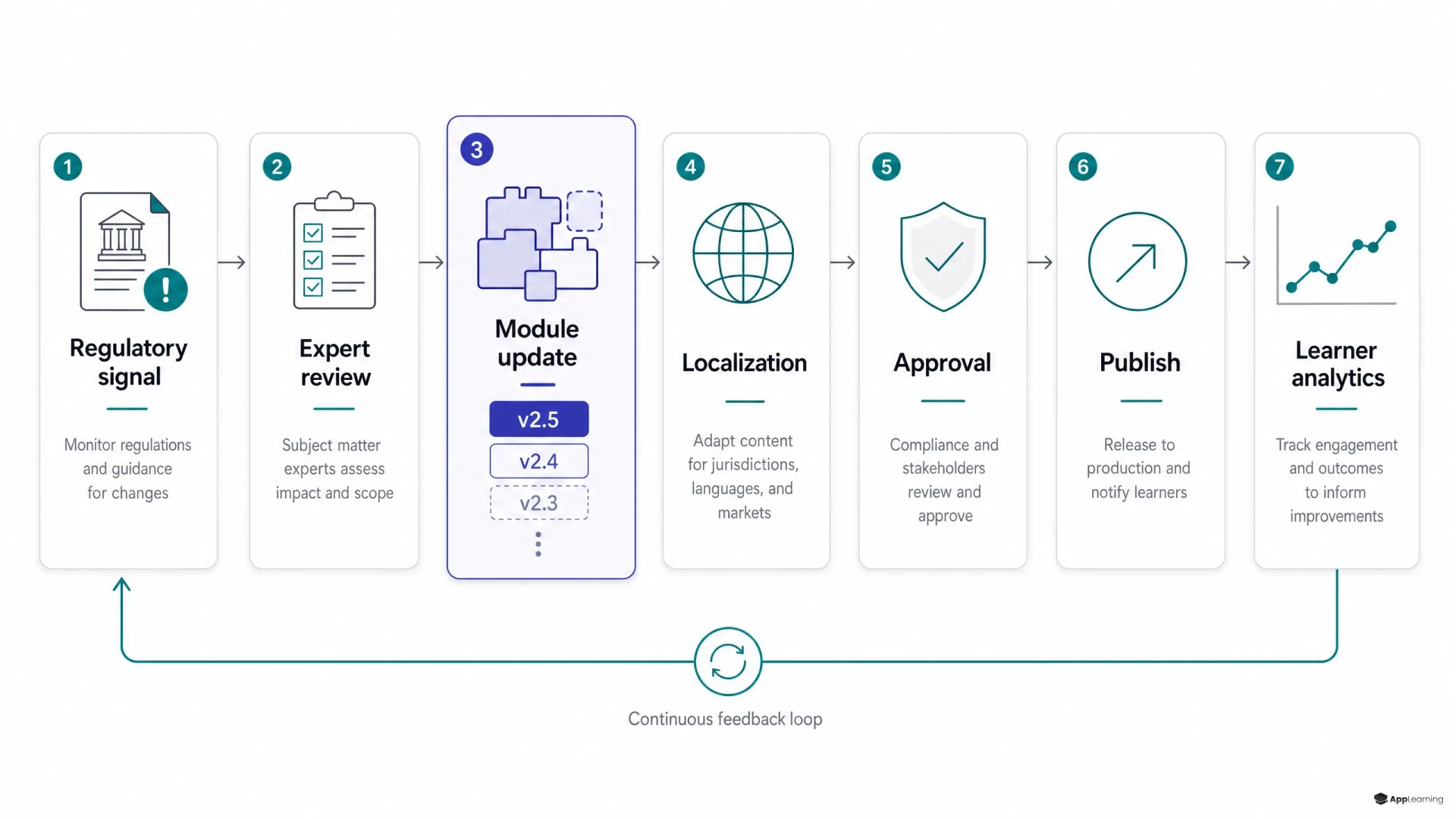
Ownership turns updates into a reliable system
The core operating model is simple, but it must be explicit. Product or policy teams raise a change signal. A curriculum owner assesses affected modules. Subject-matter experts supply evidence and approve the interpretation. Learning designers update the experience and assessment. Compliance reviews the controlled release. The platform publishes the right version to the right audience, while the team retains the prior version and audit trail.
This model also prevents the common failure of review by inbox. Without clear ownership, updates wait for a quarterly meeting, depend on one expert’s memory, or become trapped in duplicated slide decks. With named decision rights, teams can distinguish a critical correction from a scheduled enhancement. They can also document when learners must be reassigned, re-certified, or simply informed through release notes.
Good to know
How often should fintech learning content be reviewed?
Review cadence should follow volatility and risk. Payment rules, digital-asset controls, AI governance, and compliance procedures may need event-driven reviews, while stable foundations can follow a scheduled cycle.
What belongs in curriculum release notes?
Include the version number, release date, affected modules, reason for the change, evidence or policy trigger, approved owner, learner impact, and any reassignment requirement.
How does modular content improve compliance training?
It lets teams update a specific control, scenario, or assessment without reopening an entire course. That reduces approval effort, limits unintended changes, and creates a clearer audit trail.
Modularity lowers the cost of staying current
Large courses make every update expensive. A small regulatory clarification can force teams to reopen a 90-minute module, re-record video, revalidate questions, retranslate files, and republish the full programme. Modular content isolates the change. A payments scenario, a custody-control explainer, or an AI governance lesson can be revised, approved, and shipped without disturbing the rest of the curriculum.
That architecture supports continuous learning content updates without creating learner fatigue. Learners see only the material relevant to their role, market, and prior completion status. Teams can test whether a revised module improves understanding, reduces incorrect answers, or changes confidence on a key task. Completion rates alone cannot reveal whether content is current or useful. Item-level assessment results, drop-off points, search behaviour, and learner feedback give a better revision backlog.
Build a learning operation that can keep pace with fintech change.
DiscussThe fintech academy becomes a content operation
A fintech academy platform should therefore do more than host courses. It should make the content supply chain visible: modular lessons, controlled approvals, multilingual variants, audience rules, release history, and analytics in one operating environment. App-Learning is built for this kind of work, helping finance and crypto teams deliver engaging learning while keeping fast-changing content measurable and manageable inside regulated environments.
The strategic shift is straightforward. Do not ask whether the curriculum is complete for this year. Ask whether every high-risk module has a current owner, a defensible evidence base, a known version, and a release path. Fintech changes in production. The learning system that prepares people for it must be able to change there too.