
Key takeaways
- Keystroke synchronization is not content-level conflict resolution.
- Structured course objects need explicit versions, states, and transition rules.
- AI-generated changes must follow the same review controls as human edits.
- Approved learning content cannot change through invisible concurrent updates.
Sync Protects Characters, Not Decisions
A real-time LMS editor solves an important but narrow problem. It lets several people change text without overwriting each other character by character. Collaborative data models such as Yjs shared types are built for concurrent manipulation of the same underlying document state. That is the foundation for collaborative course authoring, not the complete operating model.
Enterprise learning teams do not only edit paragraphs. They move lesson blocks, reuse assessments, attach evidence, retire outdated policy content, assign reviewers, and publish modules to defined audiences. Those actions carry intent. A system can merge two sentences cleanly while still producing the wrong course structure, the wrong approval status, or an untraceable compliance change.
Courses Create Semantic Collisions
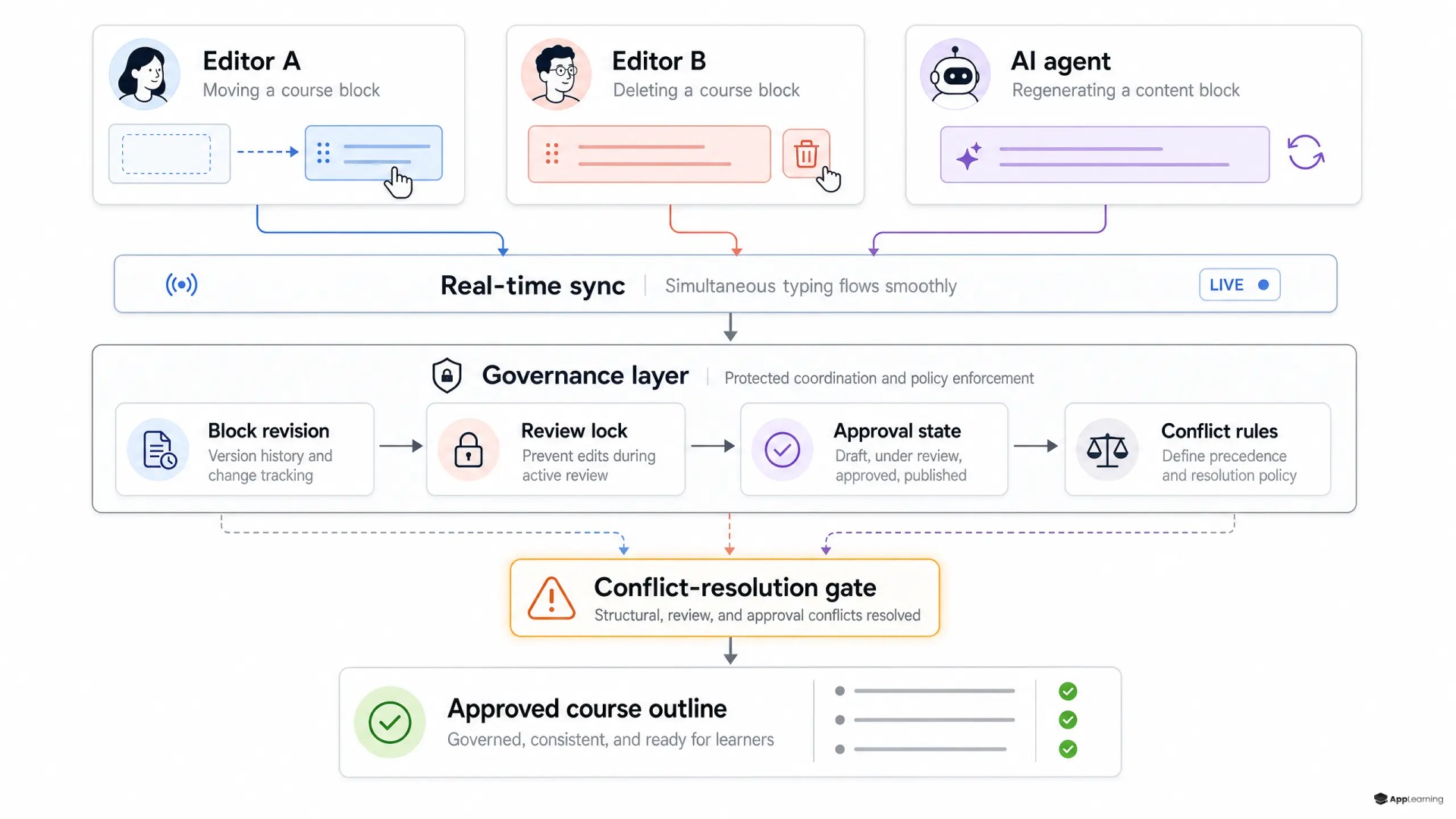
The difficult conflicts happen above the text layer. Consider a compliance author who deletes a block because a policy is obsolete while an instructional designer moves the same block into a new module. Or a reviewer opens a course revision while another session updates the assessment tied to it. Both users may see a technically valid document after synchronization. Neither may see a valid workflow outcome.
This is the difference between data convergence and content conflict resolution. The first asks whether every session reaches the same state. The second asks whether that state still respects the course model, ownership, review decision, and publication rule. Finance and crypto companies need the second answer before a changed course can reach employees.
States Turn Edits Into Workflow
Each course object needs an identity, a revision, and a state. A block, question, media asset, or learning objective should not be treated as anonymous text inside one large page. It should be an object whose changes can be compared, accepted, rejected, or restored.
A practical enterprise authoring workflow distinguishes at least draft, in review, approved, published, and archived content. State transitions need rules. A reviewer should assess a fixed revision. If an editor changes that revision, the system should mark the review as superseded rather than leave an approval badge attached to materially different content. If an approved block changes, it should create a new candidate revision rather than silently alter the approved one.
- Use stable object IDs so moves, deletions, and replacements remain distinguishable.
- Store a revision baseline when review begins and show every change since that baseline.
- Require an explicit decision when a concurrent action invalidates a review.
- Restrict high-risk actions with edit ownership or short-lived object locks.
- Keep an audit trail of actor, time, object, previous value, new value, and approval impact.
AI Becomes Another Editor
AI authoring collaboration raises the stakes because an agent can change many objects quickly. Regenerating a lesson may replace explanatory copy, distractors, learning objectives, and source references in one action. Treating that result as ordinary background automation makes review weaker exactly when the change surface becomes larger.
AI output should therefore arrive as an attributed proposal or a new revision, not as an invisible overwrite. The system should identify the model-assisted change, preserve the prior content, show a structured diff, and apply the same state rules that govern human edits. This aligns with the NIST AI RMF Core, which emphasizes documented human-AI roles, oversight, and change management.
The useful rule is simple: an AI may draft, transform, or suggest, but it cannot inherit approval. A reviewer approves a defined revision after seeing what changed and why it changed.
Good to know
Why is real-time text synchronization not enough for course authoring?
It handles overlapping text changes, but it does not decide the outcome when users move, delete, approve, or publish the same structured course object concurrently.
What should happen when content changes during review?
The review should remain attached to the exact revision reviewed. A material change should supersede, invalidate, or branch that review and require a new decision.
Should AI be allowed to edit approved course content?
AI can propose a new revision, but it should not silently alter approved or published content. Its changes need attribution, a visible diff, and the same approval path as human changes.
When do object locks make sense?
Use short-lived locks or edit ownership for high-risk actions such as publishing, major restructuring, regulated policy updates, or assessment changes. Do not lock ordinary drafting unless the risk justifies the friction.
Conflict Semantics Need a Contract
A mature system does not try to guess every conflict away. It defines a small, visible contract for resolving them. The contract should state which actions can merge automatically, which require a user decision, and which are blocked by workflow state.
- Merge independent text edits within the same editable revision.
- Flag move-versus-delete conflicts for resolution instead of choosing silently.
- Reject writes against stale revisions when they would alter approved or published material.
- Invalidate or branch a review when its underlying objects change.
- Require explicit acceptance before AI proposals alter the working course.
- Record all resolution decisions as part of the course history.
This approach makes the authoring experience slightly more deliberate at the moments that matter. It avoids a worse trade-off: fast editing followed by slow reconstruction of who changed regulated learning content, what was approved, and which version learners completed.
Make collaborative authoring safe enough for regulated learning operations.
Talk to usCollaboration Must Survive Review
For App-Learning, real-time authoring should be designed as collaborative learning infrastructure. Fast co-editing matters, but it must sit on top of structured course objects, revision-aware review, explicit ownership, and visible AI changes. That gives L&D teams the speed to update training while giving compliance and subject-matter experts a clear control point.
The strongest enterprise authoring workflow is not the one with the most animated cursors. It is the one that preserves the meaning of a decision when people and AI act at the same time. When content, workflow state, and accountability remain connected, teams can move faster without making governance a manual cleanup task.