Key takeaways
- Content-type growth creates navigation, ownership and change-management debt.
- Learning domains should shape the CMS structure, not technical convenience.
- Reusable assets, permissions and tokens require one governance model.
- AI amplifies unclear schemas and weak administrative boundaries.
- Measure CMS maturity by discoverability, safe change and traceability.
When the content model becomes an operating problem
A course CMS feels simple while one person can hold its structure in their head. Then the team adds programmes, modules, chapters, quizzes, certifications, media, translations and automations. The bottleneck shifts. It is no longer writing another lesson. It is finding the right object, knowing what may be reused and changing a relationship without creating damage elsewhere.
On 23 September 2026, Strapi 5.55.0 added content-type folders and audit logging for token management. The preceding v5.54.0 release made a redesigned Media Library the default. These are product signals, not proof that folders improve learning. They do show that CMS workspaces eventually need stronger organization and traceability.
Schema sprawl turns into ownership debt
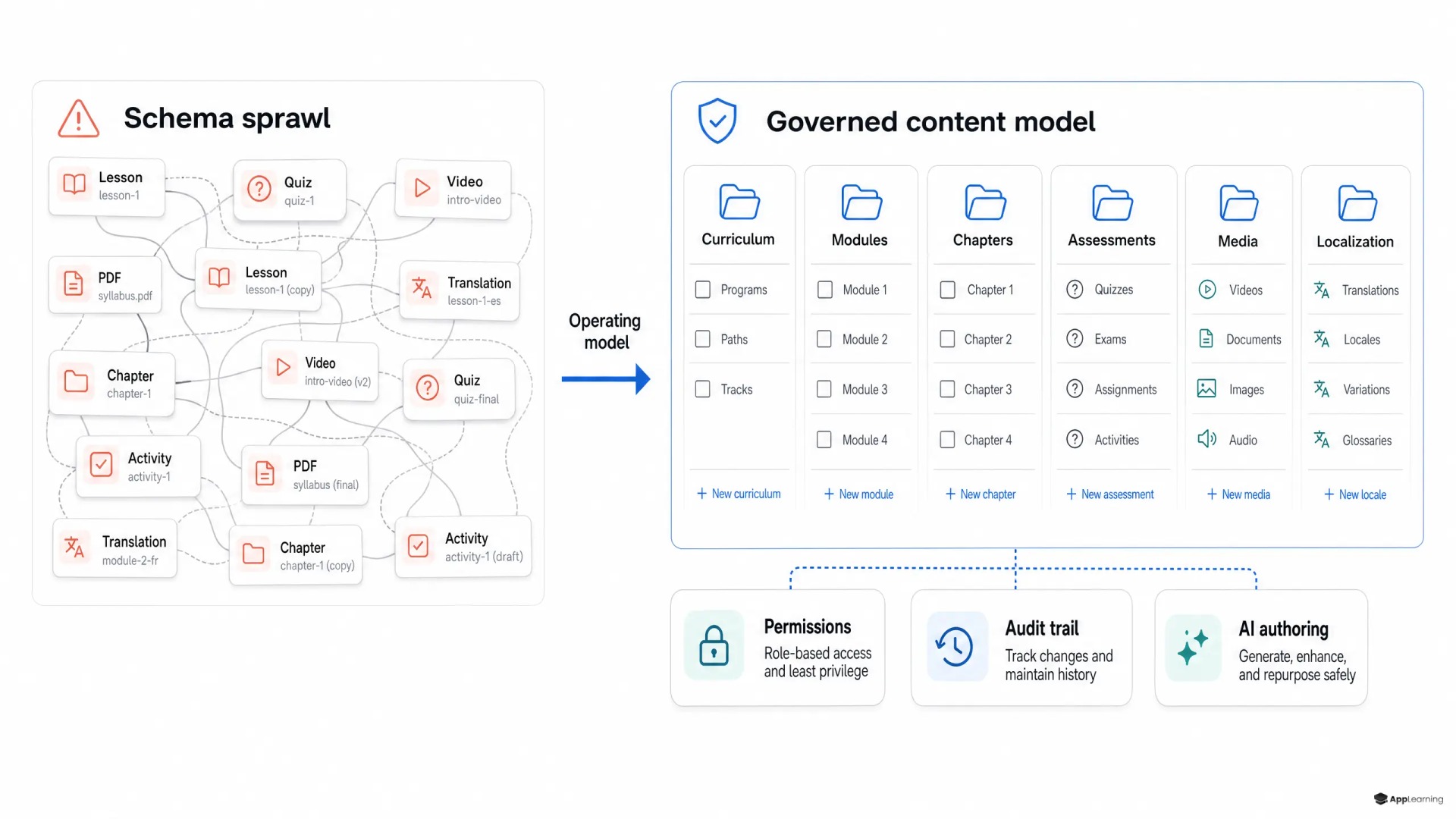
A flat list of Strapi content types is manageable until it stops being one team’s private map. Similar names emerge. A quiz block is confused with a quiz template. A chapter image is reused as a global asset. Nobody knows whether a field is still consumed by the learner app, an export or an onboarding flow. That is not a documentation problem alone. It is an LMS CMS architecture problem.
- Types become hard to find and easy to duplicate.
- Relationships exist in team memory rather than the model.
- Old fields remain because their downstream impact is unclear.
- No owner has authority to approve structural changes.
Learning domains should shape the structure
Treat the learning content model as an operational map. Group content types by recognizable domains: curriculum structure, learning activities, assessment, reusable learning assets and platform configuration. Within curriculum structure, make the chain explicit: programme contains courses, courses contain modules, modules contain chapters, and chapters contain activities. Do not bury these decisions in generic blocks simply because they are fast to create.
Folders matter because they expose that map where authors and administrators work. In Strapi, content-type folders can be versioned with project code, which makes the navigation model a shared system decision rather than a personal admin preference. A clear structure reduces the cost of onboarding a new content operator and makes ownership visible.
Assets and access belong to content governance
Media is not merely an upload area. A logo, illustration, video or PDF can be reusable across courses, restricted to one programme or tied to a regulated policy. Keep reusable assets separate from course-specific assets. Give both a clear naming and lifecycle rule. Then scope permissions around real jobs: a subject-matter expert may edit lesson copy, while a learning designer manages assessment logic and a platform administrator changes schemas.
Tokens and service identities need the same discipline. Record an owner, business purpose, permitted content scope, expiry date and review cycle for every token. Where available, Strapi’s Audit Logs record token actions alongside administrative activity. That trace is useful only when the organization can tell whether the change was expected and who was accountable for it.
Good to know
What is a learning content model?
A learning content model defines the objects that make up a learning product, such as courses, modules, chapters, activities, quizzes and reusable assets, plus the relationships and rules between them.
When should a startup formalize course content governance?
Start when more than one person creates or changes learning content, when content is reused across courses or when automated workflows begin to write into the CMS. The model is easier to govern before it becomes large.
What should an AI agent be allowed to change in a course CMS?
Give an agent narrow, purpose-built permissions. It can draft within approved types and fields, but structural changes, shared assets, publishing and permission changes should require defined review controls.
AI exposes weak architecture faster
An AI authoring CMS does not remove the need for a model. It raises the cost of an unclear one. An agent can produce draft chapters, quiz questions and metadata at high speed. It can also write to the wrong type, create near-duplicate assets or alter a shared component with a wide blast radius. Generation is safe only when the system gives the agent a constrained grammar and a narrow permission boundary.
At App-Learning, we treat the CMS as the operational layer of the learning product, not as a passive lesson repository. The useful sequence is simple: make the curriculum content operations understandable, then automate bounded parts of authoring, validation and review.
A practical operating system for course content
- Publish a domain map for every content type and component.
- Assign a named business owner and technical steward to each domain.
- Define reusable assets separately from course-bound assets.
- Require impact checks for schema and relationship changes.
- Limit AI and token write access to approved types and workflows.
Build onboarding content your growing team can safely evolve.
TalkSafe change becomes the maturity test
Measure the system with four operational metrics: time to find the correct model or asset; time to make an approved change; blast radius of a change across courses, assets and automations; and auditability of production changes. Publishing speed still matters, but it is incomplete. A fast CMS that nobody can safely change becomes a drag on every new course and every new hire.
Growing teams do not need an L&D department to establish this discipline. They need a content model that reflects how learning is designed, a governance model that reflects who can change it and controls that make automation inspectable. That is how onboarding and internal training can grow without turning the platform into another undocumented operating risk.