

Key takeaways
- Provider setup is a hidden tax on AI experimentation.
- A multi-model gateway makes controlled tool comparison faster.
- Lower access friction demands stronger evaluation gates and spending controls.
- Prototype access and production credentials should remain separate.
- Measure cost per verified learning asset, not token price.
The hidden setup tax behind every AI experiment
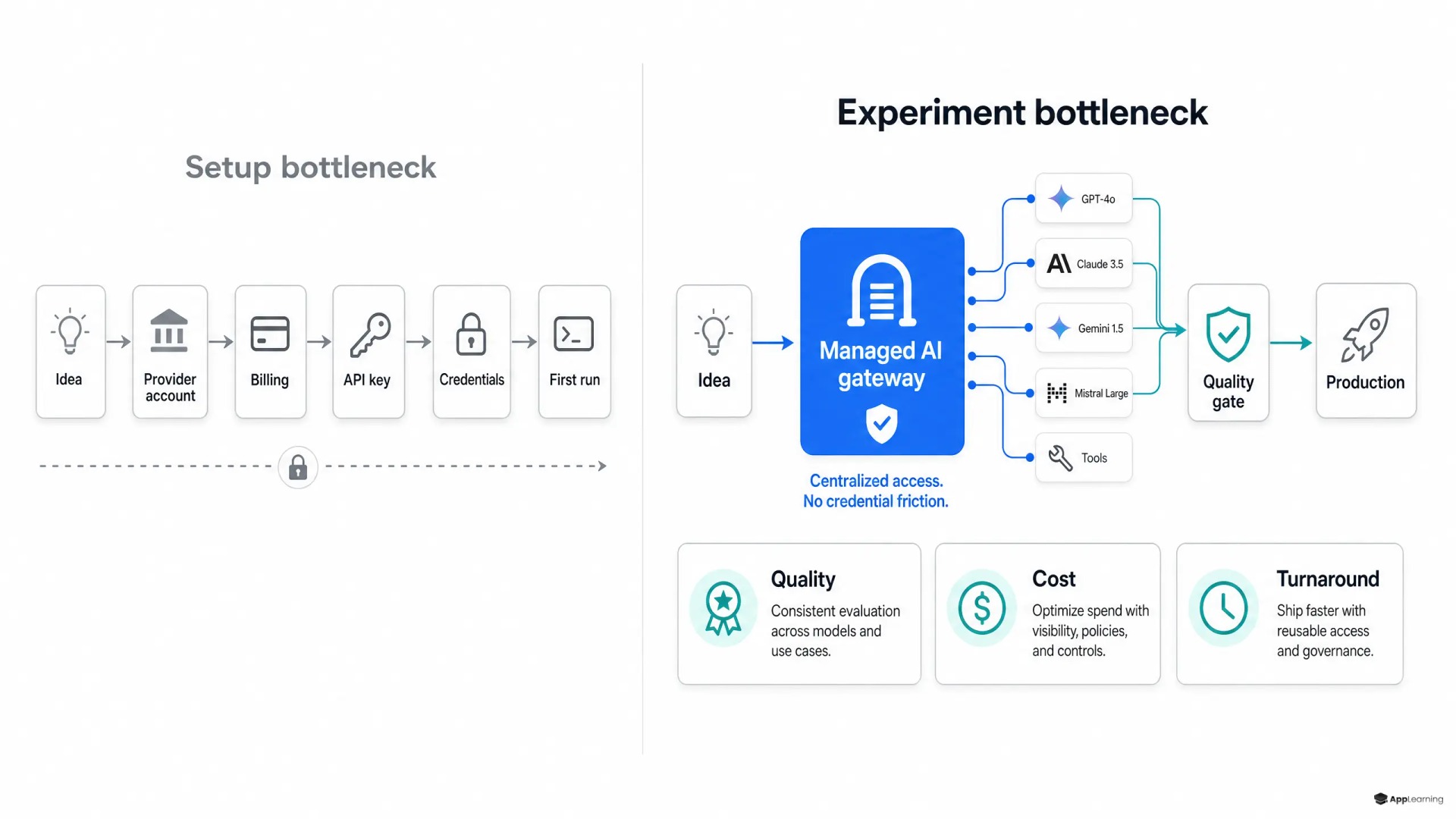
Most teams do not abandon an AI idea because the first prompt failed. They abandon it earlier. Someone must choose a provider, open an account, add payment details, create an API key, secure it, connect it to a workflow and explain the new vendor cost. For a startup with 50 people, that is not a technical footnote. It is a delay that pulls engineering, finance and operations into an experiment that may not survive its first test.
This is the quiet cost of AI workflow prototyping. The task may be small: extract facts from a policy PDF, translate onboarding content, create a first course draft, find a suitable image, or compare two research paths. Yet each task can create a new supplier relationship before the team knows whether the output is useful. The result is predictable. Teams stick with the model whose credentials already exist, not the model or tool that best fits the work.
Model access becomes a platform feature
On September 17, 2026, n8n introduced Gateway credits in version 2.36 for select Cloud plans. Eligible users can access supported models and tool services without first opening provider accounts or generating API keys. Usage comes from a shared prepaid balance, and administrators can view spending by workflow or service. Teams can still move to their own provider keys later.
That is infrastructure convenience, but it signals a larger operating-model shift. A multi-model AI gateway reduces the distance between an idea and a first comparable result. Instead of debating which provider to approve, a team can run the same source material through several configurations and inspect the differences. The AI model gateway becomes an experiment layer rather than just a billing layer.
Gateway credits make it easier to put a new model or service to work without leaving the canvas.
Easy trials raise the bar for evaluation
Removing setup friction does not remove risk. It moves the bottleneck. When anyone can test a model or service in minutes, the real questions become harder: Is the extraction accurate? Does the translation preserve product terms? Are generated questions instructionally sound? Is the research traceable? Does the image fit the content and usage rights? And can the workflow run at a predictable cost?
A fast experiment without a defined acceptance test produces fast ambiguity. Teams need a small evaluation pack before they compare tools: representative source inputs, expected outputs, known edge cases, a reviewer, a quality threshold and a spending limit. This creates evidence that a founder, operations lead or subject-matter expert can act on. It also prevents an attractive demo from becoming an undocumented production dependency.
- Use a fixed test set drawn from real onboarding and learning materials.
- Score accuracy, completeness, tone, instructional fit and required human rework.
- Set a prototype quota by workflow, owner and time period.
- Record the chosen model, tool settings, source version and reviewer decision.
- Stop tests that cannot meet the quality threshold at an acceptable total cost.
A gateway for prototypes and a governed path for production
The practical model has two stages. In the first stage, a curated gateway supports discovery. Internal teams can test extraction, translation, image handling, research and generation without managing a growing pile of provider credentials. In the second stage, only validated configurations move into a governed production path with approved data handling, named owners, stable credentials, budget controls, monitoring and rollback rules.
The separation matters. Prototype access should optimize learning speed. Production access should optimize reliability, accountability and security. Treating both stages as the same system creates two failure modes: experimentation becomes slow because every trial needs full approval, or live workflows remain informal because prototypes quietly become business-critical.
Cost per verified asset beats token price
Token price is a weak decision metric for AI content automation. A lower-cost model is expensive if it creates flawed onboarding material, needs extensive rewriting or sends a manager back to the source documents. A more expensive model can be cheaper if it produces a usable asset in one pass and reduces review time.
Use a fuller KPI: cost per verified learning asset. Include model and tool charges, workflow execution, human review, correction work and the time from source material to approved output. Track it alongside quality pass rate and turnaround time. This turns a content automation workflow from a collection of prompts into an operational system with visible trade-offs.
Good to know
What is the main benefit of a multi-model AI gateway?
It lets teams compare supported models and tools without making provider account setup the first step of every experiment.
Should prototype workflows use the same credentials as production workflows?
No. Prototype access should enable controlled learning, while production workflows need approved data handling, owners, budget limits, monitoring and rollback procedures.
How should a startup assess an AI content automation workflow?
Score output quality and required rework on real internal materials, then compare turnaround time and total cost per approved learning asset.
Which learning-content tasks are suitable for early AI experiments?
Start with bounded tasks such as document extraction, translation, source-grounded drafting, knowledge-check creation and updating existing onboarding content.
Content automation needs orchestration, not more tools
For growing startups, the highest-value use cases are often unglamorous. Turn an updated handbook into a role-based onboarding module. Extract product changes from release notes. Translate a policy update. Convert an expert interview into a manager guide. Create knowledge checks from approved source material. Each workflow crosses several steps, and each step may need a different capability.
App-Learning can apply the gateway principle through a curated orchestration layer. Teams should be able to trial these steps against real internal knowledge, compare configurations and promote only approved versions into the learning system. That keeps operational knowledge close to the people who own it while reducing the burden on founders and managers to coordinate every update by hand.
Build a governed path from internal knowledge to verified learning assets.
Talk to usThe next learning stack will be judged by verified output
The important change is not that AI becomes easier to access. It is that access becomes less scarce than judgment. As provider setup fades into the platform, strong teams will differentiate themselves by their test design, review discipline, cost controls and governance. The winning learning-content tooling will not merely generate more material. It will help a growing company turn changing internal knowledge into verified, usable learning assets at a cost and speed the business can sustain.