
Key takeaways
- Use structured flows for known course requirements.
- Reserve conversation for ambiguity, judgment, and refinement.
- Make the AI-generated course brief editable before generation.
- Refine single components instead of regenerating the whole course.
The chatbot reflex adds friction
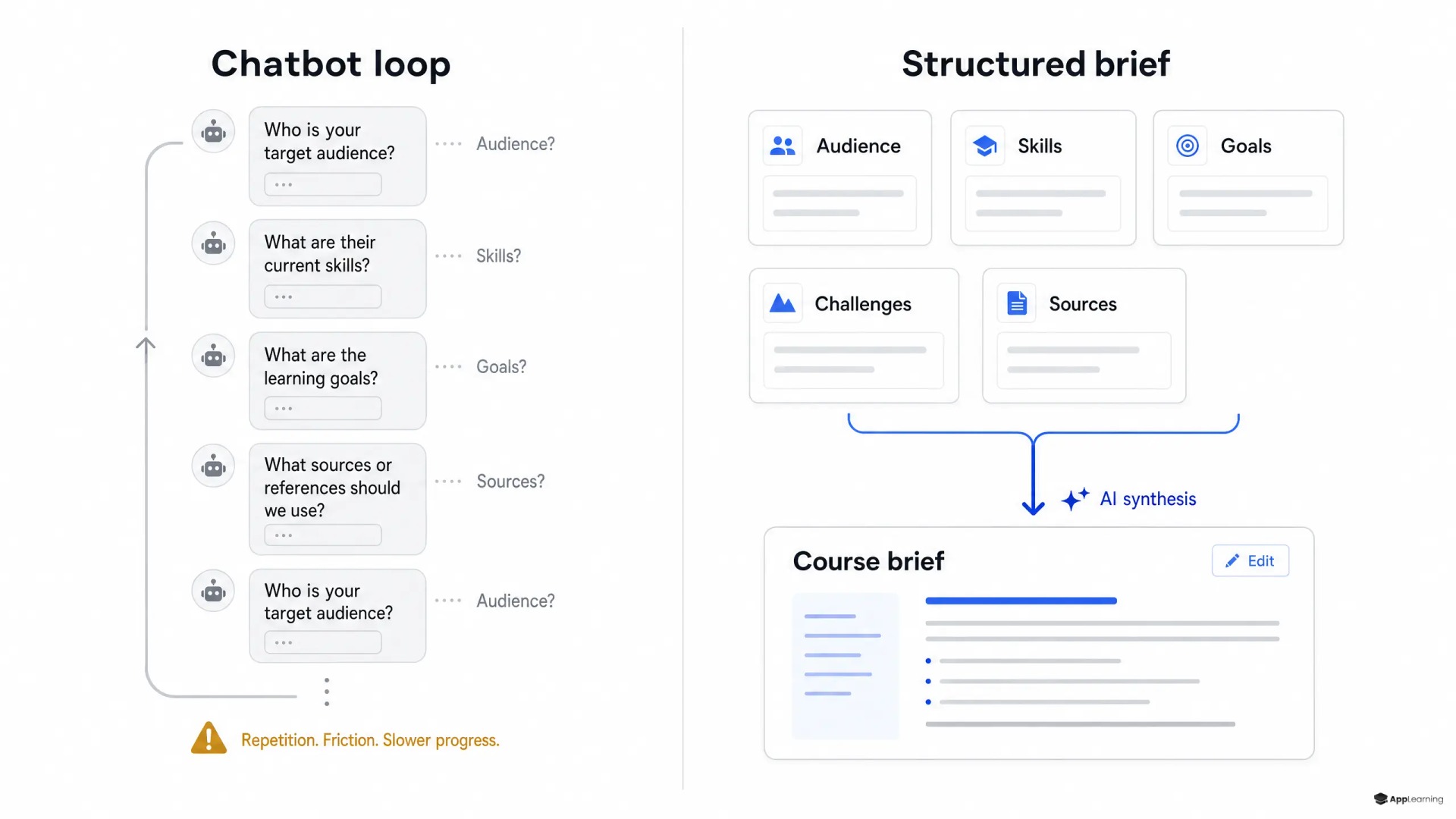
A chat interface signals modern AI. It can also turn a short course-setup task into a sequence of prompts, waits, confirmations, and corrections. That is a poor trade when the author already knows the required inputs: audience, target skills, business problem, source material, course length, and compliance constraints.
This does not mean conversational design is weak. An evaluation of conversational surveys (arxiv.org) found that participants preferred the conversational format and that it produced reliable data. But preference is not a reason to make chat the default for every workflow. Course authoring has stages. The interface should match the work in each stage.
Known constraints deserve structured capture
The first stage of an AI course authoring UX is mostly deterministic. An L&D lead in banking or fintech can usually state who needs training, which role or population is affected, what capability must change, which policies apply, and what documents are authoritative. A structured flow captures those facts with less interpretation risk and makes missing fields visible before generation starts.
This matters in regulated learning. A course on market conduct, anti-money-laundering controls, custody procedures, or AI use needs a traceable brief before it needs elegant prose. The current EU AI Act requires providers and deployers to support AI literacy for relevant staff, taking account of their knowledge, experience, training, and the context of use. Article 4 (eur-lex.europa.eu) reinforces a practical design principle: context is not optional metadata. It is a course input.
- Audience, role, region, and prior knowledge
- Required skills and observable capabilities
- Current operational challenges and risk scenarios
- Source material, policies, and approved references
- Course size, format, language, and review requirements
Structured collection also improves handover. A compliance owner can inspect the inputs. A subject-matter expert can add a missing policy. An instructional designer can see the intended behavior change. The system begins with a usable specification rather than a transcript that must be reconstructed later.
The course brief becomes the control point
AI should enter once the system has enough context to synthesize, challenge, and organize. It can turn fixed inputs into an editable course brief with a topic, audience definition, business context, learning goals, learning objectives, source assumptions, and a proposed module structure.
That brief is the control point in the course creation workflow. It lets the author catch a weak objective, an overly broad audience, or an unsupported content assumption before the platform creates screens, questions, media prompts, and assessments. This is closer to sound instructional design AI: use the model to create options and structure, while people retain responsibility for the learning decision. UNESCO’s guidance on generative AI in education (unesco.org) similarly argues for human-centred validation and pedagogical design rather than unchecked automation.
For finance and crypto teams, the brief should also show provenance. Which documents informed the draft? Which claims require SME review? Which items are policy-bound rather than explanatory? Those signals make AI-assisted speed compatible with governance.
Good to know
When should an AI authoring tool use a chat interface?
Use chat when the author needs help framing a problem, exploring options, resolving ambiguity, or refining a specific course component. Do not use it for fields the system can collect directly and validate.
Why should authors review a course brief before generation?
The brief exposes the audience, goals, objectives, source assumptions, and proposed structure before production begins. Reviewing it prevents weak assumptions from spreading across the full course.
How does component-level prompting improve course creation?
It lets authors improve a scenario, objective, quiz, explanation, or translation without discarding approved work elsewhere in the course.
How can regulated teams keep AI-generated course content under control?
Capture approved source material and constraints at the start, make the brief reviewable, retain human approval points, and show which content needs subject-matter or compliance review.
Refinement belongs at component level
Full-course regeneration is a blunt instrument. If the structure is right but one scenario lacks realism, the author should improve that scenario. If a knowledge check is too easy, they should revise the questions. If a learning objective is vague, they should sharpen the objective without resetting the rest of the course.
This is where conversational prompting earns its place in an AI authoring tool. Let authors ask AI to create a higher-stakes customer conversation, simplify a compliance explanation, add a realistic decision point, align a quiz with a specific objective, or rewrite copy for a different role. The prompt has a clear object, relevant context, and an immediate review surface.
- Refine a single learning objective
- Improve one lesson explanation or example
- Generate a role-specific scenario
- Adjust assessment difficulty and feedback
- Translate or localize an approved component
Build governed AI authoring workflows that keep course teams moving.
Talk to usA quieter interface can produce better learning
No-code course authoring should reduce author effort, not disguise every action as a conversation. The stronger pattern is hybrid: collect known requirements in a structured flow, use AI to produce an editable brief, generate a coherent first draft, then apply AI at component level where judgment and iteration matter.
That is the direction App-Learning can take: make the system fast when the path is known and intelligent when the author needs help thinking. The result is not less AI. It is AI applied at the points where it can improve decisions, preserve control, and help regulated teams ship learning that people can actually use.