

Key takeaways
- AI avatars are one instructional modality, not a universal interface.
- Early evidence suggests knowledge and motivation benefits, not lower cognitive load.
- Map each learning objective to a format before generating assets.
- Use avatars for dialogue and role-play, not routine information transfer.
- Judge formats by learning outcomes, accessibility and production cost.
Cheap video shifts the bottleneck
Generative tools have made it easy to create an AI training video from almost any document. That removes a production constraint, but it creates a design risk. When every source file becomes narrated video with a face on screen, content automation confuses what is easy to generate with what is useful to learn from.
For a growing startup, this matters most in onboarding. New hires need reliable answers, practice and fast access to company knowledge. They do not need every policy, product note and process map performed by an avatar. An avatar is an instructional modality: a way to deliver dialogue, explanation and social presence. It is not a default presentation layer.
Promising results with narrow bounds
The August 20, 2026 randomized matched-pair study gives AI avatars in education a useful but limited signal. Students who learned introductory AI concepts through a voice-enabled, embodied AI avatar outperformed peers using autonomous internet research. The avatar group also showed a more favourable motivation trajectory. Perceived cognitive load, however, did not differ significantly.
That is not proof that AI avatar learning beats every alternative. The final sample was 48 university students, the intervention lasted 40 minutes, and the comparator was self-directed web research rather than a well-designed text lesson, diagram, simulation or branching scenario. The authors also note that the study cannot isolate the effect of embodiment from interactivity, structured guidance or novelty.
Novelty cannot become the learning objective
A polished conversational interface can hold attention. But attention is not the outcome. The operational question is whether the interaction helps a learner make a decision, practise a response, understand a relationship or complete a task with fewer errors. If the answer is no, an avatar adds runtime, review work and visual noise without adding instructional value.
This is the difference between format-led production and objective-led design. Format-led production asks which asset the system can generate. Objective-led design asks what a learner must be able to do next.
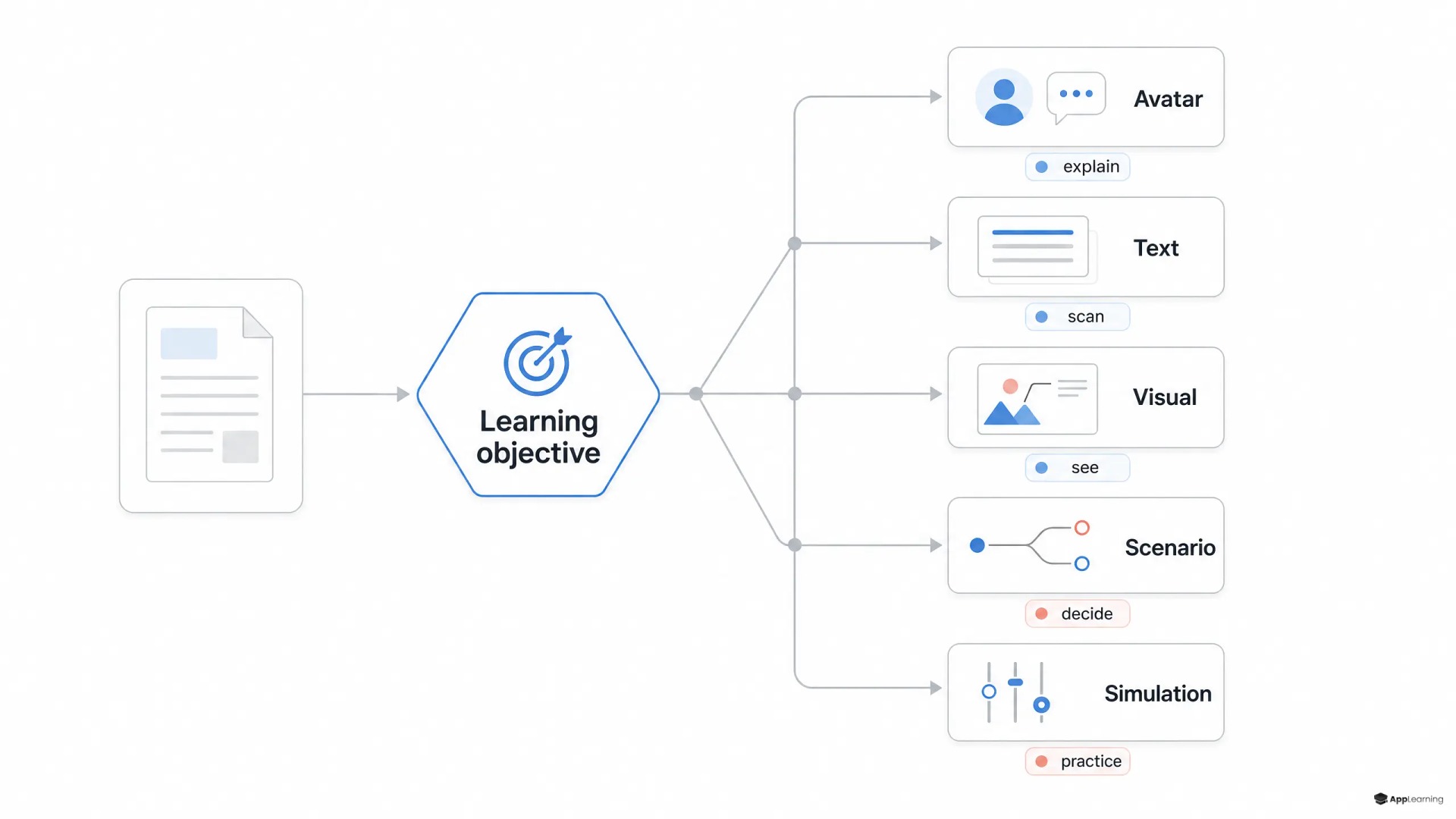
A modality rule before asset generation
An AI content automation pipeline should classify the objective before it writes a script or renders a scene. It should select the lightest learning content format that can produce the required behaviour.
- Use concise text with a short knowledge check for policies, definitions and reference material.
- Use an annotated diagram or short visual sequence when learners must see a system, product flow or cause-and-effect relationship.
- Use an avatar for explanation, coaching dialogue, manager modelling, objection handling and role-play.
- Use a branching scenario when a learner must choose under realistic constraints and see the consequence.
- Use a simulation when procedural fluency depends on operating a tool, workflow or environment.
- Use quizzes and spaced checks when the priority is recall, discrimination and reinforcement.
This rule does not ban avatars. It gives them a clear job. For example, a new sales hire may learn pricing rules through text, inspect package differences in a diagram, then practise a customer conversation with an avatar. Each format carries the part of the learning task it handles best.
Good to know
Should every onboarding module use an avatar?
No. The current evidence is preliminary and compares an avatar with autonomous web research, not with every well-designed alternative. Use an avatar only where dialogue, modelling or role-play changes the learning task.
When does AI avatar learning justify the added effort?
Use it when learners must ask questions, rehearse difficult conversations, observe expert judgement or stay engaged through a guided explanation. Avoid it when concise text, a diagram or a quiz can achieve the outcome faster.
How should a founder judge the right format?
Define the capability first, then measure completion, assessment performance, time to proficiency, error reduction and maintenance cost. The format that improves the outcome at a sustainable operating cost should win.
Constraints belong inside the decision
Format choice is also a delivery decision. Video and interactive dialogue need scripts, captioning, quality assurance, voice and language reviews, and fallback paths. The WCAG 2.2 criteria for synchronized media include captions for prerecorded audio, while interactive functionality must remain keyboard-operable. Those needs should be inputs to generation, not remedial work after launch.
Add localization and maintenance to the same model. A short product-policy update may take minutes to revise in text and far longer to revise across scripts, voice tracks, captions and rendered scenes. If content changes often, the default should usually be a durable text or visual layer, with an avatar reserved for the interaction that still earns its cost.
Choose formats that make onboarding faster to run and easier to learn from.
DiscussAutomation needs a format governor
A mature authoring system starts with structured inputs: target capability, task risk, required practice, need for dialogue, visual complexity, target device, accessibility needs, localization scope and expected rate of change. It then recommends a modality mix, generates the assets, and records outcome data by format.
That is the opportunity for App-Learning. The value is not generating more media. It is helping a lean team turn scattered company knowledge into onboarding that is consistent, measurable and simple to maintain. Cheap generation rewards volume. Deliberate modality selection turns that volume into capability.