
Key takeaways
- AI support captures confusion that completion data cannot show.
- Recurring questions expose missing explanations, weak examples and unclear processes.
- Clusters need objective mapping before they become curriculum work.
- Privacy controls and human review must govern every content change.
- Track whether updates reduce repeat questions and improve assessed performance.
Continuous support changes the learning signal
Most internal learning systems measure enrolment, completion and quiz scores. Those signals matter, but they arrive late and explain little. A learner who completes an onboarding module may still not know how to qualify a lead, handle an incident or use a product process. Always-available support captures the missing layer: the question asked at the moment work becomes unclear. On August 26, 2026, OpenAI reported that people across age groups have up to 70 million weekly conversations devoted to testing knowledge. That is a behaviour signal, not proof of workplace outcomes. Still, it shows the scale of demand for timely explanation, misconception checks and extra practice.
Questions carry more value than chat volume
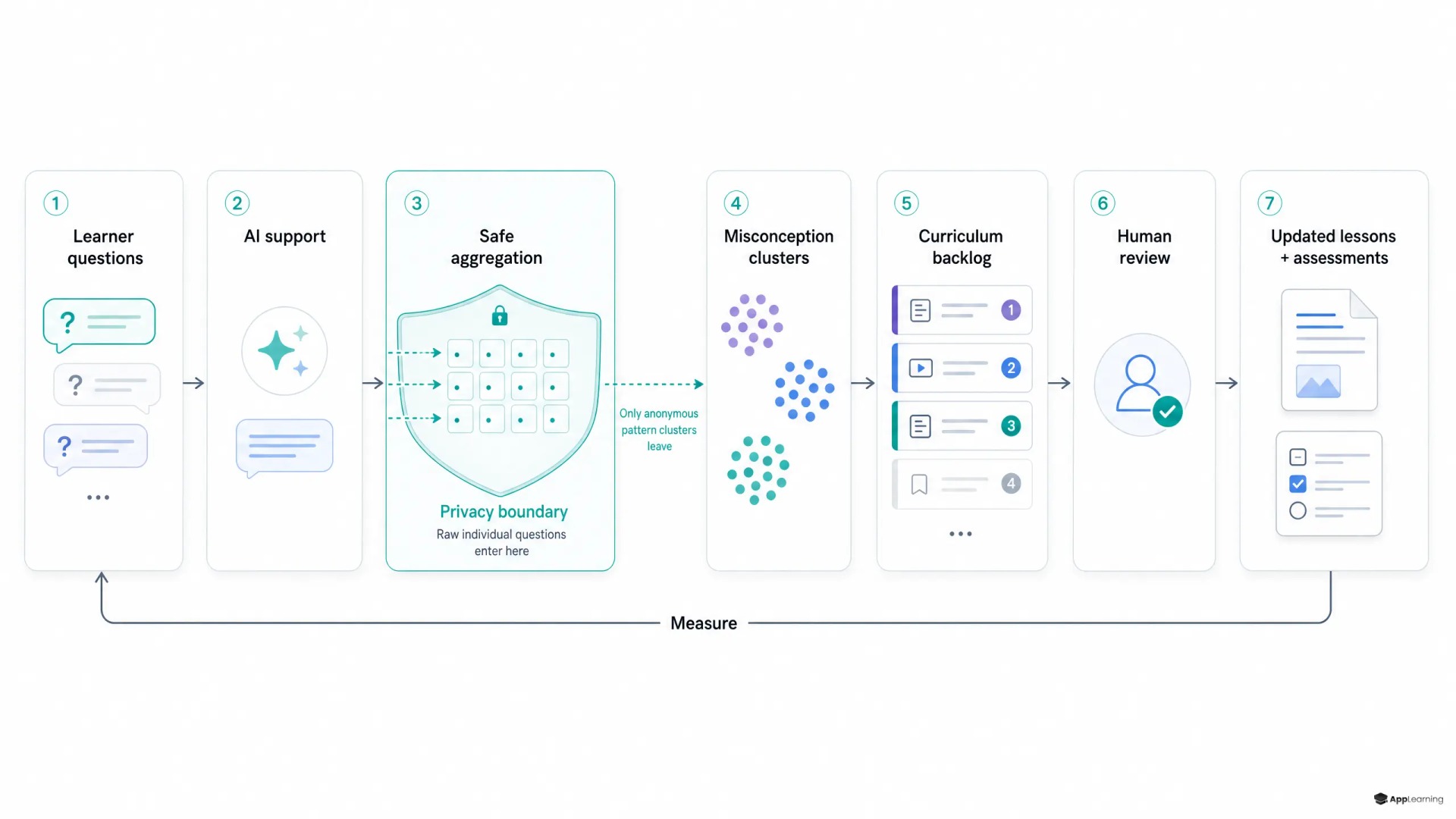
Raw chat volume is a vanity metric. A hundred requests for a policy link do not equal a hundred learning failures. The useful unit is a classified learning signal: a request for clarification, a repeated misconception, an unsupported edge case, a request for practice, or a question the tutor could not answer from approved material. This is where AI tutor analytics becomes useful. It turns unstructured conversations into evidence about where people cannot apply what the company expects them to know.
Misconception clusters reveal the broken layer
A single question may reflect one person’s context. A cluster of similar questions is different. If new sales hires repeatedly ask when a lead becomes qualified, the problem may be an unclear definition, a weak example, conflicting CRM guidance or an assessment that tests recall rather than judgment. Misconception analytics should group semantically similar questions, retain the underlying intent, and show the affected audience, role, course and time period. Do not let a model label a cluster without a reviewable sample of the actual questions behind it.
Objectives make signals actionable
A useful curriculum feedback loop connects every cluster to a learning objective, lesson, knowledge source and assessment item. Without this map, content teams receive a vague request to “improve onboarding.” With it, they can see that objective three has a high unresolved-question rate, that its example is outdated, and that learners who ask about it miss the scenario question that follows. The tutor should answer from approved, source-grounded content. When that content is insufficient, the gap becomes a structured backlog item rather than an improvised answer that creates another version of company policy.
Good to know
What counts as a useful learner-question signal?
Questions that show confusion, request clarification or practice, challenge an apparent misconception, or cannot be answered from approved knowledge are useful signals. Greetings, duplicate prompts and simple navigation requests should be filtered out.
Should AI automatically rewrite learning content from question clusters?
No. AI can propose a draft, identify likely gaps and prepare examples, but a subject-matter owner and content reviewer should approve every change before publication.
How many repeated questions justify a content update?
There is no universal threshold. Set a minimum cluster size by audience volume, then prioritise based on business risk, affected roles, unresolved answers and impact on assessment or task performance.
Can this work with fragmented startup knowledge?
Yes, but the tutor must distinguish approved sources from informal material. Start with high-risk onboarding topics, map them to owners, and use unanswered questions to identify which knowledge needs formal documentation first.
The backlog must stay under human control
For a startup beyond 50 people, this workflow can be lean. It does not need an L&D department or a separate analytics programme. It needs clear ownership and a regular operating rhythm.
- Collect only approved support interactions and classify their learning intent.
- Cluster recurring questions and map them to objectives, lessons and assessments.
- Create backlog items with evidence, affected roles, likely cause and suggested content changes.
- Route each item to a subject-matter owner and content reviewer.
- Release the approved update, then compare question patterns and assessment results before and after the change.
Privacy is part of the system design
Do not treat learner conversations as a free research archive. Remove direct identifiers from analytical views, restrict access by role, define retention periods, set a minimum cluster size before reporting patterns, and give employees clear notice about how aggregated signals improve training. Pseudonymisation reduces linkability but does not make data anonymous; the European Data Protection Board explains that pseudonymised data can remain personal data. Never use question telemetry to rank individuals or infer performance. Its purpose is to improve the learning system.
Build a learning system that improves from every recurring question.
Talk to usMeasure the decline in avoidable confusion
The first metric is unresolved-question rate: the share of questions the support layer cannot answer from approved material. The second is repeat-question rate: how often the same intent returns after a learner has seen the relevant content. The third is post-update learning gain, measured through scenario-based checks or observed task performance. Add time-to-productivity for onboarding when the workflow supports it. A lower question rate alone is not success; learners may simply stop asking. The target is fewer repeated questions alongside stronger application.
The practical shift is simple. Treat the AI tutor as both a learner interface and a curriculum sensor. When question telemetry enters a reviewed content backlog, internal knowledge stops depending on whichever manager happens to explain it well. It becomes a system that detects confusion, fixes the right layer and gets sharper as the company grows.