
Key takeaways
- AI adoption changes task composition before it changes job titles.
- Prompting matters, but AI verification skills preserve accountability in automated workflows.
- Assess accept, correct, and escalate decisions against realistic evidence.
- Use short recurring scenarios to train the failure modes people actually encounter.
- Measure overrides, corrections, and escalations instead of training completions alone.
The Verification Work AI Leaves Behind
AI changes tasks before it changes job titles
The first effect of AI at work is rarely the clean removal of a role. It changes the sequence of work inside the role. A September 2026 study from Trinity College Dublin found that 47.4% of respondents use AI tools daily, while describing the present impact as task and workflow transformation. For finance and crypto teams, that distinction matters. A draft, summary, classification, or case recommendation may arrive faster. Someone still owns the decision.
Task and workflow transformation rather than immediate large-scale job displacement.
The verification layer grows
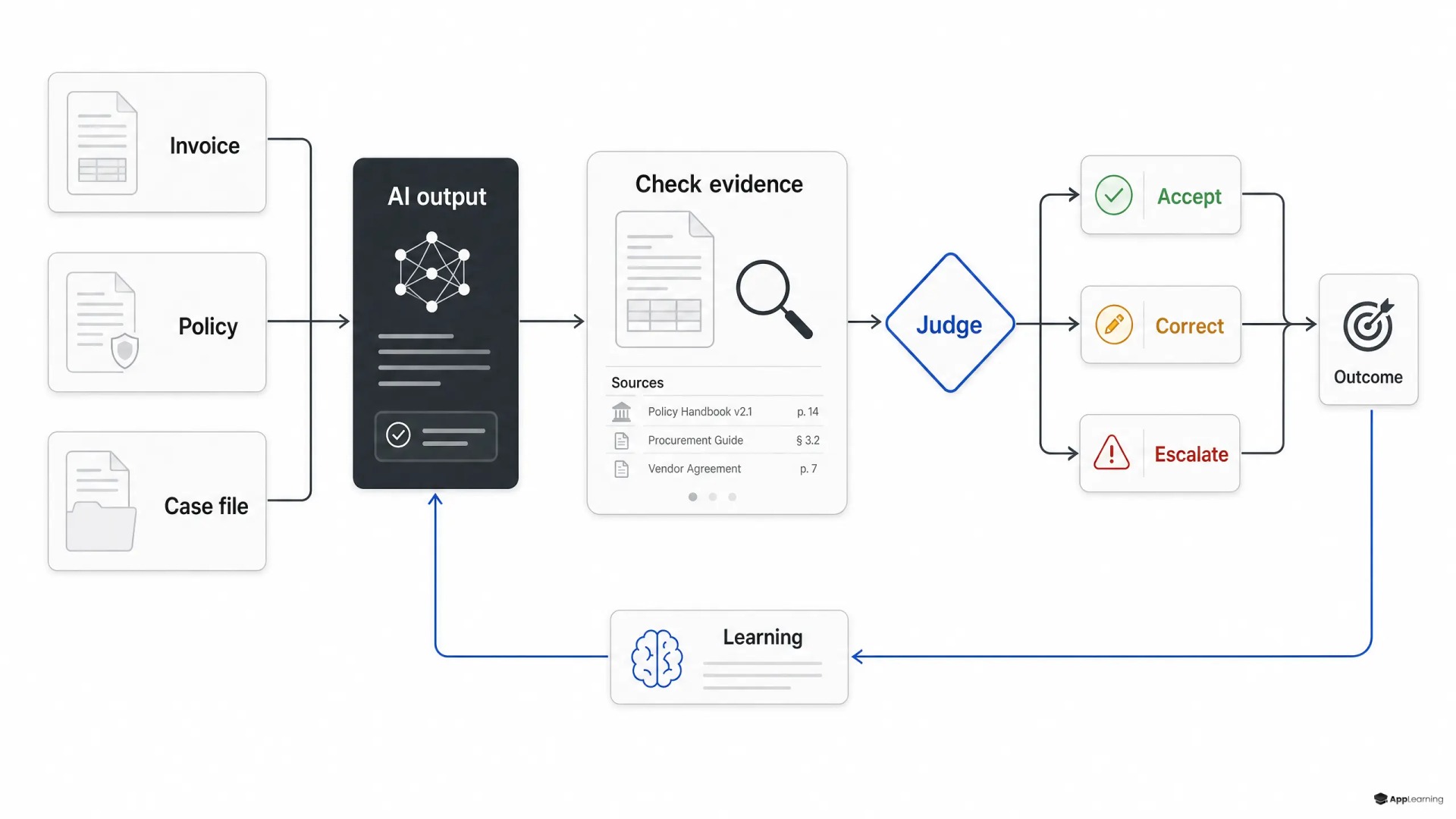
AI-supported workflows leave behind work that is easy to overlook in a process map but decisive in practice. The employee must compare the result with source material, detect missing context, judge whether the stated confidence fits the evidence, record the rationale, and route exceptions to the right person. This is not passive human-machine collaboration. It is active control work.
- Check whether the output is grounded in the relevant evidence.
- Identify omissions, unsupported claims, and conflicting signals.
- Decide whether to accept, correct, or escalate the result.
- Document the decision so another reviewer can reconstruct it.
- Escalate when policy, risk tolerance, or evidence limits require it.
Accountability needs observable skills
Many AI policies state that humans must remain in the loop. That is not a capability model. Teams need to define what a competent reviewer can see, decide, and document under real conditions. The NIST AI Risk Management Framework calls for defined human-AI oversight roles, documented knowledge limits, and output interpreted within its operational context. Human AI oversight training should turn those governance requirements into visible behaviors.
Micro-scenarios make judgment trainable
Generic AI awareness courses explain risks but rarely test decisions. A stronger AI literacy assessment presents a short, realistic task: an AI-generated output, the relevant evidence, and the operating rule. The learner must choose accept, correct, or escalate, then explain why. That format makes AI supervision training specific enough to assess and short enough to repeat.
- A customer-risk summary that ignores a contradictory source note.
- A transaction review that uses stale policy guidance.
- A generated client response that overstates certainty.
- A screening recommendation where the evidence does not meet the review threshold.
Good to know
What should an AI literacy assessment measure?
Measure whether learners can evaluate evidence, identify uncertainty, apply the relevant rule, and justify an accept, correct, or escalate decision.
Is prompting enough for AI supervision training?
No. Prompting helps employees obtain useful outputs, but supervision training must also test review, correction, documentation, and escalation.
How often should verification learning be refreshed?
Refresh it when policies, tools, workflow risks, or recurring error patterns change. Short scenario updates are more useful than infrequent full-course replacements.
Evidence belongs inside the assessment
Do not teach verification as a checklist detached from the work. Put the original records, policy excerpts, confidence signals, and missing facts inside the scenario. The learner then practises the comparison that the workflow demands. This also separates a plausible answer from a defensible one. In a regulated environment, that distinction is often where accountability sits.
Failure patterns should drive the next lesson
Learning data should reveal where judgment breaks down. Track incorrect accept decisions, unnecessary escalations, weak rationales, and the evidence types people miss. The NIST AI RMF Playbook recommends measuring and documenting human oversight, including overrides, reported errors, and policy exceptions. These signals can feed the next microlearning loop instead of waiting for an annual compliance refresh.
Build verification fluency into your AI learning workflows.
PlanVerification fluency becomes the operating skill
The aim is not to make every employee an AI expert. It is to make each person reliable at the point where AI output meets business judgment. App-Learning can model that moment in short scenario loops, assess the reasoning behind the decision, and refresh content as new failure modes emerge. As automation deepens, AI verification skills become the practical bridge between speed and accountable work.