Key takeaways
- A reusable workflow can become the central curriculum artifact.
- Role-based workflow packs shorten the path from learning to productive use.
- Versioning protects training when tools, permissions, and policies change.
- Assessment should test work quality, judgment, and escalation decisions.
- Enterprise academies can become infrastructure for AI deployment.
Training Moves Into the Workflow
Most AI training still ends too early. Employees watch a module, learn prompting basics, pass a quiz, and return to work without a safe starting pattern for the task in front of them. The gap is not information. It is the absence of an approved, usable workflow at the moment of work.
That gap matters in banking. A relationship manager preparing a client brief, an operations analyst resolving an exception, or a compliance team reviewing a policy change each needs more than generic AI fluency. They need clear inputs, permitted tools, a reliable sequence of steps, quality checks, and rules for when human review must take over.
AI workflow training should therefore ship as a package. The package combines a short explanation of the job and its risks with the workflow, prompt structure, source material, template, and competence check needed to perform it. Learning is no longer separate from deployment. It becomes part of the deployment unit.
The Package Is the Learning Artifact
In its August 4, 2026 announcement, OpenAI describes its education plugins as packages of apps, role-specific skills, instructions, and common workflows. The point is practical: users start with relevant context and an operating pattern rather than constructing complex prompts from zero.
OpenAI’s September 10, 2026 ChatGPT Edu session extends the same pattern beyond basic prompting into approved files, multistep workflows, agentic capabilities, permissions, and human oversight. This is not a bank blueprint. It is a useful product signal. As AI work becomes more structured, enablement must teach people to operate within that structure.
The same direction appears in automation tooling. n8n’s AI Assistant announcement describes creating, editing, testing, and troubleshooting inspectable workflows from natural-language requests, while requiring review before production use. The workflow is becoming an editable business asset, not a hidden outcome of training.
Start With One Banking Job
A role-based AI academy should not begin with a broad course on generative AI. Begin with one job-to-be-done that is frequent, bounded, valuable, and possible to review. For example, an operations team might use AI to turn approved case notes into a structured exception summary for an authorised reviewer.
Define the work before writing the curriculum:
- Name the role, trigger, intended output, and business owner.
- Set the approved data boundary and connected tools.
- Specify the workflow steps, including handoffs and decision rights.
- State the failure modes that require escalation.
- Define what a good work product must contain.
This keeps enterprise AI workflows close to real operating conditions. It also prevents a common failure: teaching employees polished prompt patterns that cannot be used with the systems, permissions, or controls available in their day-to-day environment.
Build the Governed Operating Pattern
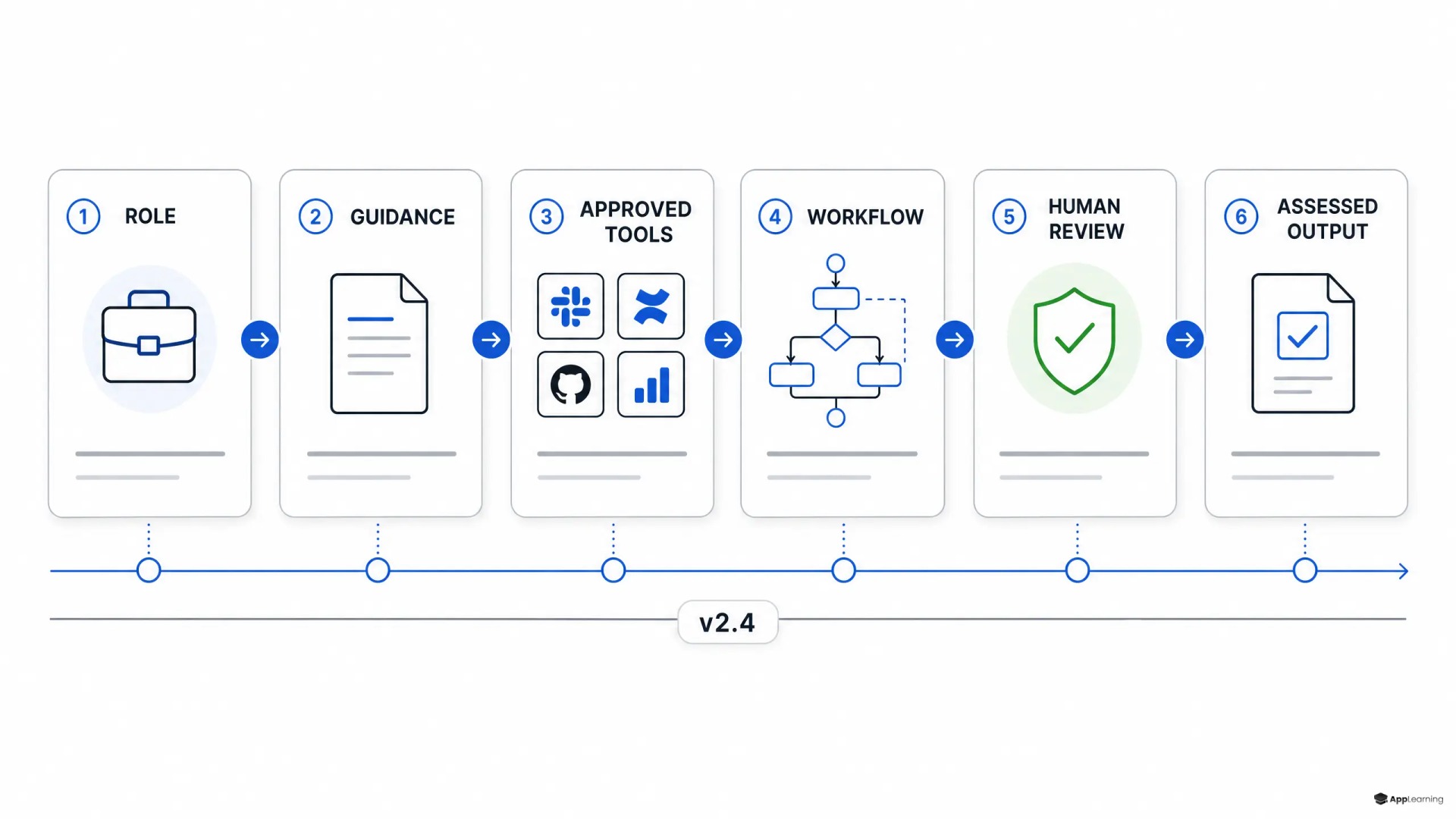
Each workflow-based learning pack needs four connected layers. The learning path explains the task, the business purpose, and the risks. The operating layer provides the approved prompt, template, checklist, and tool sequence. The safeguard layer defines source constraints, privacy boundaries, review points, and escalation rules. The practice layer gives learners a realistic case in which they must produce the work.
This format makes agentic AI training more concrete. Learners do not merely hear that an agent may help with recurring work. They see which actions can be delegated, what evidence must be checked, which outputs need approval, and where authority remains human. That is the difference between adoption theatre and operational capability.
Good to know
What is a workflow package in enterprise learning?
It is a versioned learning and operating asset built around one real job-to-be-done. It combines concise instruction, approved tools and templates, safeguards, practice, and assessment of the completed work product.
Which banking use cases fit workflow-based learning first?
Start with repeatable work that has a clear output and review path, such as internal research briefs, exception summaries, meeting preparation, policy-change analysis, or draft communications. Avoid poorly bounded use cases until ownership, data rules, and escalation paths are clear.
Why is versioning necessary for AI workflow training?
The recommended process can change when models, connected systems, permissions, risk controls, or source materials change. Versioning keeps the learning experience aligned with the operating pattern employees are expected to follow.
Proof Sits in the Work Product
A multiple-choice quiz can confirm that a learner remembers workflow steps. It cannot show whether that person can create a safe and useful result under realistic conditions. Assessment should focus on the resulting work product and the judgment used to produce it.
Give learners incomplete or ambiguous inputs. Ask them to use the approved workflow. Score the output against a simple rubric: factual grounding, completeness, appropriate handling of sensitive information, correct use of the template, quality of review, and timely escalation. Analytics should then show where a workflow is misunderstood, bypassed, or producing weak outputs.
Versioning Is a Control
A workflow pack is not a one-time course. Models change. Connected applications change. Permissions change. A risk team may alter the approved source set or require a new review step. If the training asset stays static, it soon teaches an obsolete operating pattern.
Treat every pack as a controlled product. Assign an owner, version number, change log, review date, validation process, and retirement rule. When a material change occurs, update the workflow and send a targeted refresher only to affected roles. This is more efficient than relaunching a large academy each time the AI stack changes.
Create a governed workflow pack with App-Learning.
StartAcademies Become Deployment Infrastructure
The strategic shift is straightforward. A role-based AI academy should not sit beside transformation as a communications layer. It should help deliver transformation by packaging the approved way to perform a new task, measuring whether people can use it, and improving the package from operational feedback.
For banks, this creates a practical bridge between innovation, risk, technology, operations, and workforce enablement. App-Learning can turn priority use cases into mobile-ready workflow packs that explain the task, guide practice, assess the work product, and surface capability data for leaders. The academy then becomes a living interface between a new AI capability and the people expected to use it well.