

Key takeaways
- Convert product specifications into explicit learning acceptance tests.
- Test definitions and edge cases, not only the main narrative.
- Use subject-matter review for conditional and time-dependent rules.
- Keep visuals, scenarios, and assessments aligned to one source logic.
- Re-run the edge-case checklist whenever the product specification changes.
The Main Narrative Hides the Real Risk
Most complex product education gets the headline right. A module can explain a feature, name its value, and show the happy path. It can still teach the product incorrectly. The failure often sits in a foundational term, an eligibility condition, a cut-off time, a failed transaction, or a rule that changes once another event has occurred.
This is especially acute in fintech. A vague explanation may not only slow feature adoption. It can lead users to take the wrong action, lose confidence, or contact support when the product behaves differently from what they learned. Good product training QA must therefore test the rules behind the narrative, not merely whether the narrative sounds clear.
In one recent financial-product education build, three internal product requirement documents were enough to draft two viable curriculum structures. The deeper structure won because the products needed more than a surface overview. During subject-matter review, the team found a missing foundational definition and an incorrect rule tied to a time-dependent product event. The lesson was corrected against the authoritative specification, and the supporting visual changed with it. That is the work that protects LMS content accuracy.
A Learning Test Matrix Makes Rules Visible
Treat the product specification as the source of truth, then translate its testable rules into a learning test matrix. The idea borrows from requirements discipline. ISO/IEC/IEEE 29148 defines a requirements traceability matrix as a structured artifact that links requirements across levels. Product education needs the same chain, from source rule to learning objective, content component, assessment item, reviewer, and approval state.
Each row should state what the learner must understand or do, the exact source reference, the scenario that proves understanding, the expected answer or action, and the owner who can approve it. This turns review from a broad request to “check the module” into a controlled verification process.
- Source rule and version identifier
- Learner-facing interpretation
- Risk if the rule is misunderstood
- Scenario or quiz that tests the rule
- Expected answer, action, or explanation
- Subject-matter owner and approval status
Four Checks Catch the Rules That Matter
The matrix does not need to reproduce every line of a specification. It should focus effort where misunderstanding is most likely and most costly. This follows the logic of boundary-value and requirements-based testing, where representative cases come from the conditions that change system behaviour rather than from random examples.
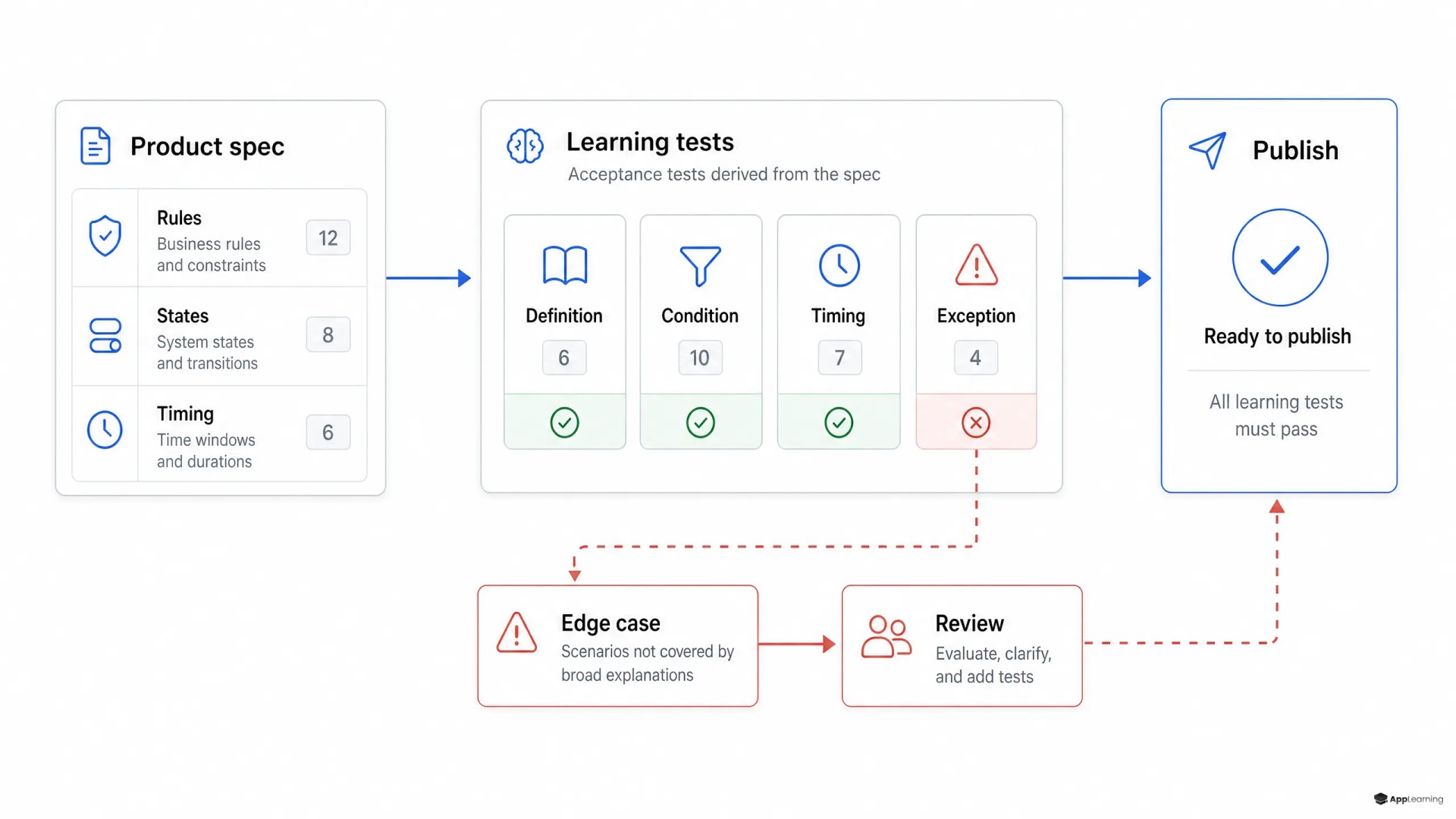
- Definitions. Test terms that experts use casually but new users may interpret differently. If a definition affects eligibility, timing, ownership, risk, or fees, it needs a dedicated check.
- Conditions. Test the “only if” logic. A learner should know which account state, verification stage, market, balance, or prior action enables a feature.
- Exceptions. Test what happens when the normal path does not apply. Include failed, delayed, reversed, unavailable, or restricted states where relevant.
- Boundary cases. Test the moments and thresholds that change the outcome, such as before and after a cut-off, at a minimum amount, or when a status changes.
Scenarios Turn Ambiguity Into Evidence
Explanatory copy can hide uncertainty because readers can nod along without making a decision. Scenarios force a choice. A strong edge-case training item gives a concrete customer state, adds the condition that changes the rule, and asks for the correct next step or explanation.
Quizzes should not exist only to produce completion data or gamified progress. They should expose whether the content itself is precise. If reviewers disagree about the correct answer, the issue may sit in the wording, the scenario, or the underlying source. Resolve that conflict before release. Then update every affected component, including visuals, feedback text, translations, and in-app prompts.
Good to know
What is a learning acceptance test?
It is a documented check that links a product rule to the learner behaviour, scenario, expected answer, source reference, and approval owner needed before release.
Which product rules should be tested first?
Start with definitions, eligibility conditions, timing logic, exceptions, failure states, thresholds, and any rule that could change a customer’s action or expectation.
How often should product education be re-tested?
Re-test whenever a product specification changes materially, including rule updates, altered user flows, new markets, revised eligibility, or changed time-dependent behaviour.
Review Must Resolve Against the Source
Subject-matter review is not a stylistic approval round. Its job is to compare each learning acceptance test with the current product source. Reviewers should mark one of three outcomes: confirmed, corrected, or unresolved. “Unresolved” matters. It prevents a confident-looking module from shipping when the product team has not settled the rule.
This also gives product leads a clean operating boundary. The education team owns instructional design, component quality, and version control. Product, operations, compliance, or legal owners confirm the product rule. No one should rely on an old slide deck, remembered launch decision, or a visual that has drifted from the specification.
Make the rules your learners need to get right testable.
Build itProduct Changes Need a Learning Regression Check
Every material product change should trigger a targeted re-test. Compare the changed specification against the learning matrix. Identify affected definitions, conditions, exceptions, and boundary cases. Re-approve the related modules, questions, visuals, and translations before the change reaches users.
This is where a product education platform becomes more than a content repository. App-Learning can operationalize source-backed modules, reusable scenario and quiz components, structured reviewer workflows, versioned corrections, and acceptance checks that travel with the product rule. The same governed system can support embedded web and mobile learning without forcing core product teams to rebuild education from scratch.
Complex products do not need longer explanations by default. They need stronger proof that learners can handle the rules that change the outcome. When edge cases become explicit learning acceptance tests, education becomes a governed product layer: accurate enough to trust, structured enough to maintain, and practical enough to improve activation without adding avoidable support demand.