

Key takeaways
- Digital adoption platforms usually emphasize overlays, walkthroughs, and step guidance.
- Customer education platforms build structured understanding, confidence, and progression across the journey.
- The right choice depends on whether the barrier is task completion, product understanding, or both.
- Complex Bitcoin products need more than interface-level guidance at critical decisions.
A shared surface hides two different jobs
The categories overlap because both can appear inside a product. Both can target a user segment, trigger content at a moment of friction, and support onboarding. That surface-level similarity causes the mistake: teams buy a walkthrough layer and expect it to build understanding, trust, and long-term product confidence.
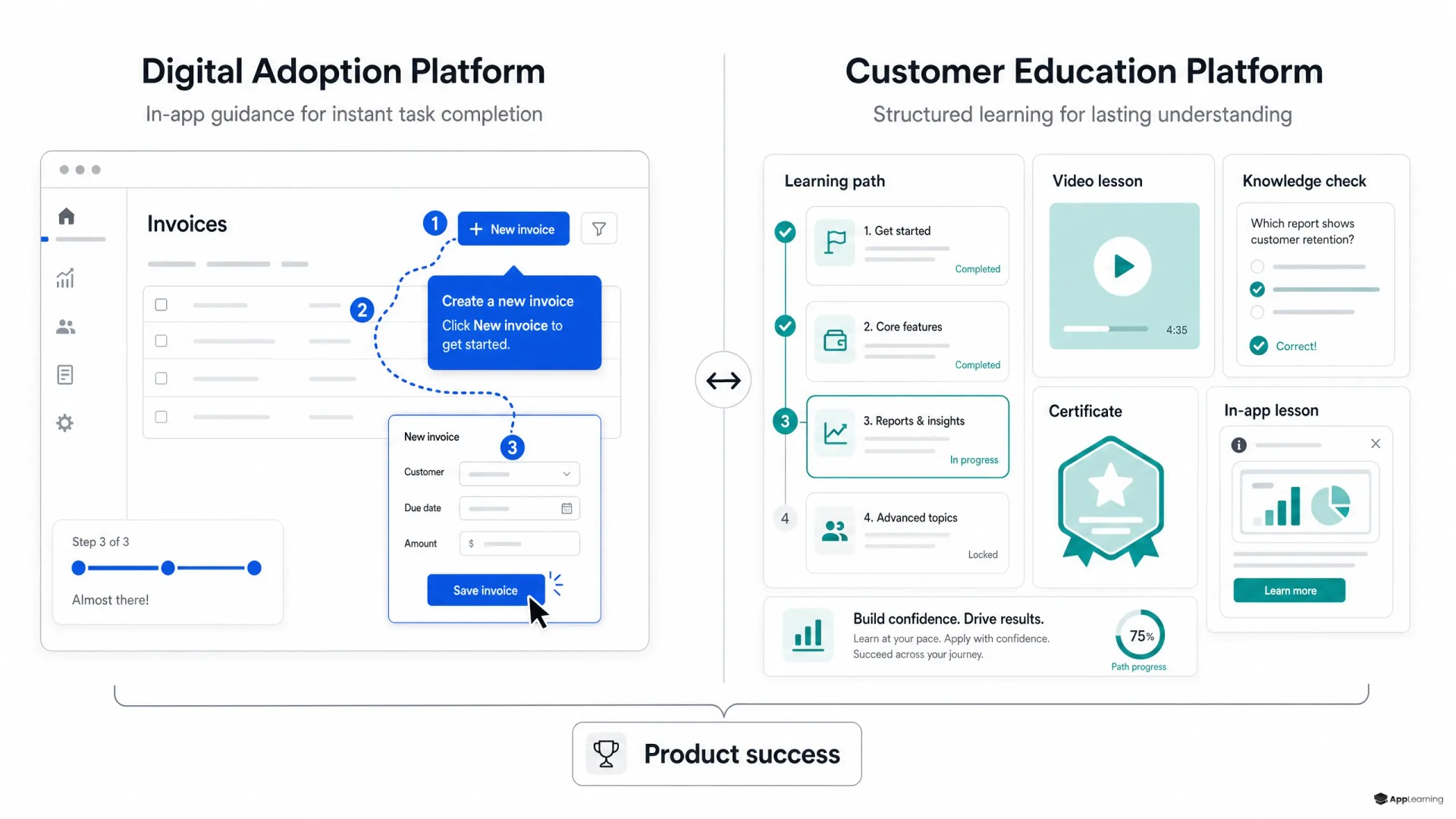
A digital adoption platform is built to help someone use an interface. A customer education platform is built to help someone understand a product well enough to make sound, repeatable decisions. One guides movement through a workflow. The other develops capability across a journey.
The walkthrough layer
A digital adoption platform earns its place when the user knows the goal but needs help completing it. Pendo’s guide documentation, for example, describes overlay guides for step-by-step walkthroughs and for highlighting specific elements in an application. That is useful mechanics, especially when product changes create short-term friction.
- Point to the correct field during account setup.
- Show where to find a newly released feature.
- Guide a user through a repeatable configuration task.
- Prompt an inactive user to complete an unfinished action.
These are interface problems. The user needs orientation, timing, or a nudge. A tooltip, checklist, or guided flow can remove the obstacle without asking the user to retain much knowledge after the task is complete.
Learning begins where a click path ends
Customer education handles a different class of barrier. The user may know which button to tap, yet still hesitate because they do not understand the concept, risk, or consequence behind the action. They need an explanation, an example, a chance to test understanding, and a clear next step.
That requires a system for modular content, structured learning paths, quizzes or knowledge checks, progression, localization, and analytics that connect learning to behavior. It also requires governance. Product, compliance, support, and content teams need a practical way to update approved explanations when the product, policy, or market changes.
The measurement model changes with the job
A walkthrough layer should be judged on task completion, time to complete, errors, and drop-off at a defined screen. A customer education platform should add measures of knowledge, confidence, repeat use, advanced-feature adoption, and support demand. Completion alone is weak evidence: a user can finish onboarding without understanding why a recurring buy, wallet withdrawal, or security setting matters.
Bitcoin journeys expose the gap
Bitcoin products make the distinction unusually clear. A guide can show a beginner how to make a first purchase. It cannot, by itself, explain volatility, custody, transaction finality, fees, address checks, or the tradeoff between convenience and control. Those are not navigation questions. They are confidence questions.
The practical design is not to force a course before every action. It is to place short learning objects at concept-heavy moments: before a first purchase, during savings-plan setup, before a wallet withdrawal, or when a user considers self-custody. The lesson should explain the decision. The product flow should then make the action easy.
Good to know
Do we need both a digital adoption platform and a customer education platform?
Use both when users need help completing workflows and need deeper understanding to make confident decisions. A simple product may only need task guidance. A complex fintech product often needs both layers.
When is a digital adoption platform enough?
It is enough when the main barrier is interface friction, such as finding a feature, completing setup, or following a known workflow. It becomes insufficient when users hesitate because they do not understand the product itself.
What should Bitcoin education measure?
Track progress through learning paths and knowledge checks, then connect those signals to first purchase, repeat use, savings-plan activation, wallet behavior, advanced-feature adoption, and relevant support demand.
Should customer education live outside the product?
A separate academy can support discovery and deeper study, but critical learning should also appear in context. Users need the right explanation when they face a real decision, not only when they choose to browse a content library.
Regulation makes shallow guidance riskier
In regulated categories, education does not replace required disclosures, suitability processes, or legal review. It makes them more usable. Under the EU’s Markets in Crypto-Assets regulation, crypto-asset service providers must provide fair, clear, and non-misleading information and warn clients about risk. A modal that users dismiss may meet a delivery requirement, but it does not prove they understood the decision.
Teams should therefore separate the two layers in their evaluation. Ask the digital adoption platform how it targets, triggers, and measures task guidance. Ask the customer education platform how it structures content, validates understanding, localizes modules, manages approvals, and links learning progress to product outcomes.
Build confidence into every product decision.
TalkA combined system for confident adoption
The strongest product stack often uses both systems. The digital adoption platform handles immediate interface guidance. The customer education platform builds the durable mental model that makes the next action feel safe and worthwhile. Neither should be stretched to do the other’s primary job.
This is where App-Learning’s platform fits for Bitcoin and fintech teams. It provides short, branded learning paths, quizzes, gamified mechanics, learner analytics, and product-connected delivery through embeds or deep links. That gives product teams a reusable education layer without turning every explanation into an engineering ticket.
Good product guidance gets users through the next step. Good customer education helps them understand why the step matters, what can go wrong, and what to do next. In a complex financial product, that difference is where activation becomes durable trust.