
Key takeaways
- Feedback should remain attached to the exact learner-facing content object.
- Preview links and CMS editing links serve different operational purposes.
- Resolution status turns reviewer discussion into a manageable correction queue.
- Traceability is critical when meaning, terminology and rendering are reviewed together.
Review fails when feedback loses its coordinates
Most learning-content review delays are not caused by difficult corrections. They start when a useful comment becomes detached from its context. A reviewer writes that a term is unclear, a graphic is misaligned, or a quiz explanation needs revision. Days later, nobody can tell whether the comment referred to chapter three, a specific swipe, or one answer option in a quiz.
This is a common failure in a learning content review workflow built around screenshots, spreadsheets, email threads, or generic comment fields. Each handoff strips away information. The reviewer remembers the learner experience but not the content identifier. The instructional designer knows the course structure but not the visual state the reviewer saw. The editor can change the content, but must first search for the right CMS record.
A recent internal review of a live compliance-learning module showed the pattern clearly. The feedback covered an unclear explanation, a terminology correction, and a visual-formatting issue. In one case, the reviewer could no longer remember the chapter containing the comment. The item became actionable only because it could be traced back to the precise learner-facing object and its editable content record.
The traceability chain makes comments operational
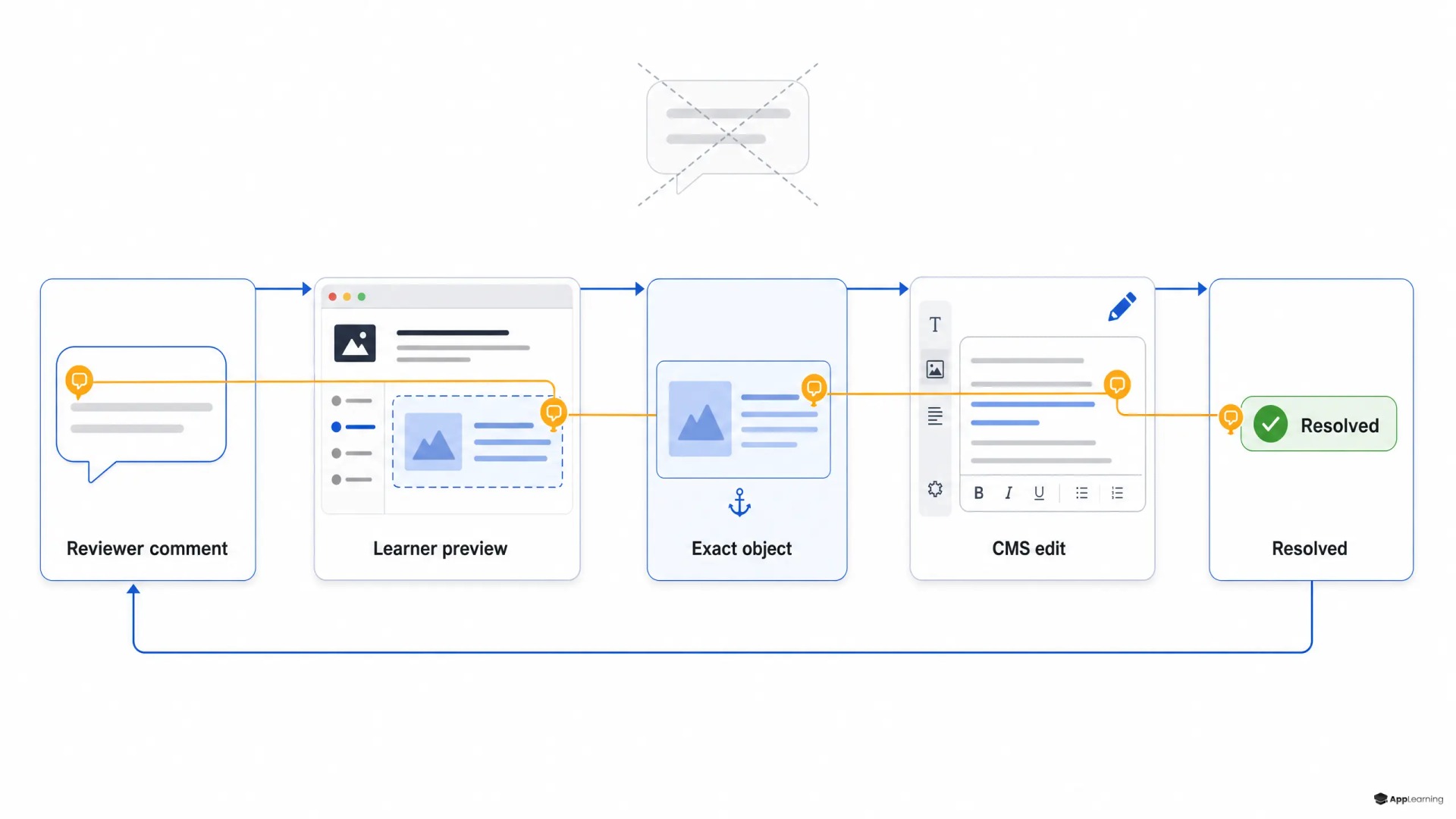
A professional academy needs more than a place to collect instructional content feedback. It needs a persistent chain between the feedback item and the work required to resolve it. At minimum, every review item should preserve five elements.
- The reviewer comment, including the issue and intended correction
- The exact learner-facing object, such as a chapter, swipe, quiz, or answer explanation
- A direct preview link that shows the object in its learning context
- A separate CMS editing link that opens the underlying editable record
- A clear resolution status with ownership and a visible decision trail
The two links are not interchangeable. The preview link lets a subject-matter expert validate what learners actually see. The CMS link lets a content owner make the change without navigating through course structures or guessing which object is affected. Keeping both links with the same review item prevents the usual back-and-forth between reviewer, learning designer, and editor.
Meaning, terminology and rendering need one review system
LMS content QA often treats review as a single approval step. In regulated training review, that model is too coarse. One content object can require three distinct checks at the same time.
- Meaning checks whether the explanation, instruction, or question is accurate and understandable.
- Terminology checks whether approved language, product names, legal terms, and internal definitions are used consistently.
- Rendering checks whether layout, emphasis, line breaks, media, and interactive elements communicate the intended message.
These dimensions often overlap. A terminology change can make a sentence too long for its swipe layout. A formatting issue can hide an important qualifier. A simplified explanation can alter the compliance meaning. The review system must therefore retain the object context while allowing each issue to be assigned, corrected, verified, and closed independently.
Good to know
What is object-level traceability in learning-content review?
It is the persistent connection between a reviewer comment, the exact learner-facing content object, the editable CMS record, and the item’s resolution status.
Why should preview and CMS links be kept separately?
A preview link lets reviewers assess the learner experience in context. A CMS link lets content owners open the precise record that needs to be edited. Combining both removes unnecessary navigation and ambiguity.
Which learning objects should be reviewable?
Any object that can change meaning or learner experience should be addressable, including chapters, swipes, media, quiz questions, answer options, explanations, and completion screens.
Resolution status shortens the correction loop
A comment is not a workflow. It becomes one when the team can see its state. Open, in review, resolved, rejected, and needs clarification are simple labels, but they change the operating model. They expose stalled decisions, prevent duplicate work, and give the academy team a reliable queue instead of a growing archive of conversations.
Object-level traceability also reduces the cost of rechecking. Once an editor changes a swipe or quiz explanation, the reviewer returns to the same object, not to a rebuilt course map or a new screenshot pack. The correction loop becomes direct: identify, edit, preview, verify, close. That matters when compliance teams, legal reviewers, product experts, and L&D owners must review the same learning experience from different angles.
Make every review comment ready for action.
DiscussReview becomes part of academy operations
App-Learning can support this workflow at the content-object level. A comment on an individual chapter, swipe, or quiz can retain a learner-facing preview reference alongside a CMS reference for the editable object. Reviewers work from the experience they need to judge. Content owners work from the record they need to change. Status keeps both sides aligned on whether the issue is still open or already resolved.
For finance and crypto companies, this approach makes faster content rollout more controlled rather than less controlled. It creates a CMS review workflow that can handle subject-matter accuracy, approved terminology, and learner-facing quality without forcing teams to reconstruct context at every handoff.
The real standard is simple: no reviewer comment should require someone to search the whole course to understand it. When feedback, preview, editable object, and resolution state stay connected, review stops being a fragile conversation and becomes a traceable operating system for learning quality.