

Key takeaways
- Content readiness and review readiness are separate delivery states.
- Reviewer authentication can become the final launch bottleneck.
- Direct preview links remove avoidable navigation and account friction.
- Exports support offline checking, while the platform preview remains the source of truth.
Review Access Is Part of Learning Delivery
A completed learning module can still be unlaunchable. The copy may be approved in principle, assessments may be configured, and the curriculum may look complete in the CMS. Yet the release stalls if the people responsible for sign-off cannot open the right version, see the full learner experience, or confirm what will be published. That is not an authoring problem. It is an LMS review workflow problem.
Finished Content Can Still Be Unlaunchable
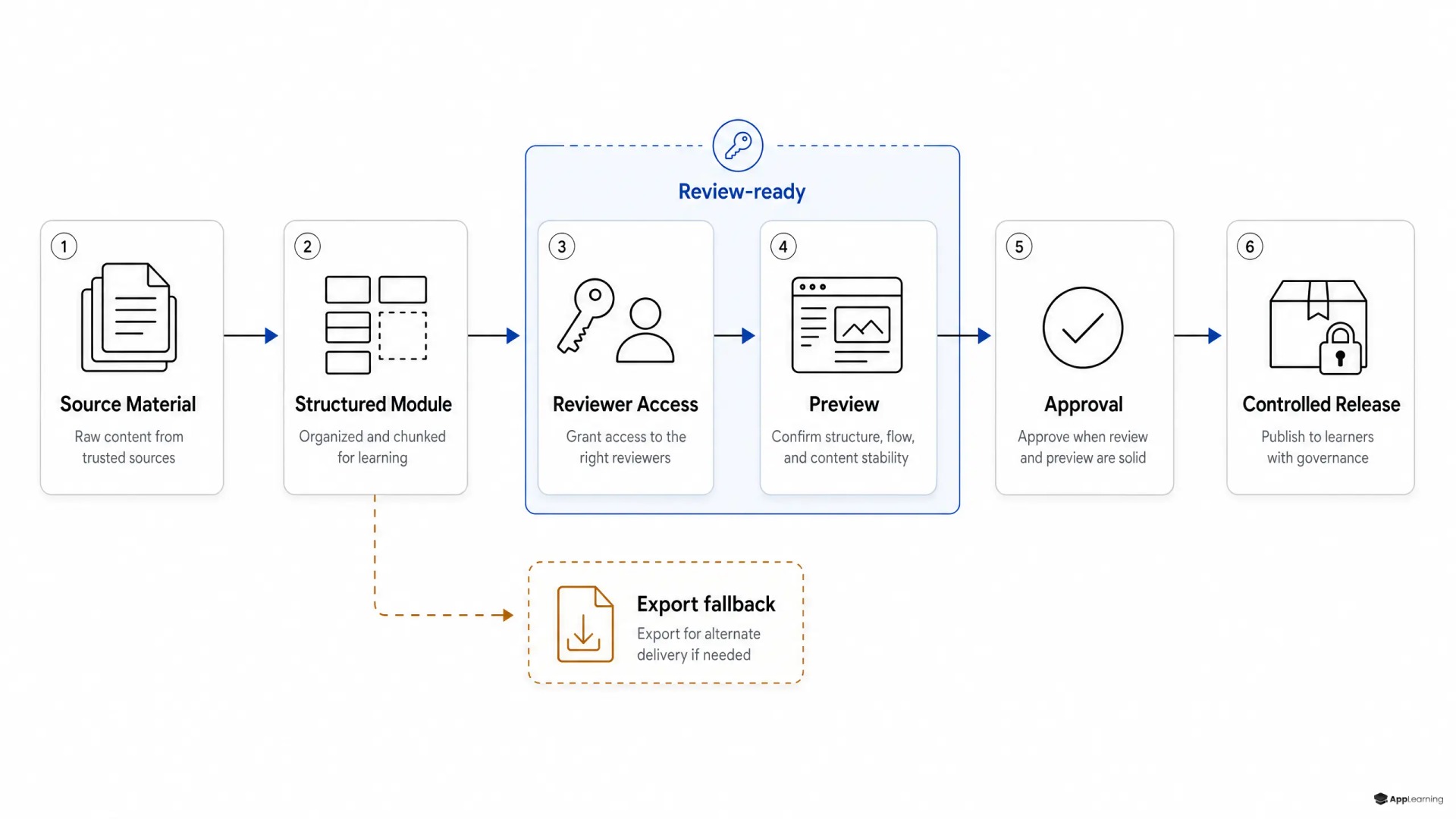
One recent delivery made the gap clear. A five-part source specification became 19 short chapters and five ten-question assessments with feedback. The learning design and content production were complete. The remaining constraint was access: reviewers needed an alternative account path, direct routes to an unpublished module, and an export for offline checking.
This distinction matters most in finance, banking and crypto. A compliance review is not meaningful when reviewers see a draft in a document but learners will encounter a different structure, interaction flow or assessment state in the academy. Compliance training approval has to cover the delivered experience, not only the source text.
Access Fails at the Last Mile
Reviewers are often outside the normal learner model. They may not have an active account, belong to another identity provider, or need read-only access that does not expose authoring controls. They may also arrive through a generic academy homepage and have to search through menus before they can find a draft. Each extra step creates delay, support work and uncertainty about whether the reviewer saw the intended version.
A review environment should therefore be designed as a controlled operating path. It needs enough access for a reviewer to validate the module, but not enough access to edit content, change release settings or reach unrelated material. The goal is not broad access. It is reliable, purpose-specific access.
Four Controls Make a Module Reviewable
Course preview access should be specified alongside the module structure, audience and assessment rules. A usable review setup has four practical controls:
- Reviewer permissions that allow viewing and testing without granting authoring or publishing rights.
- Direct preview links that open the exact unpublished module or chapter sequence under review.
- A stable preview state with a clear version label, fixed assessment logic and no silent changes during sign-off.
- A document export that gives reviewers an offline fallback for detailed copy, legal or policy checks.
The export is useful, especially when legal or compliance teams work in annotation-heavy document workflows. It should not replace platform review. Documents cannot reliably show navigation, completion logic, answer feedback, mobile behavior or the final assessment experience. The academy preview remains the source of truth for the delivered module.
Good to know
Why is a document export not enough for course review?
An export supports detailed text review, but it cannot show the full learner journey. Reviewers still need the platform preview to validate navigation, assessment behavior, feedback, completion logic and the final published structure.
What permissions should a course reviewer receive?
Reviewers usually need read-only access to the assigned draft, its assessments and its preview environment. They should not receive authoring, publishing or broad academy administration rights unless those rights are required for their formal role.
When should review access be set up?
Set it up during module planning, before content production is complete. This allows identity, permissions, preview links and fallback exports to be tested before the approval window begins.
Approval Needs a State Machine
Learning content governance becomes stronger when review states are explicit. A practical academy publishing workflow separates draft, editorial review, compliance review, approved, scheduled and published. Each transition needs an owner, a decision and a defined consequence. If a material change is made after approval, the module returns to the appropriate review state rather than carrying an ambiguous approval forward.
This creates a usable release record without turning learning delivery into paperwork. Teams can see which version was reviewed, who approved it, what remains blocked and whether the published module matches the approved preview. That visibility matters when compliance content changes quickly and learning teams need to update training without weakening control.
Build review access into your next academy release.
Plan reviewGoverned Delivery Starts Before Sign-Off
At App-Learning, managed academy delivery covers more than transforming source material into engaging modules. It connects source transformation, structured assessments, CMS review, direct preview links, exports, approval and controlled release into one delivery path. Review access is planned while the module is being built, not improvised once the deadline is close.
That approach protects both speed and trust. Learning teams can move faster because reviewers receive a clear route into the exact experience they must assess. Compliance teams gain a dependable approval surface. And employees receive learning that has been checked in the form in which it will actually be delivered.