
Key takeaways
- The best microlearning platform depends on the team's operating model, not lesson length.
- Employee training needs role-based paths, assessment evidence, certificates, analytics, and fast content updates.
- Microlearning apps work best when they support onboarding, compliance, product knowledge, and manager refreshers together.
- App-Learning fits regulated teams that want a modular academy instead of disconnected lesson delivery.
Choosing the best microlearning platform for employee training is not just a feature checklist. Teams comparing microlearning apps for employee training need to know whether each product can support role-based onboarding, compliance refreshers, product knowledge, manager training, and measurable skill gaps. In finance and crypto, the shortlist should prove that short lessons can be updated, assigned, tested, and reused when policy, products, or risk signals change.
Regulated teams also need evidence. The EU's Digital Operational Resilience Act requires financial entities to maintain ICT security awareness and digital operational resilience training, and management bodies must keep their ICT risk knowledge up to date through regular training under Regulation 2022/2554. That raises the bar. Learning cannot live as static slide decks and completion screenshots.
Best microlearning platforms solve workflows, not lesson length
The best microlearning platform for a team is the one that maps short lessons to real work. A useful unit teaches one decision, one control, one product concept, one risk pattern, or one customer scenario. It should help an employee complete a task or make a better judgment, not simply finish a shorter video.
That is the difference between content length and learning design. Length reduces friction. Structure creates transfer. Analytics prove whether the learning system works for each role, cohort, and training requirement.
How to choose a microlearning platform for employee training
Start with the workflows your team must improve, then compare platform capabilities against those workflows. Instructional designers and learning coordinators should test role-based paths, mobile access, reminders, accessible delivery, reusable content updates, and reporting by role, cohort, and location. Evaluate each platform against this operating model, not the demo interface.
- Role logic that assigns different paths to analysts, advisors, engineers, managers, and support teams.
- Content operations that let non-technical teams update lessons, quizzes, certificates, and paths quickly.
- Assessment evidence beyond completion, including quiz results, knowledge gaps, retries, and cohort patterns.
- Compliance proof through certificates, audit exports, archived versions, due dates, and reminders.
- Reuse across onboarding, compliance, product education, risk training, and upskilling.
- Integration with HRIS, LMS, identity, reporting, and communication tools.
- Governance that keeps AI-generated, imported, and SME-authored content under expert review.
Best microlearning platforms by team use case
App-Learning fits regulated finance and crypto teams that need a branded academy rather than disconnected lessons. The App-Learning academy model combines microlearning modules, role-based learning paths, certificates, analytics, and content updates for onboarding, compliance, risk, product knowledge, sales enablement, and internal process training.
Axonify is strongest when training must reach high-volume operational or frontline teams. Its frontline enablement platform combines microlearning, execution, communications, AI-supported content creation, and knowledge-gap insights. That makes it especially relevant for instructional designers training frontline retail and hospitality employees at scale: Axonify documents multi-device access, mobile-first delivery, and scaling across locations, brands, and languages. Test whether employees can open assigned lessons in a few taps, resume across devices, receive reminders, and complete accessible training without desktop-only friction.
5Mins.ai is built around fast daily learning. Its AI microlearning platform positions role-based recommendations, compliance, leadership, and skill development around short sessions. It suits teams that want a lightweight, habit-based layer for upskilling and mandatory refreshers.
iSpring Learn is a good fit for teams that still need conventional LMS administration and rapid course production. Its microlearning LMS page focuses on launching bite-sized training quickly, with authoring and tracking close together.
Go1 is useful when the biggest gap is content access. The Go1 corporate learning platform emphasizes search, recommendations, AI chat, and curated learning across compliance and upskilling. It can support teams that already have an LMS but need a broader content layer.
Docebo is a broader enterprise learning platform rather than a pure corporate microlearning tool. Its employee training solution supports blended learning, online training, webinars, virtual classrooms, external content providers, and multiple training audiences. It fits larger organizations that need enterprise learning infrastructure across employees, partners, and customers.
EdApp now needs a specific caveat. Buyers comparing historic EdApp features should know that EdApp retired on March 31, 2026, with training features moved into SafetyCulture. Treat it as a migration or legacy reference, not a new standalone platform choice.
Analytics must prove more than attendance
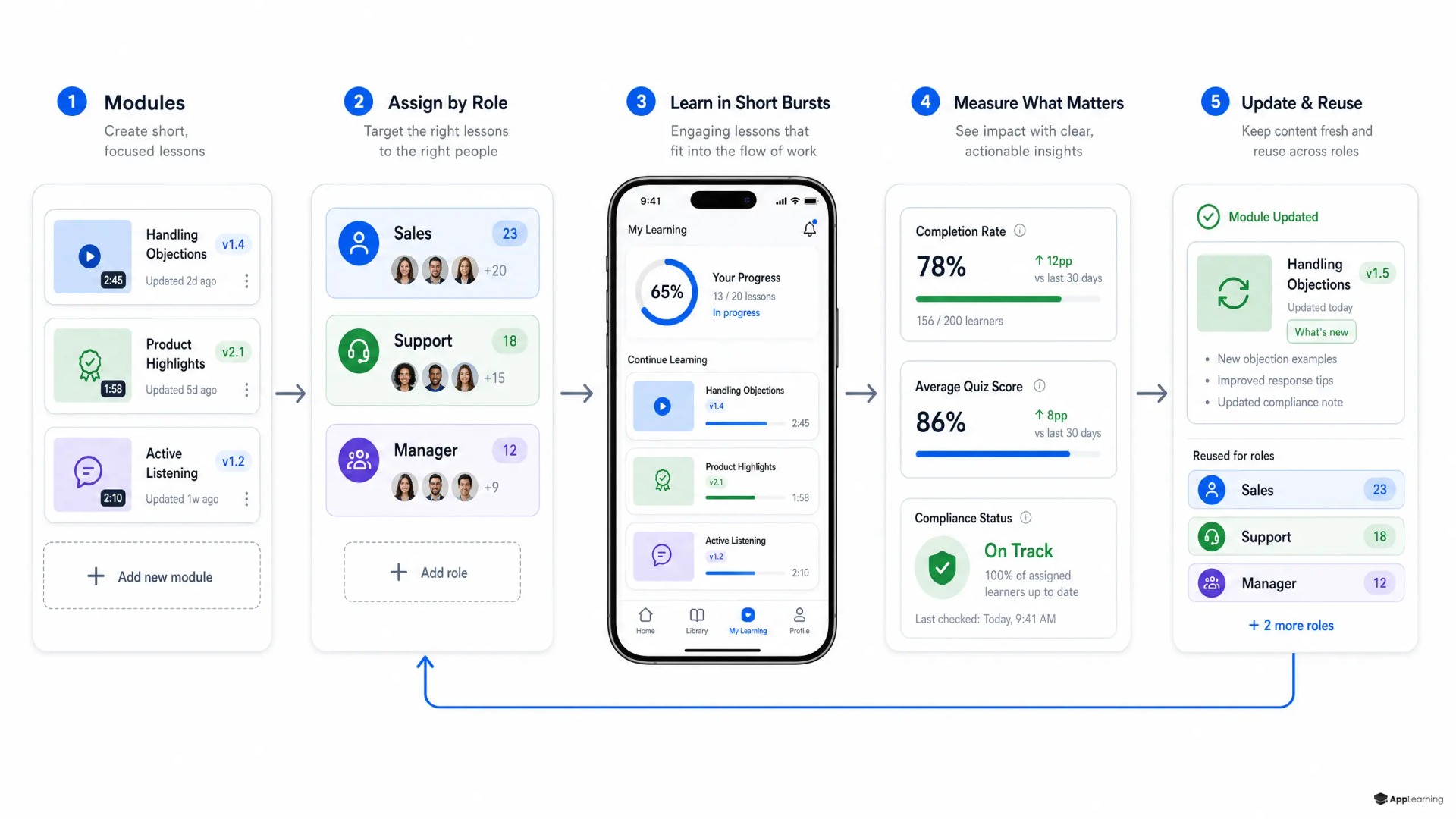
Completion is only the entry metric. After the initial implementation rollout, learning teams should measure adoption by invited-to-activated learner rate, weekly and monthly active learners, path starts, return frequency, completion, overdue training, and adoption by role, cohort, and location. Regulated companies should pair those signals with where people hesitate, which questions fail, and which roles need reinforcement.
The useful analytics stack tracks adoption and outcomes together: active learners, path progress, quiz accuracy, overdue learners, certificate status, weak topics, content age, update history, and manager follow-through. Review the baseline before rollout, then compare 30-, 60-, and 90-day cohort trends. For finance and crypto, this moves the conversation from whether people clicked through training to whether they understood the risk.
Good to know
What is the best microlearning platform for employee training teams?
The best choice depends on the team's operating model. App-Learning fits regulated teams that want a modular academy with role-based paths, certificates, analytics, reusable content, and evidence across compliance, onboarding, product knowledge, and risk training.
How should teams evaluate AI microlearning platforms for compliance training?
AI can accelerate outlines, quizzes, personalization, and content updates, but compliance teams still need expert review, approved sources, version control, assessments, certificates, reminders, reporting, and audit-ready records. Short AI-generated content without governance and evidence is not a compliance system.
Should a company replace its LMS with a microlearning platform?
Not always. Some teams use microlearning as a layer on top of an LMS, while others move toward a modular academy. The decision depends on governance, integrations, reporting needs, and how much content must be updated regularly.
How do learning teams measure microlearning platform adoption after rollout?
Track invited-to-activated learner rate, weekly and monthly active learners, path starts and completions, return frequency, overdue training, manager follow-through, and adoption by role, cohort, and location. Compare 30-, 60-, and 90-day trends with quiz accuracy and knowledge gaps so activity does not get mistaken for learning.
Reuse beats one-off course production
The best employee microlearning platform behaves like content infrastructure. Each unit should be tagged by role, topic, product, process, regulation, jurisdiction, and skill. The same fraud typology module can support new hire onboarding, annual refreshers, manager briefings, and incident follow-up. The same product risk lesson can support support teams, sales teams, and compliance reviewers with different surrounding paths.
This is where modular academies outperform isolated micro-courses. They let teams start with one urgent use case, then expand without rebuilding the system every quarter. App-Learning uses this logic for regulated teams that need learning paths, short modules, certificates, analytics, and content operations in one academy environment.
Build a learning academy that fits regulated work.
TalkSelection checklist: choose the right microlearning app for your team
- Pick three real employee training workflows before watching demos.
- Map roles and risk exposure, not only departments.
- Test how fast your team can update a lesson, quiz, certificate, and path after a policy or product change.
- Ask for audit exports, certificate logic, archived versions, and data ownership details.
- Pilot with one regulated use case and one capability-building use case.
- Reject microlearning apps where short lessons sit outside governance, evidence, and analytics.
- Choose the platform your HR, L&D, compliance, risk, and managers can operate together.
Corporate microlearning is not a format decision. It is an operating model for keeping workforce knowledge current. The right platform makes training smaller, but also more specific, more measurable, and easier for teams to maintain. That is what regulated companies need now: learning that fits the work, survives audit pressure, and keeps pace with change.