

Key takeaways
- Regulated training needs evidence and role relevance.
- Fast updates matter when rules, products, and controls change.
- Assessment quality matters more than passive completion.
- App-Learning fits teams that need understandable, trackable learning.
Regulated training is evidence work
Training platforms for regulated companies have to do two jobs at once. They must help people understand complex rules, products, risks, and procedures. They must also produce evidence that the right people learned the right material at the right time.
That second job is where the requirements become concrete. DORA requires financial entities to include ICT security awareness programmes and digital operational resilience training as compulsory staff training modules. The broader governance baseline points in the same direction, because the EBA describes robust governance in terms of clear responsibility lines, effective risk management processes, and control mechanisms.
Generic libraries break at the control layer
A content library can be useful, but it is not a compliance training platform by itself. It may deliver annual AML, conduct, privacy, or cybersecurity courses. It often fails when compliance asks harder questions: who needed this version, who completed it, who failed the assessment, who was exempted, who approved the update, and which team still carries open training risk.
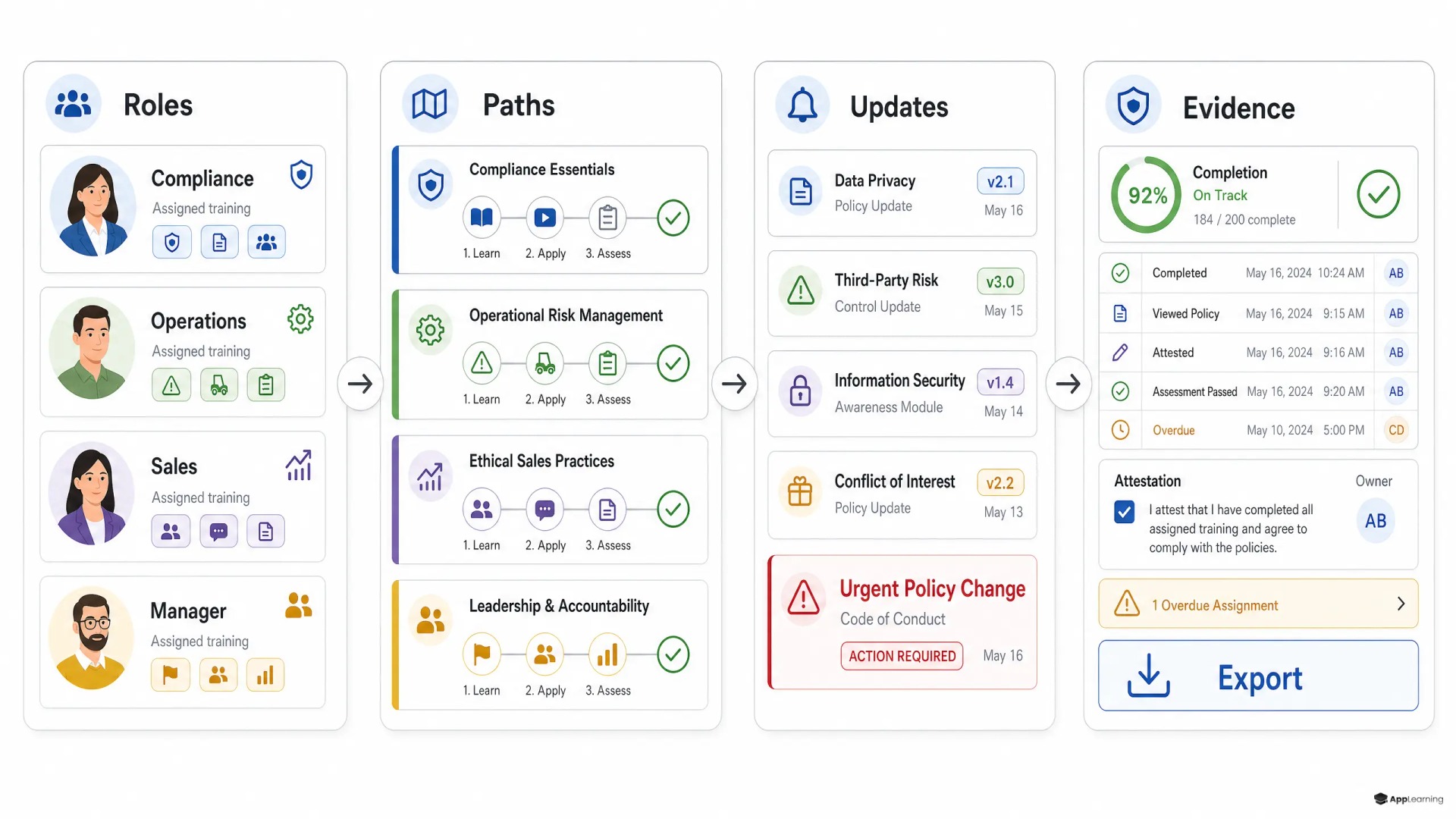
The gap is operational. Regulated industry training software must map learning to roles, entities, products, regions, systems, and control owners. A customer support agent at a crypto broker, an incident manager under DORA, a treasury analyst, and a product manager do not need the same path. They need a shared baseline and different decision practice.
Three platform fits for regulated teams
App-Learning is strongest when the regulated team needs a branded academy rather than another static LMS layer. App-Learning’s public profile describes mobile and web academies with microlearning, quizzes, analytics, and reward mechanics. A Bitcoin Bundesverband article also describes the App-Learning model as short modules, adaptive paths, knowledge checks, visible progress, and fast content updates. That fit matters for finance and crypto teams where comprehension, not course attendance, is the constraint.
Moodle Workplace fits teams that want configurable LMS infrastructure and have the admin capacity to run it well. Moodle positions Workplace around compliance reporting, learning sequences, certifications, recertification cycles, SCORM integration, and manager visibility. It can be a good choice when internal L&D or IT wants control over structure, integrations, and reporting logic.
Docebo fits larger organisations that need enterprise automation and stronger platform-level audit functions. Docebo’s audit trail documentation describes an immutable record of administrative actions, including important changes to course completion and enrolment status. That is useful when audit evidence must show not only learner completion, but also what changed inside the platform.
The comparison starts with controls
Before demos, define the control model. The best platform depends less on the logo and more on whether it can run your regulated learning process without spreadsheets, manual chasing, or unverifiable exceptions.
- Role-based assignment by job, entity, location, product, system access, and control ownership
- Version history for content, approvals, changes, and retirement of outdated modules
- Assessments that test decisions, escalation routes, and applied judgement
- Evidence of assignment, completion, score, retake, exemption, expiry, and recertification
- Manager dashboards that show overdue learning and team-level risk
- Exportable audit records that compliance can use without vendor support
- Integrations with HRIS, SSO, LMS, collaboration tools, and reporting systems
- A content update process that works in days, not quarters
Good to know
Which training platform is best for a finance or crypto company?
The best fit depends on the operating model. Choose App-Learning for role-based academies and engagement, Moodle Workplace for configurable LMS control, and Docebo for larger enterprise audit and automation needs.
Is a generic LMS enough for regulated training?
Only if it can prove role assignment, completion, assessment results, recertification, content versioning, approvals, and audit exports. If those records live in spreadsheets, the LMS is only part of the control.
How often should regulated training be updated?
Update training whenever rules, products, risks, controls, systems, or responsibilities change. Annual refresh cycles are often too slow for finance, crypto, cybersecurity, and operational resilience topics.
Finance, crypto, and cyber need different paths
Finance teams need a common control baseline and deeper paths for operations, IT, vendor management, incident response, and leadership. Crypto teams need clearer separation between customer education, employee onboarding, product knowledge, market conduct, custody, fraud, and client-facing advice. ESMA’s MiCA competence guidance focuses on knowledge and competence for staff who provide information or advice on crypto-assets and services, including market features, volatility, and cyber security risks.
Cybersecurity training needs the same role logic. NIST’s awareness and training work includes a role- and performance-based model for information security training. For healthcare-adjacent and operational teams, the pattern is similar: people need to know the rule, recognise the scenario, act correctly, and leave evidence that the organisation can defend.
Build a regulated learning academy your teams can prove.
TalkThe procurement checklist that prevents rework
- Ask for a sample audit export before signing.
- Test one real regulatory update in the platform workflow.
- Map three roles and check whether assignment rules stay clean.
- Review how failed assessments trigger retraining or manager action.
- Check whether content approvals are visible and preserved.
- Confirm data retention, hosting, access rights, and deletion rules.
- Inspect analytics beyond completions, especially scores, attempts, gaps, and overdue risk.
- Decide who owns content changes after go-live.
The best regulated industry training software is not the biggest content catalogue. It is the system that keeps learning current, specific, measurable, and defensible. Regulated companies should buy for proof, update speed, assessment quality, and accountability. If the platform cannot show who understood what and where the risk still sits, it is not ready for a regulated environment.