

Key takeaways
- Static docs are easy to store but hard to operationalize.
- Mobile learning improves access at the point of need.
- Sequenced lessons and checks beat passive reading for frontline training.
- Frontline teams need repeatable guidance, not only documentation.
Static docs break at the point of work
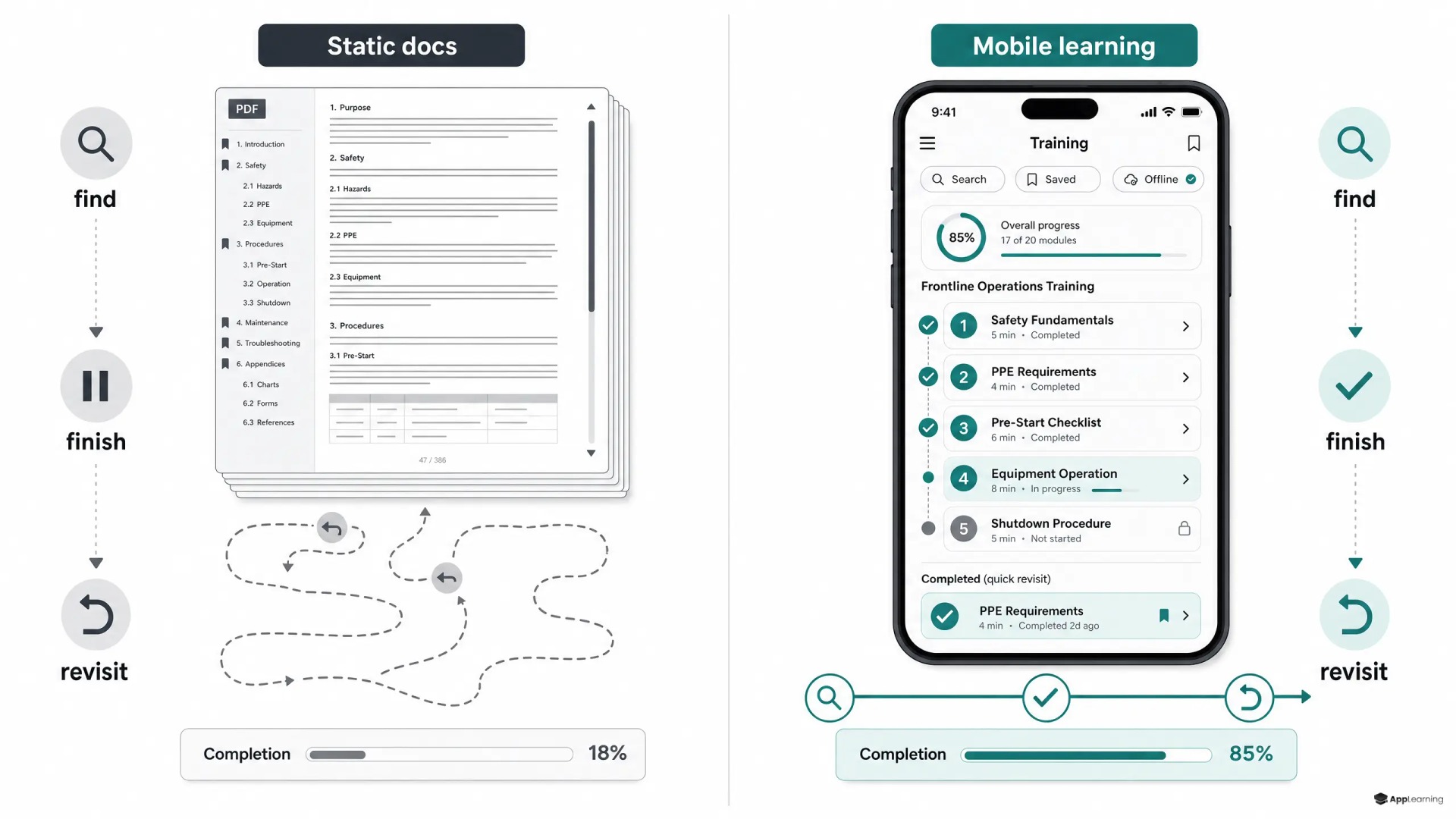
Static docs are easy to publish. They are hard to use when an agent is standing in a shop, explaining a prepaid bundle, checking a tariff, or trying to complete a first sale. A PDF, SharePoint folder, or chat attachment stores information, but it does not tell the agent what matters now, what comes first, or whether they are ready to act. The usability problem is not new; Nielsen Norman Group has long described PDFs as problematic for online reading.
For a CEO or COO, the failure shows up as slow activation, repeated support questions, uneven sales quality, compliance gaps, and regional performance swings. Static docs transfer the work of interpretation to the least supported person in the system: the field agent.
Mobile access changes the training unit
A mobile learning platform changes the unit from document to action. Instead of a 30-page onboarding file, the agent sees a short path: register, set up payment, order stock, run a demo transaction, explain the offer, pass a readiness check. UNESCO’s mobile learning guidance highlights benefits such as anytime learning and immediate feedback; in field sales, those are operating requirements, not convenience features.
Mobile-first does not mean heavy. For low-end Android devices, weak signal, and expensive data, the platform has to be lightweight, cache key content, avoid large files, support local languages, and work inside the agent flow where possible. If training sits in a separate tool, adoption becomes another operational campaign.
Sequences beat libraries
The difference in static docs vs mobile learning is sequence. A library answers “where is the document?” A learning journey answers “what should this person do next?” That distinction matters when thousands of semi-independent agents join, churn, and rejoin across regions.
Learning science supports this direction. A large review in Psychological Science in the Public Interest rated practice testing and distributed practice as high-utility learning techniques, while rereading and highlighting were weaker. For frontline training, this means short lessons, scenario questions, spaced refreshers, and checks are not decoration. They are the mechanism that turns information into usable memory.
Checks turn content into control
Static docs cannot reliably prove who is ready to sell a new bundle, follow a KYC step, or explain a campaign condition. A frontline training platform can. It can gate access to a product launch, require a micro-certification, flag weak regions, and trigger follow-up coaching before errors reach customers.
- Activation rate after onboarding
- Time from signup to first successful sale
- Completion and drop-off by lesson step
- Pass rates and repeat attempts on readiness checks
- Support tickets after specific training modules
- Campaign readiness by region, supervisor, and cohort
- Sales quality and compliance outcomes after certification
Static docs still have a place
Documentation is still useful. Keep it for legal terms, full policy records, product specifications, and audit trails. The mistake is using documentation as the main learning interface. Source-of-truth material should feed the learning system, not replace it.
A good operating model separates the archive from the action layer. The archive holds the full truth. The mobile journey gives the agent the next move, the key explanation, the practice moment, and the confidence check.
Good to know
When are static docs still useful?
Use static docs for full policy records, legal terms, audit material, and detailed reference content that does not need to guide immediate action.
What should a field sales business convert first?
Start with onboarding, first-sale steps, product launches, promotion updates, compliance checks, and the support questions agents ask every week.
Which metrics show real learning?
Track activation speed, lesson completion, readiness pass rates, support ticket reduction, repeat attempts, campaign adoption, and sales quality after certification.
The App-Learning pattern
At App-Learning, we treat field knowledge as a product surface. Campaign notes, sales playbooks, SOPs, compliance rules, and support answers become modular mobile journeys with short explanations, visual prompts, practice tasks, quizzes, rewards, and analytics. Where possible, they sit inside the existing field app and connect to CRM, performance, and reporting systems.
This matters because field training is not only an L&D problem. It is an activation system, a sales quality system, and a support deflection system. The better the learning path, the less the organization depends on supervisors, phone support, and informal chat groups to repair confusion after the fact.
Turn field knowledge into guided mobile action.
TalkLearning metrics expose the real bottleneck
Static docs measure publishing. Mobile learning measures behavior. You can see which agents start but do not finish, which step blocks activation, which promotion is misunderstood, and which region passes certification but still underperforms. Those signals let operations improve the process, not just resend the memo.
Mobile does not beat documentation because phones are fashionable. It wins because the work happens on the move, under time pressure, with changing offers and uneven support. A document preserves knowledge. A mobile learning platform turns that knowledge into a repeatable operating sequence.