
Key takeaways
- Age inclusion fails when managers are expected to improvise.
- Knowledge-sharing needs structure across career stages, not slogans.
- Manager enablement should cover assumptions, communication, mentoring, and escalation.
- Measurement shows whether age-inclusive intent changes team behaviour.
Manager training makes age inclusion real
Age-diverse teams do not create value because a company has four generations on payroll. They create value when experience, new context, risk memory, digital fluency, and customer perspective are put into useful work. That is a management system, not a demographic fact. In regulated finance and crypto teams, the same logic applies to conduct, fraud, controls, onboarding, and product knowledge.
Ciphr and ProAge’s 30 June 2026 summary reports clear upside and clear friction. Employers named broader experience and perspectives, knowledge sharing, succession planning, problem-solving, and stronger collaboration as benefits. Yet only 21% had age-inclusive recruitment policies, and communication styles and working expectations were the two biggest barriers. The gap is not awareness. It is multigenerational workforce training.
Age inclusion is no longer a future workforce issue.
Managers are the point of failure
Line managers translate policy into meetings, feedback, workload, development access, and promotion signals. If they are not trained, they will use habits. Some habits are good. Some carry age assumptions: who is adaptable, who needs support, who should mentor, who should learn, who is close to exit, and who is ready for responsibility.
This is also a risk issue. Acas guidance on preventing age discrimination tells employers to prevent exclusion, challenge stereotyping, and support managers to tackle problems. For HR and L&D, age inclusion training should not sit beside manager development. It should be inside it.
Learning must respect career stage
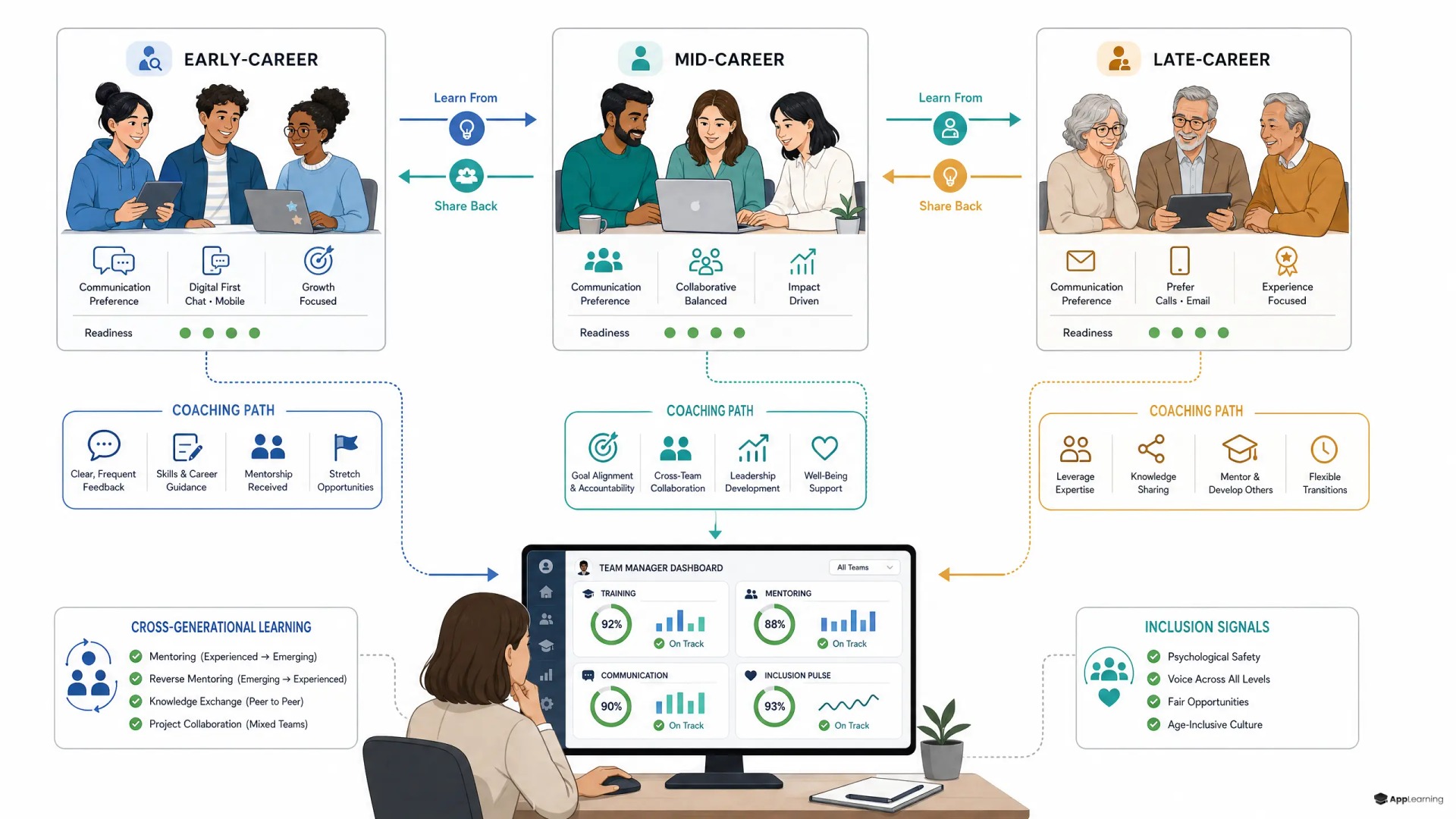
A single course on age diversity will not fix age-diverse team management. People need different learning at different career moments. Early-career employees need confidence, norms, and access to experienced judgement. Mid-career employees need stretch, mentoring skill, and protection from silent stagnation. Late-career employees need continued development, knowledge-transfer routes, and credible options beyond a slow exit path.
- Early career: team norms, feedback, psychological safety, product and risk basics.
- Mid career: coaching, cross-functional judgement, succession, and role redesign.
- Late career: reskilling, advisory contribution, mentoring, and phased transitions.
Enablement needs operating detail
Good manager training for multigenerational teams is practical. It should not ask managers to memorise generational labels. ProAge describes high-performing multigenerational teams as teams that set shared norms, use mentoring both ways, invest in confident managers, and make learning available at every age.
- Set explicit communication norms for channels, response times, and feedback.
- Challenge assumptions before staffing, promotion, and learning decisions.
- Use mentoring, reverse mentoring, and project pairing with defined outcomes.
- Give managers scripts for tension, bias, exclusion, and escalation.
- Refresh learning after reorganisations, product changes, and policy updates.
Good to know
Is age inclusion training only for older employees?
No. It should support people at every career stage and challenge assumptions about both younger and older employees.
How should regulated finance and crypto teams approach this?
Treat it like any capability risk: define expected behaviour, train managers, test understanding, and keep evidence.
What should HR measure first?
Start with manager confidence, learning access by career stage, mentoring participation, and employee feedback on fairness.
Measurement turns intent into practice
Completion rates are not enough. HR and L&D teams need signals that age inclusion is changing how work happens. For finance and crypto companies, this is familiar control logic. Define the behaviour, train it, test it, monitor weak spots, and refresh when the operating environment changes.
- Manager confidence before and after training.
- Participation in mentoring across age and role groups.
- Learning access by career stage and team.
- Employee survey cuts on fairness, voice, and development.
- Escalation patterns linked to communication, bias, or exclusion.
Build manager readiness with short measurable learning.
PlanThe scalable path is a manager academy
This is where App-Learning fits. App-Learning’s microlearning academy model supports short modules, quizzes, certificates, analytics, role-based paths, and refreshers. That structure works for age inclusion because managers do not need a one-off workshop. They need a system that teaches the behaviour, checks understanding, gives HR visibility, and keeps guidance current.
Age inclusion becomes real when it enters the operating rhythm. Managers need practice. Teams need shared patterns. L&D needs evidence. The employer that builds those loops will get more than a compliant DEI statement. It will protect knowledge, reduce avoidable friction, and make capability visible across every career stage.