

Key takeaways
- The 1 October 2026 change raises the evidence bar for prevention.
- Training must rehearse behaviour, not only explain policy.
- Risk assessment, reporting, and review need a repeatable operating rhythm.
- Readiness signals are stronger than completion dashboards alone.
- Finance and crypto teams need role-based conduct education that can update fast.
The deadline changes the evidence problem
From 1 October 2026, UK employers face a higher standard. The GOV.UK June 2026 employer bulletin says employers will be expected to take all reasonable steps to prevent sexual harassment, alongside an obligation not to permit harassment of employees by third parties.
That is not a small wording change for HR and L&D teams. It moves workplace sexual harassment training in the UK from policy communication toward evidence of prevention. A bank, fintech, or crypto firm will need to show more than attendance. It will need to show how risks were found, how people were prepared, how reports move, and how the system improves after new signals.
Reasonable becomes operational
The government factsheet on harassment explains that future regulations may specify steps such as assessments, plans or policies, reporting routes, and complaint handling. It also makes the key point: prescribed steps will not replace the wider duty to take all other preventative steps that are reasonable in the employer’s circumstances.
The EHRC frames the current preventative duty as anticipatory. Employers should not wait for a complaint before acting, and the EHRC technical guidance says prevention should not be a one-off exercise because workplaces, workforces, and reporting tools change.
Annual awareness is weak evidence
A completion record proves that a module was opened and a quiz was passed. It rarely proves that a manager can interrupt a client conversation, respond to a disclosure without minimising it, protect a reporter from retaliation, or escalate a concern through the correct route.
This is where many programmes fail. They teach definitions, then leave the hard moment to instinct. In harassment prevention training for employers, the evidential unit should be a practised decision, a logged escalation, a reviewed control, and a refreshed scenario based on live risk.
The learning market is already reacting. Learning News reported on a scenario-based conduct platform launched as harassment duties tighten, built around realistic workplace situations and coaching feedback rather than passive compliance content. The point is not that one product solves the duty. The point is that the old format is being questioned for the right reason.
Training needs a control loop
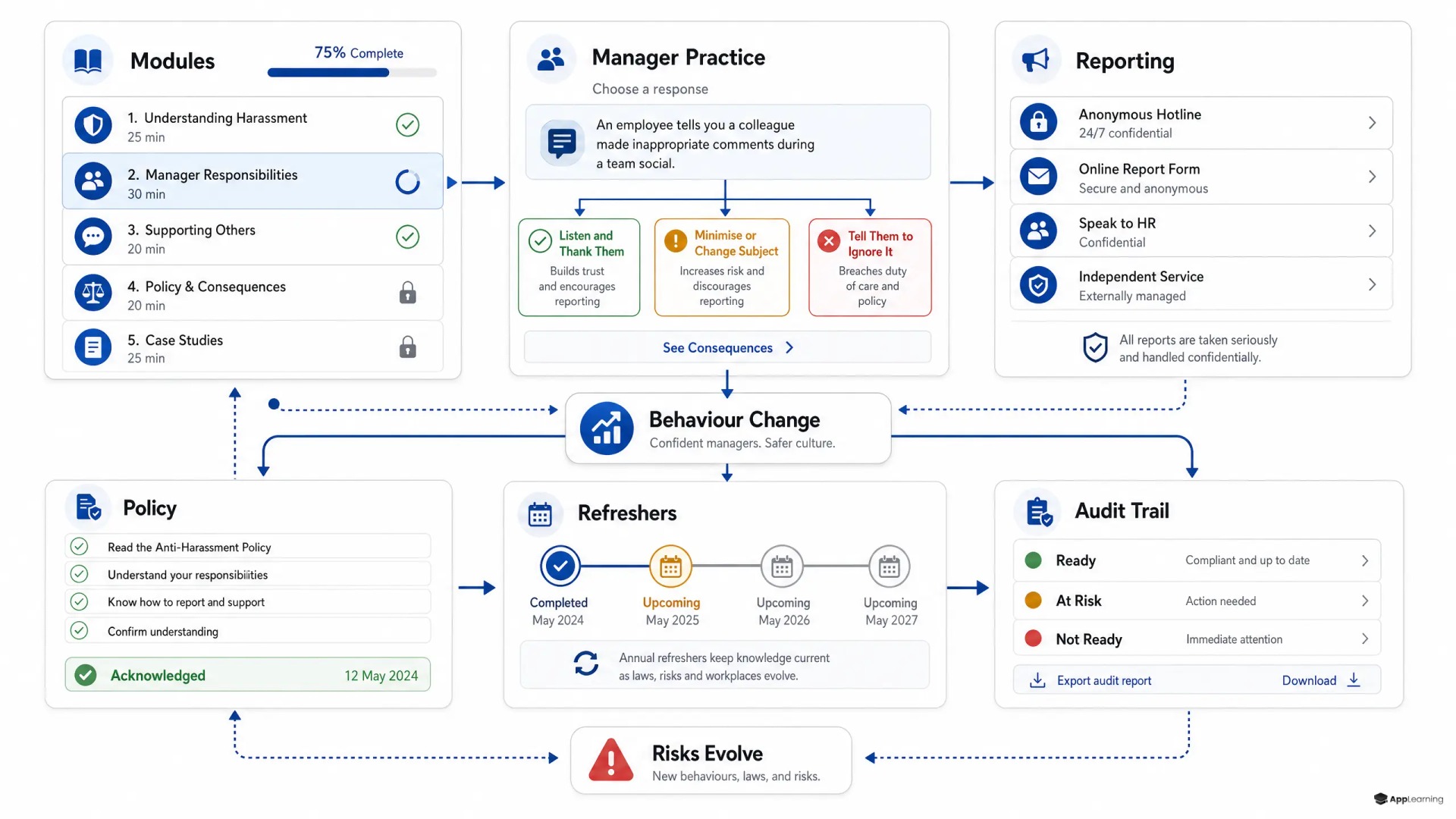
Acas says employers must assess risks, put measures in place, and cannot wait until harassment happens before acting, in its guidance on preventing sexual harassment at work. A stronger operating model connects four parts.
- Risk assessment by role, location, workflow, power dynamic, and third-party exposure.
- Scenario practice for employees, managers, senior leaders, HR, and client-facing teams.
- Reporting workflows that are visible, trusted, documented, and tested before incidents occur.
- Review cycles that refresh training when complaints, survey data, restructures, events, or new products change the risk profile.
Good to know
When does the UK all reasonable steps duty start?
The GOV.UK timeline update places the harassment measures in October 2026, and the employer bulletin gives 1 October 2026 as the commencement date.
Does annual workplace sexual harassment training in the UK still have value?
Yes. It can support baseline awareness, but it is weak evidence on its own if it does not connect to risk assessment, role-based practice, reporting, complaint handling, and review.
What should finance and crypto firms prioritise first?
Start with the risk map. Identify where power gaps, client contact, off-sites, remote channels, high-pressure incentives, or third-party relationships create realistic harassment risk.
Readiness signals beat completion dashboards
In App-Learning projects, we treat conduct training as a system, not a single module. The goal is to turn policy into role-specific choices and to make those choices visible enough for HR, L&D, compliance, and legal teams to review.
For finance and crypto companies, that matters because the risk surface is uneven. A trader, a support agent, a compliance analyst, a founder, and a people manager do not face the same moments. Role-based scenarios can test judgement where the risk actually appears: client entertainment, off-sites, late-night messaging, reporting lines, incentive pressure, power gaps, and third-party contact.
The useful dashboard is not only completion by department. It is readiness by risk. Which managers mishandle first responses? Which teams miss bystander intervention cues? Which reporting routes are not understood? Which scenarios need refresh after a complaint trend or business change? Those signals give learning leaders better evidence and give the business a clearer prevention record.
Build harassment readiness before the deadline.
PlanA readiness checklist before October 2026
HR and L&D teams should run a practical readiness check before the 1 October 2026 change.
- The sexual harassment risk assessment names third-party risks and high-risk work contexts.
- Policies explain expected conduct, reporting routes, complaint handling, and retaliation protection in plain language.
- Employees practise realistic bystander, reporting, and escalation scenarios.
- Managers practise receiving complaints, stopping harm, preserving evidence, and escalating without delay.
- Training records show scenario performance and follow-up, not only completion.
- Reporting routes are tested, accessible, and understood by employees and contingent workers.
- Risk reviews trigger content updates after incidents, surveys, restructures, events, or new working patterns.
- Leadership receives readiness signals that show weak points and improvement over time.
The higher standard will not be met by larger policy PDFs. It will be met by a prevention system that teaches people what to do, lets them rehearse it, records the evidence, and improves when the risk changes. For learning leaders, that is the real shift: training must prove readiness.