

Key takeaways
- Article 4 AI literacy duties started on February 2, 2025.
- August 2, 2026 is the next operational deadline fintech teams should work backward from.
- AI explanation belongs inside onboarding, support, and guidance flows, not only in policy docs.
- Role-based microlearning scales AI literacy better than annual awareness training.
August 2, 2026 is not the starting line
The timing matters. The European Commission’s AI Act timeline says the Act entered into force on August 1, 2024, that AI literacy obligations started applying on February 2, 2025, and that the regulation becomes fully applicable on August 2, 2026, while the Commission’s AI literacy Q&A notes that supervision and enforcement of Article 4 apply from August 3, 2026 onward.
That makes Article 4 a current operating requirement, not a future project. In the legal text of Regulation (EU) 2024/1689, providers and deployers must take measures to ensure a sufficient level of AI literacy for staff and others using AI on their behalf, taking account of experience, training, the use context, and the people affected by the system.
Growth now owns part of the AI Act
Most fintechs do not expose AI only inside model risk or compliance. It already sits inside customer acquisition and activation: onboarding checks, support triage, personalized offers, eligibility routing, next-best-action prompts, and financial guidance. The Plaid onboarding stack promotes instant onboarding with device signals and risk-based step-ups, Klarna’s AI assistant handles a large share of support chats, and Intuit Assist is positioned as a personalized financial assistant across consumer and business products.
Once AI shows up in those moments, growth teams inherit part of the trust burden. The copy on the landing page, the prompt inside onboarding, the explanation after a recommendation, and the handoff to a human agent all shape whether a user keeps moving or abandons the flow.
Poor explanation becomes a conversion tax
Financial products are high-hesitation decisions. When people do not understand whether a decision was automated, what data was used, or how to reach a human, they slow down or exit. The CFPB’s issue spotlight on chatbots in banking warns that poorly deployed chatbots can reduce trust and create legal risk, and the FCA’s 2025 research note on LLMs in consumer guidance shows how carefully consumer-facing financial explanations need to be tested.
That is the part many teams miss. AI literacy is not only about whether employees can define a model class. It is about whether the system around the model makes the right claims, sets the right boundaries, and helps a customer understand what happens next.
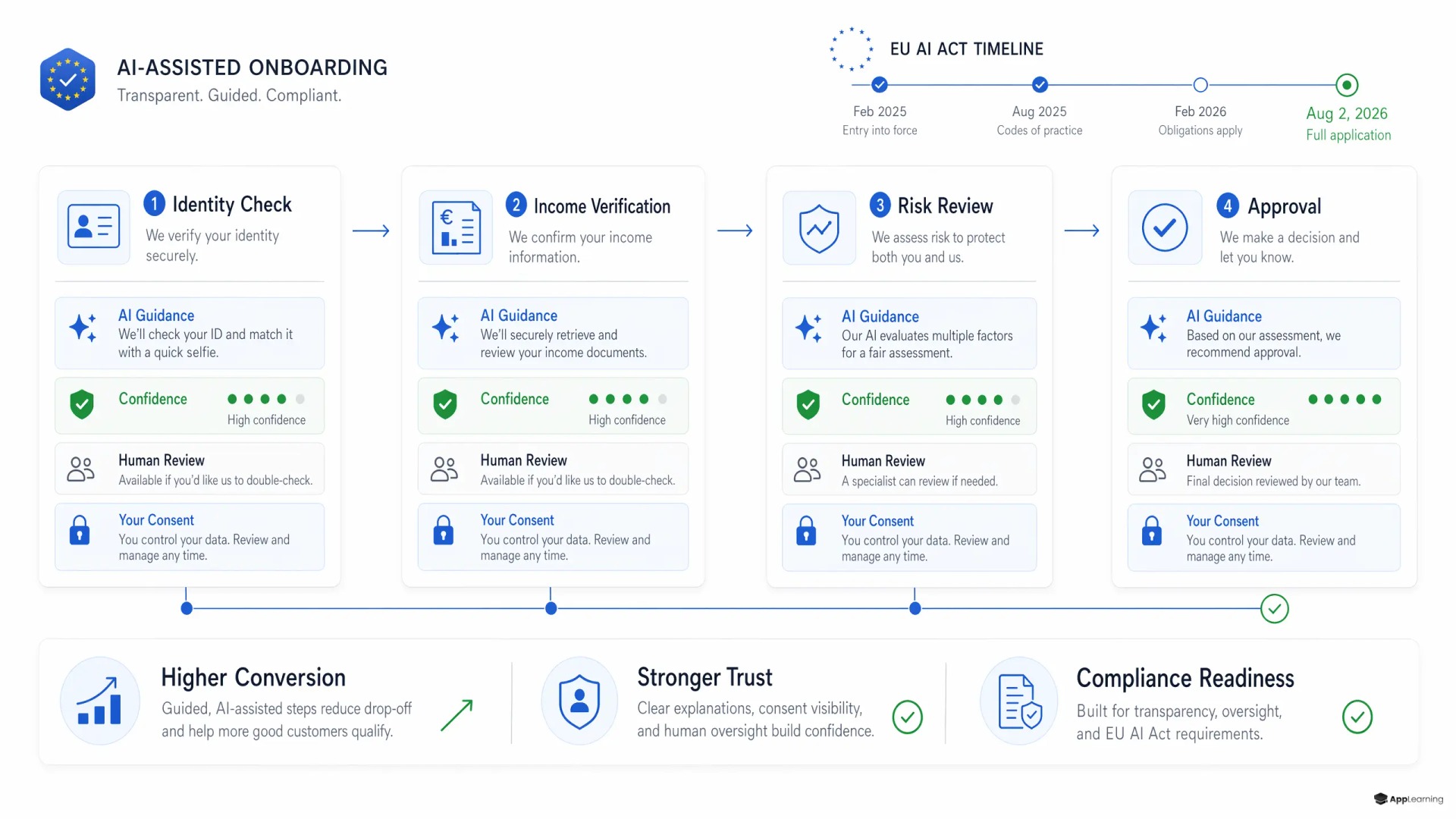
Audit the journey where AI is visible
Before August 2026, fintech leaders should review every customer and team touchpoint where AI affects interpretation, guidance, or confidence. The fastest way to do that is to inspect the journey end to end rather than wait for a formal policy review.
- Signup and onboarding steps that auto-fill, score, route, or step up verification
- Support entry points that start with an AI assistant before a human takes over
- Personalization layers that recommend products, next actions, or financial guidance
- Decline, hold, fraud, or eligibility messages that users must interpret under stress
- Internal workflows where growth, support, ops, and compliance rely on AI outputs
Good to know
Does Article 4 already apply to fintechs?
Yes. The Commission’s AI literacy Q&A says Article 4 started applying on February 2, 2025, even though supervision and enforcement ramp around August 2026.
What if our AI sits in support or onboarding rather than credit decisions?
You still need to look at literacy and explanation. The obligation in Article 4 of Regulation (EU) 2024/1689 is not framed as a narrow HR issue; it applies to providers and deployers of AI systems, and customer-facing use in onboarding or support can still affect trust, decision-making, and consumer outcomes.
What is the minimum practical rollout before August 2026?
At minimum, map where AI appears, create role-based microlearning for the teams who use it, define customer explanations and human handoffs, and review the copy in every AI-assisted journey before August 2026.
Role based literacy beats annual training
The Commission’s AI literacy Q&A makes clear that Article 4 is contextual. One generic awareness course is not enough for a fintech that uses AI differently across growth, support, risk, product, and operations.
A practical rollout usually has five parts.
- Map which teams use or configure AI, and which customer moments are affected.
- Define plain-language explanation patterns for each AI-assisted journey, including when a human can intervene.
- Deliver short, role-specific learning modules instead of one annual training deck.
- Add escalation rules for edge cases, disputes, and vulnerable users.
- Track operational outcomes such as completion rate, support deflection reversal, repeat questions, and escalation volume.
The Commission’s AI talent, skills and literacy page now points to a repository with more than 40 AI literacy initiatives, which is useful evidence that teams do not need to start from zero. What they do need is a format that can travel across departments and be refreshed as the product changes.
See how App-Learning turns AI literacy into measurable growth education.
ExploreApp-Learning turns literacy into product infrastructure
This is where App-Learning has a concrete role. Instead of treating AI literacy as a static policy file, fintechs can turn it into short, role-based learning objects tied to real screens, real prompts, and real customer scenarios. That makes the work measurable: who completed what, where misunderstandings still appear, and whether clearer education improves activation, support quality, and retention.
For a Head of Growth, that matters because AI explanation is now part of conversion design. If customers understand where AI is helping, where its limits are, and how to get human support when the stakes rise, the product feels safer to adopt. If they do not, the market will charge you long before a regulator does.
By the August 2, 2026 milestone in the Commission’s AI Act timeline, the enforcement clock is no longer theoretical. But the bigger signal is commercial. Fintech teams that fix AI literacy now are removing hidden friction from onboarding, support, and product guidance at the exact moments where trust decides whether a user converts.