

Key takeaways
- AI literacy should match the AI risks and workflows of each role.
- Scenario-based training builds judgment, not just policy awareness.
- Microlearning supports short practice loops without adding training overload.
- Audit value improves when learning data shows decisions, gaps, and remediation.
AI literacy has moved into governance
AI literacy training is no longer a soft skills topic for regulated teams. It is becoming part of the control environment. Employees now use AI to draft, classify, summarise, analyse, code, review, and decide. The EU AI Act frames AI literacy around staff and other people using AI systems on an organisation’s behalf, taking account of their technical knowledge, training, use context, and affected persons. (digital-strategy.ec.europa.eu)
That makes the training problem practical. A finance or crypto company does not need one abstract lesson on “responsible AI”. It needs people to know what they may enter into a tool, which outputs require verification, which cases need human review, and when to stop and escalate. The NIST AI Risk Management Framework also treats AI risk as something managed across design, use, and evaluation, while ISO/IEC 42001 defines an AI management system for organisations that provide or use AI-based products or services. (nist.gov)
Generic training creates a control gap
A single company-wide AI module can explain hallucinations, personal data, and prompt hygiene. It cannot teach a recruiter how to challenge an AI-ranked shortlist, a support agent how to handle a customer complaint drafted by AI, or a compliance analyst how to verify an AI-generated risk note. The same tool creates different risks in different hands.
This is why EU AI Act AI literacy should be built around job decisions, not AI facts. The Commission says there is no one-size-fits-all format and that different levels of training or learning approaches can be appropriate based on employee knowledge, experience, education, and the systems used. (digital-strategy.ec.europa.eu)
Scenarios turn policy into decisions
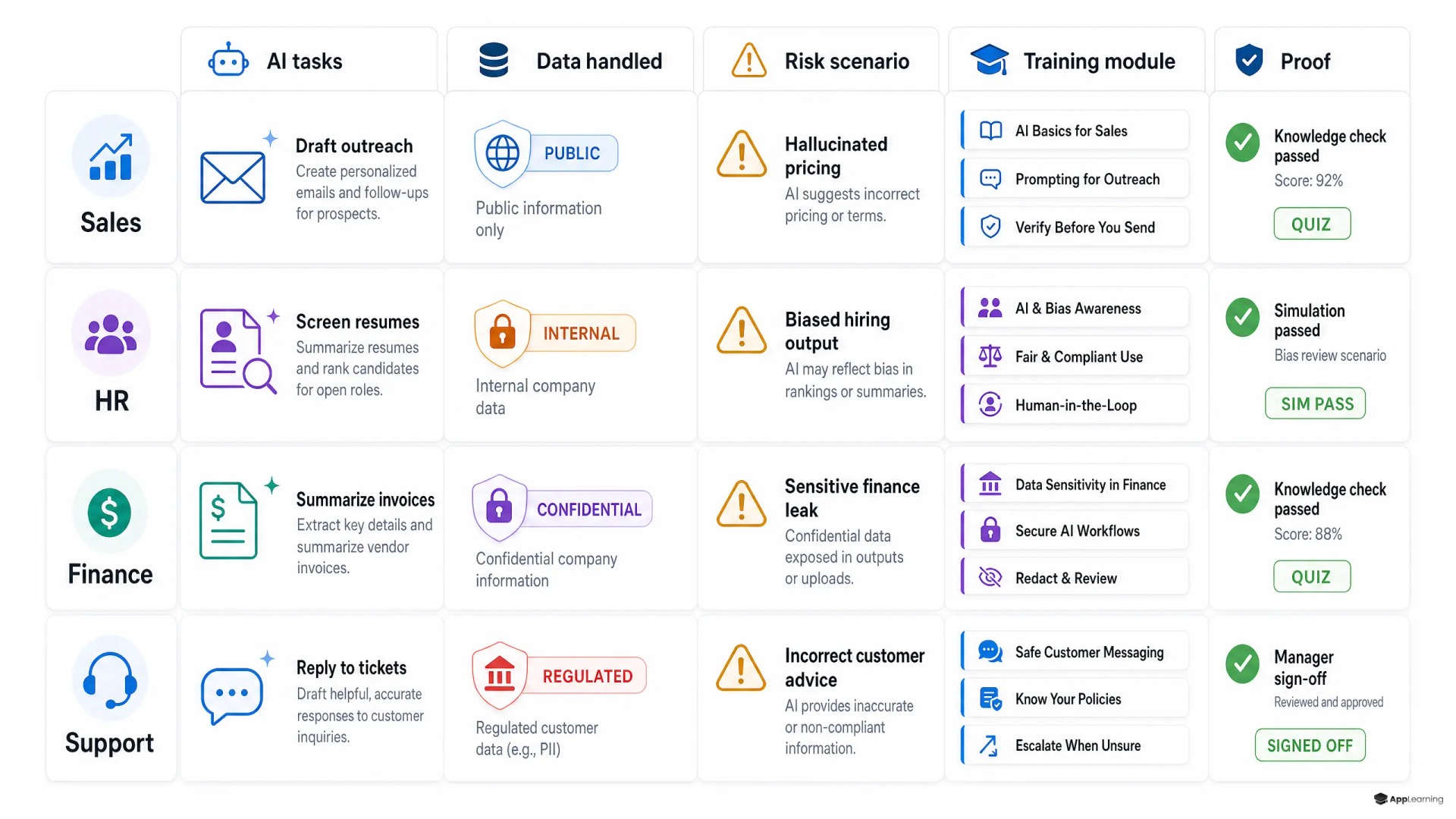
Role-based AI training should start with the moments where a person can make a wrong call. Good scenarios are short, realistic, and tied to the company’s actual AI use cases.
- HR reviews an AI-generated candidate summary and must spot missing evidence or bias risk.
- Customer support uses AI to draft a response involving a payment dispute and must decide what needs manual review.
- Marketing creates campaign copy and must check claims, regulated wording, and source reliability.
- Product teams assess whether an AI feature affects users in a way that needs documentation or legal review.
- Compliance teams receive an AI-generated control summary and must verify the source trail before relying on it.
- Leadership reviews an AI-assisted business case and must ask for assumptions, limits, and residual risk.
Each scenario should use the same operating pattern: use case, data classification, output reliance, affected person, escalation path, and evidence. The value is not the quiz score alone. The value is seeing whether employees can apply policy under realistic pressure.
Microlearning fits the rhythm of regulated teams
In regulated environments, training fails when it becomes a second job. Microlearning works best when each unit contains one decision, one risk, and one feedback loop. A 2024 systematic review found positive effects of microlearning on several learning outcomes, while also making clear that design and instructional intent matter. (pubmed.ncbi.nlm.nih.gov)
- A three-minute scenario tied to one role.
- A data-use decision before the answer is revealed.
- A knowledge check that asks for judgment, not recall only.
- A short explanation of the better decision.
- A repeat version later to check retention.
This format is useful for AI compliance training because AI tools and policies change fast. Short modules can be updated when a new tool, model policy, vendor workflow, or internal escalation rule changes. L&D does not need to rebuild a full course every time the risk map moves.
Good to know
Does every employee need the same AI literacy training?
No. AI literacy should vary by role, system exposure, knowledge level, and risk. The Commission’s AI Act Q&A explicitly supports different levels of training or learning approaches where appropriate.
Where should HR and L&D start?
Start with a role-by-role inventory of AI use. Identify where employees enter data, rely on AI output, affect customers or candidates, create regulated content, or need to escalate uncertainty.
What evidence should regulated teams keep?
Keep internal records that show the training action, role, date, policy version, assessment result, and remediation status. The Commission notes that a certificate is not required for Article 4, but internal records of training or guidance can be kept.
Why are scenarios better than a generic AI policy course?
A policy course explains the rule. A scenario tests whether someone can apply the rule when the data, output, customer impact, and escalation path are unclear.
Evidence should follow the risk
Completion data is the weakest proof of AI readiness. A better evidence model records who completed which role scenario, what decision they made, where they struggled, which policy version applied, and whether remediation was completed. The Commission’s AI literacy Q&A says there is no need for a certificate and that organisations can keep internal records of trainings or guiding initiatives. (digital-strategy.ec.europa.eu)
For high-risk systems, this becomes closer to an operating control. Article 26 of the AI Act says human oversight for high-risk AI systems must be assigned to people with the necessary competence, training, authority, and support. That does not mean every employee needs deep technical AI education. It means each role needs enough practice for the risk it carries. (ai-act-service-desk.ec.europa.eu)
Build AI literacy around real decisions.
DiscussThe practical training system
For HR and L&D leads, the operating model is simple but often missing. Map AI use by role. Define the risky decisions. Build scenarios from those decisions. Deliver them in short loops. Track evidence by role, tool, policy version, and result. Review weak spots with compliance, risk, legal, security, and business owners.
This is where App-Learning typically fits for regulated teams. The goal is not to add another static LMS layer. It is to turn AI literacy into measurable learning journeys with role-based paths, microlearning, checks, remediation, analytics, and audit-friendly training data. That gives L&D a way to modernise the employee experience while still respecting compliance constraints.
AI literacy is not solved by publishing a policy. It is solved when employees can make the next correct decision in their own workflow. The organisations that treat training as applied judgment will get more value than those that treat it as another checkbox before an audit.