
Key takeaways
- Founder knowledge only scales when teams can reuse it without live founder access.
- Capture judgment, standards, and customer context before they become bottlenecks.
- Short learning paths reduce repeated explanations and protect founder focus.
- A living internal academy improves onboarding consistency and decision quality.
Founder knowledge turns into drag
Founder knowledge is a real competitive asset at ten people. At fifty, it often becomes a hidden dependency. If pricing judgment, customer nuance, quality standards, and escalation logic still live mostly in the founder’s head, the team does not actually have access to them. It has access only to the founder’s calendar.
That pattern is not just anecdotal. Using World Management Survey data, NBER researchers found that founder-CEO firms had the lowest management scores among owner-manager types, and that the gap was associated with significant performance differentials. (nber.org)
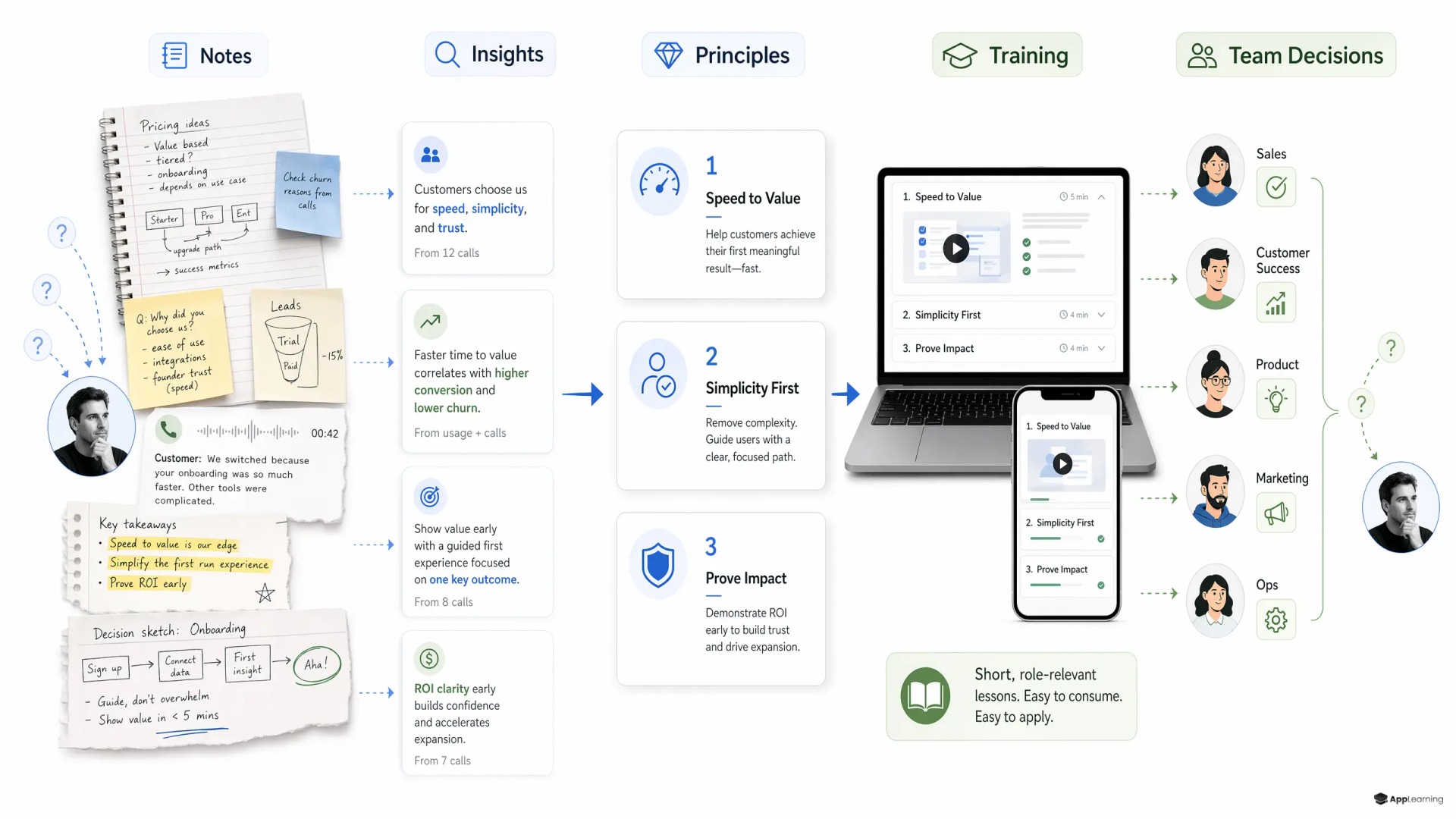
This is why internal training matters earlier than most founders expect. The job is not to formalize the company for its own sake. The job is to make the company’s best judgment available without requiring founder intervention every time someone needs context.
Capture the knowledge that changes decisions
What needs capturing first is not every process step. It is the knowledge that changes decisions. OECD and USAID work on knowledge transfer distinguishes between explicit knowledge that can be documented and tacit knowledge embedded in experience and organisational memory. Tacit knowledge is harder to transfer, but it is also where much of the firm-specific edge sits. (oecd.org)
That matters because structured onboarding does more than welcome new hires. A recent systematic review found formal onboarding is associated with higher role clarity and task mastery and lower role ambiguity and role conflict, while SHRM notes that time-to-productivity is strongly influenced by onboarding design. (pmc.ncbi.nlm.nih.gov)
- Decision principles and trade-offs
- Customer stories and recurring objection patterns
- Quality bars and review criteria
- Escalation rules and exception handling
- The mistakes the company cannot afford to repeat
If a piece of knowledge repeatedly changes how someone sells, reviews, prioritises, or escalates, it belongs in training. A checklist tells people what to do when the world is stable. Training should tell them how to think when the checklist no longer fits.
Short modules beat long documentation
Most startups respond to knowledge gaps with long documents. That is usually the wrong format. OECD research on enterprise learning shows two things at once: informal learning accounts for more than 70% of total learning time, and lack of time by employees and management is a key constraint on training provision. In other words, the format has to fit the workday, not compete with it. (oecd.org)
- One decision, standard, or recurring judgment call
- A short explanation from the founder or content owner
- One concrete example of good judgment
- A quick scenario or knowledge check
- Links to source documents and the responsible owner
A useful module is short, specific, and tied to a real operating moment. When a founder answers the same question for the third time, there is usually already enough signal to turn that answer into a reusable lesson. That is the point where knowledge capture stops being admin and starts becoming leverage.
Keep founders in the loop without keeping them in the workflow
Founders should not disappear from training. They should move to the parts of it only they can do. New market bets, fresh product narratives, unusual customer objections, and strategic trade-offs still need live founder input. Stable explanations such as pricing logic, review criteria, handoff standards, and common failure patterns should be turned into reusable modules.
This is also where learning culture matters. OECD work on learning organisations finds that strong workplace learning environments raise the returns on training and help firms adapt more effectively as skill demands change. Training only becomes valuable at scale when people can apply it inside the flow of work. (oecd.org)
Good to know
What should founders capture first?
Start with the explanations that keep returning in onboarding, reviews, customer calls, and escalation threads. If the same context is needed three times, it is usually ready to become a module.
How short should internal training modules be?
Short enough to solve one real decision at a time. In most startups that means a few minutes of focused explanation, one example, and one quick check.
Do we need a full L&D team to do this?
No. A founder, operations lead, or people lead can run the system if each module has a clear owner and updates are tied to real business changes.
The internal academy becomes operating infrastructure
For a growing startup, an internal academy is not a nice-to-have HR layer. It is operating infrastructure because onboarding design materially affects time-to-productivity, and structured onboarding improves role clarity and task mastery. That means better training is not just a people initiative. It is a decision-quality system. (shrm.org)
That is the practical angle behind App-Learning. The goal is not to build a heavy learning stack or simulate a corporate L&D department. It is to give a growing company one place to turn company-specific know-how into short onboarding and upskilling paths that people can actually use.
- Role-based paths for the first 30, 60, and 90 days
- A searchable library of company-specific modules
- Clear ownership for each lesson and standard
- Simple visibility for managers on completion and gaps
- Refresh triggers tied to product, process, and customer changes
The best version is lightweight. A central knowledge hub, role-based paths, visible completion signals, and a simple ownership model are usually enough to replace a surprising amount of ad hoc explanation without adding operational complexity.
See how App-Learning turns founder know-how into structured onboarding.
See demoKnowledge only scales if it stays current
Captured knowledge only creates leverage if it keeps moving. USAID’s 2024 Knowledge Management and Organizational Learning policy defines organisational learning as knowledge that can be transferred, applied again, and improved over time. An OECD 2024 survey on workplace knowledge transfer also found that lack of know-how on how to implement these initiatives was the most commonly cited barrier among surveyed companies. (usaid.gov)
So the maintenance rule should be operational, not aspirational. Refresh modules after product releases, pricing changes, major deal losses, support incidents, or any decision that triggers the same founder explanation twice. If training is tied to real operating events, it stays useful.
Founder knowledge becomes more valuable the moment it stops being scarce. Once judgment, context, and standards are turned into short repeatable learning, the company gains something more durable than access to one smart person. It gains a system for making good decisions without waiting for permission.