

Key takeaways
- AI-driven learning needs structured skills data, not only content libraries.
- Microlearning creates cleaner signals than long passive course completion.
- Capability data can support reskilling, mobility, and workforce planning.
- Banks can start with academy data before building a full skills architecture.
AI needs evidence, not more content
AI-powered learning is only useful when the data behind it is structured enough to act on. A content library tells the bank what was available. It does not tell leaders who understands AI risk, who can explain tokenisation to clients, who can spot a cybersecurity red flag, or which operations team is ready for a new automation workflow. SoLAR defines learning analytics around the collection, analysis, interpretation, and communication of learner data in context. That context is the missing layer in many corporate academies.
For a bank, the problem is not a shortage of topics. The problem is weak signal quality. Innovation leaders need AI skills intelligence that connects learning to roles, products, controls, and transformation priorities. Without that link, AI can recommend another course, but it cannot support serious workforce planning.
Long courses produce large blind spots
Traditional courses often create one large event. Someone enrols, watches, clicks through, passes a final quiz, and receives a completion record. That may satisfy administration. It rarely proves capability.
A two-hour course on digital assets can hide five different realities. One employee already knew the basics. One guessed through the quiz. One understood custody but missed market risk. One lost attention after the first module. One could apply the concept in a client conversation. The LMS record may show the same result for all five.
This creates an operational problem. Leaders see training volume, not readiness. HR sees completion, not confidence. Risk sees attendance, not evidence. Internal experts still repeat foundational explanations because the system cannot show which gaps were actually closed.
Microlearning turns learning into signal
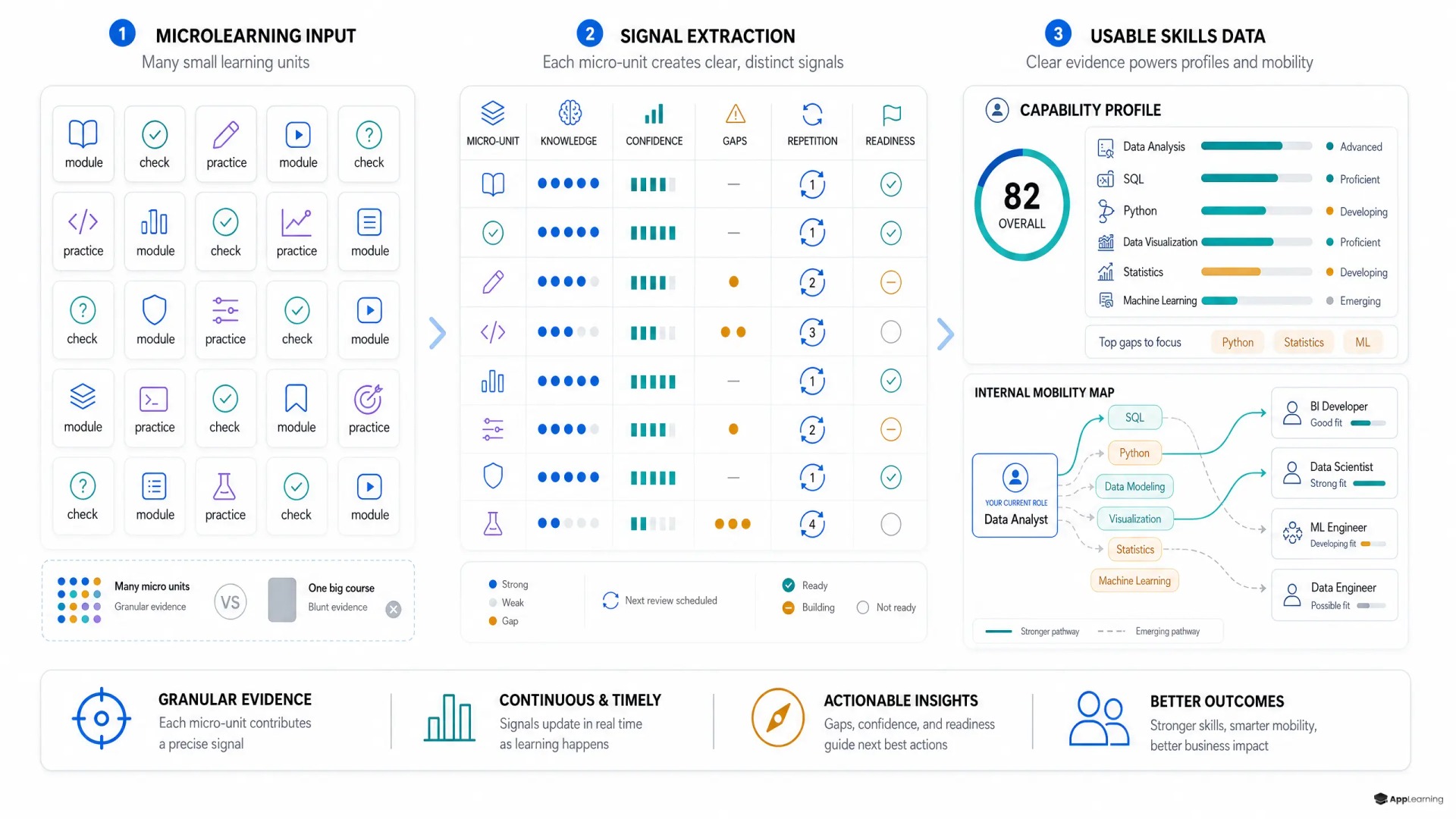
Microlearning works best when it is designed as a signal system, not as shorter content for its own sake. Each unit should target one concept, one decision, one misconception, or one behaviour. The shorter format makes it easier to test understanding immediately, repeat the topic later, and compare results across teams.
Research on spacing and retrieval practice gives the design logic: learners need repeated opportunities to recall and use knowledge, not only to consume it once. Microlearning can place those retrieval moments inside the work rhythm. That is where microlearning analytics become useful.
- Completion shows whether the learner reached the end of a unit.
- Correctness shows whether the learner understood the concept or decision rule.
- Confidence shows whether the learner knows what they know and where they hesitate.
- Repetition shows whether knowledge survives after a delay.
- Application shows whether the learner can use the concept in a realistic banking scenario.
Taken together, these signals create skills data. Not perfect data. Useful data. They show movement over time. They separate exposure from understanding. They help learning teams see whether a new academy is building real capability or only distributing information.
Capability data changes workforce planning
Clean employee capability data lets a bank compare current readiness with strategic demand. If the innovation roadmap depends on AI-enabled service, API partnerships, fraud automation, or digital asset infrastructure, leadership needs to know where capability is strong, where it is thin, and which roles need support first. The OECD describes accessible skills intelligence as including labour-market data, taxonomies, ontologies, and signalling platforms that support job matching, career exploration, and workforce mobility.
This does not require a complete enterprise skills ontology on day one. A bank can start with role-based academies, mapped learning objectives, and simple evidence rules. Public structures such as the European Commission’s ESCO classification can provide shared language, while internal academies create the practical signals that show whether people are becoming ready for specific work.
Good to know
Why is microlearning better for skills data than a long course?
Microlearning breaks learning into smaller units with clearer objectives. Each unit can generate evidence about one concept, decision, confidence level, or application gap.
Can a bank start without a full skills taxonomy?
Yes. Start with role-based academies, mapped learning objectives, and a small set of signals such as completion, correctness, confidence, repetition, and application.
What makes employee capability data trustworthy?
Trust comes from clear purpose, limited access, transparent use, data minimisation, and a strict separation between development support and disciplinary decisions.
Governance keeps the signal usable
Employee capability data is sensitive. It should not become covert performance surveillance. European banks must be especially careful when learning data is connected to AI, assessment, mobility, or worker management. The European Commission’s AI Act overview places AI used in education and employment contexts in higher-risk territory, and the Commission’s GDPR guidance makes purpose limitation and data minimisation basic operating principles.
Good governance is practical. Define the purpose of each signal. Limit who can see individual-level data. Use team-level dashboards for planning where possible. Separate development data from disciplinary decisions. Explain to employees how the data improves learning paths, support, and internal opportunity.
Build capability signals before the skills gap becomes expensive.
TalkThe first layer is the academy
App-Learning fits as a practical first layer for capability signals. We support microcourses, quizzes, role-based tracks, certificates, gamified mechanics, and admin analytics such as completions, drop-off points, time spent, and exportable reports. For a bank, that means an AI academy, innovation academy, compliance academy, or digital assets academy can start producing structured learning evidence before the organisation has a full skills architecture.
The real shift is simple. Learning can no longer be treated as a content distribution function. It has to become a measurement layer for transformation. Microlearning creates the small, repeatable, role-specific evidence that AI needs to support better recommendations, better reskilling decisions, and better capability planning. The bank that builds this signal layer early will understand its workforce faster than the bank that only counts course completion.