

Key takeaways
- The 50-plus stage exposes informal onboarding fast.
- Founder access cannot remain the main knowledge channel.
- Repeatable onboarding should start with role clarity and company context.
- Lean structure protects manager capacity without slowing hiring.
- Metrics must track ramp speed, not just checklist completion.
The breakage starts before the org chart shows it
At 10 people, startup employee onboarding can feel direct and human. A founder explains the strategy. A senior employee gives context. The new hire asks questions in Slack. It works because the system is still carried by memory, proximity, and repeated conversations.
At 50-plus people, the same approach starts to fail. The company has more roles, more tools, more customer history, more internal language, and more exceptions. New hires do not just need a laptop and a welcome call. They need to understand how decisions are made, what good work looks like, which mistakes already happened, and where to find the current version of company knowledge.
This is the real shift in onboarding after 50 people. The problem is not that the team needs heavy process. The problem is that key knowledge has become too important to live only in people’s heads.
Founder access stops being a delivery mechanism
Early onboarding often depends on founder density. New employees absorb the company by spending time with the people who built it. That creates high signal, but it does not scale. Once hiring accelerates, founder time becomes fragmented. The same story gets told differently. Some hires get context. Others get tasks.
Managers then become the fallback system. That sounds reasonable until every manager is also hiring, shipping, selling, fixing process gaps, and protecting team morale. Gallup’s research shows that manager involvement materially shapes onboarding quality, which is exactly why startups should not leave the full onboarding load with managers alone.
The founder’s job is to define the system, not personally deliver every piece of it. The manager’s job is to apply it to the role, not reconstruct it from scratch for each hire.
The first repeatable layer is not HR policy
A scalable startup onboarding process should not begin with a 70-page handbook. It should begin with the knowledge that most affects productivity in the first 30 to 90 days.
- Company context, including the customer, product, market, strategy, and operating principles.
- Role expectations, including what success means in the first 30, 60, and 90 days.
- Decision rules, including how priorities are set and who decides what.
- Tool and workflow basics, including where work happens and how handovers work.
- Cultural behaviors, including what the company rewards, rejects, and repeats.
- Early milestones, including the first real outputs each role should produce.
This layer does not remove manager judgment. It gives managers a stable base. Each new hire still needs live conversations, feedback, and team integration. But the repeatable part should not depend on whether the manager remembered to explain the pricing model, escalation path, or customer promise.
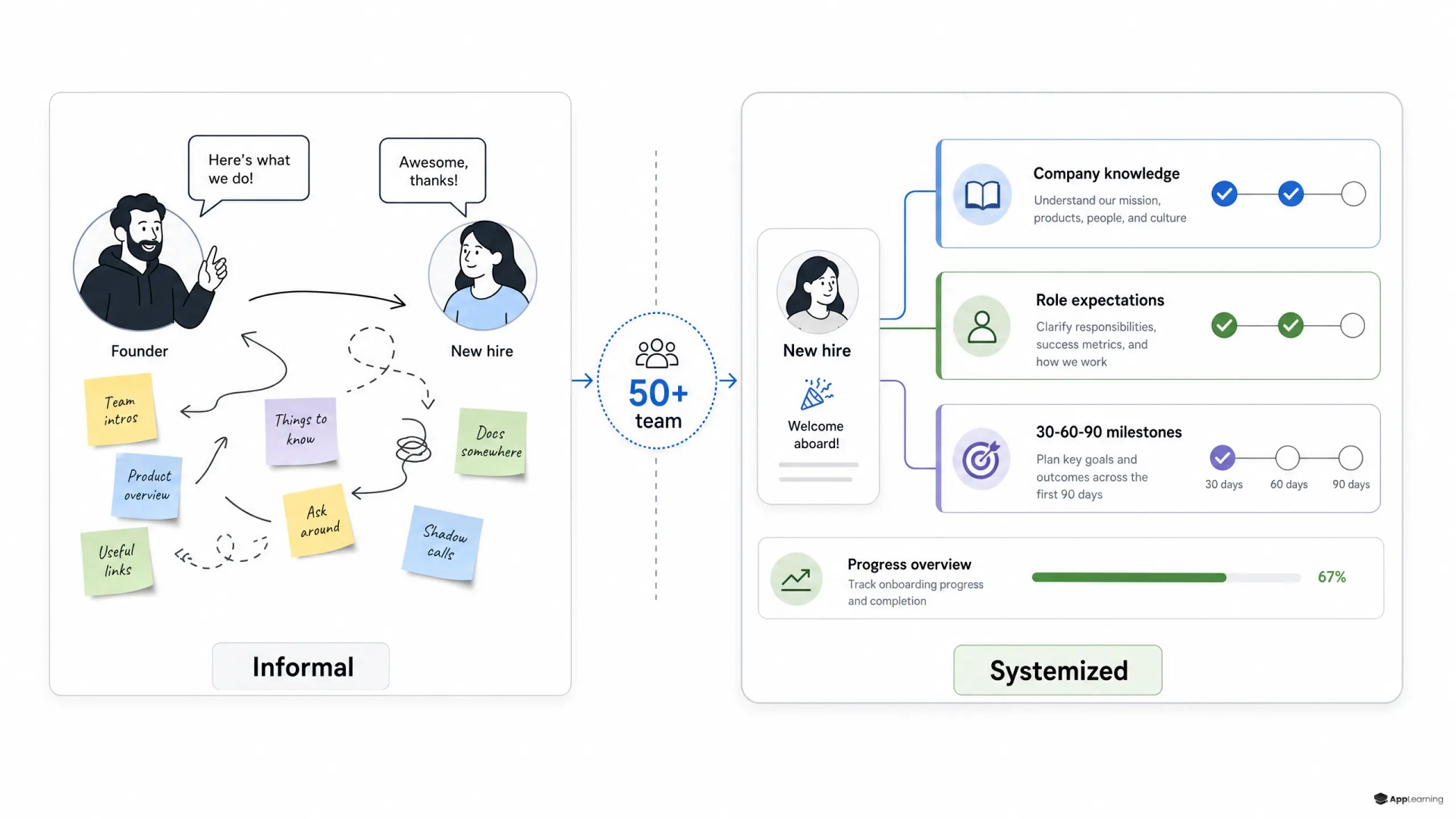
Structure that keeps startup speed
Founders often resist onboarding structure because they associate it with corporate drag. That is a false choice. Good structure removes drag. It turns repeated explanation into reusable learning. It turns vague expectations into visible milestones. It turns “ask someone” into “start here, then ask better questions.”
The format should stay light. Use short modules, role tracks, checklists, quizzes, and applied tasks. Keep the language close to the work. Do not create content for content’s sake. Every unit should help the new hire do something sooner, avoid a known mistake, or understand a decision faster.
The best test is simple. If five new hires joined next month across sales, product, customer success, and operations, would each receive the same core company context and a role-specific path without the founder rebuilding the week by hand? If not, the onboarding system is still too informal.
Good to know
When should a startup formalize onboarding?
Start before hiring volume creates visible inconsistency. A good trigger is when new hires depend on different managers for the same basic company context.
Does structured onboarding slow a startup down?
Not if it is built around short learning paths, real work, and clear milestones. The wrong structure adds meetings. The right structure removes repeated explanations.
What should founders document first?
Document the knowledge that affects early productivity: company context, role expectations, decision rules, customer understanding, tool workflows, and first milestones.
Can onboarding stay personal at 50-plus people?
Yes. Repeatable content should handle the basics, while founders and managers focus on live conversations, feedback, relationships, and judgment.
A lean academy beats another folder
A folder of documents is not an onboarding system. It stores information, but it does not sequence learning, confirm understanding, or show where people get stuck. This is where a lean internal academy becomes useful for growing startups.
App-Learning supports this layer by turning existing source material into short, structured learning paths. The platform supports microcourses, role-based tracks, quizzes, certificates, and progress analytics, so a startup can professionalize onboarding without hiring a full L&D team or building a custom system.
The operational point is not to make onboarding look polished. It is to make knowledge transferable. Founders and senior experts should spend less time repeating basics and more time handling judgment, feedback, and edge cases.
Build onboarding your managers can actually sustain.
TalkThe metrics that expose the system
After 50 people, onboarding should be measured like an operating system. SHRM recommends time-to-productivity, retention, new-hire surveys, engagement, performance measures, and informal feedback as practical onboarding success measures. For startups, the most useful metrics are the ones that reveal friction early.
- Days to first meaningful output.
- Completion of core company and role modules.
- Manager time spent on repeated explanations.
- New-hire confidence at day 14, 30, and 60.
- Missed expectations caused by unclear context.
- Early retention and probation success by cohort.
These numbers should not become bureaucracy. They should tell founders where the system leaks. If hires complete the modules but still miss priorities, the content is too abstract. If managers still repeat the same explanations, the knowledge base is incomplete. If ramp time varies wildly by manager, expectations are not clear enough.
Startup onboarding still works at 50-plus people when it becomes a product of the company, not a side effect of proximity. The goal is not to remove the personal parts. The goal is to protect them. When the basics are repeatable, founders and managers can use their scarce time where it matters most: judgment, trust, feedback, and the transfer of real operating standards.