

Key takeaways
- Training completion is not the same as field readiness.
- Fragmented product and process knowledge creates inconsistent sales execution.
- Sales onboarding needs sequencing, checks, refreshers, and campaign loops.
- Mobile-first delivery matters when agents work on low-end phones.
- Readiness metrics expose weak onboarding before sales performance drops.
The paper version of onboarding hides the real gap
Sales onboarding often looks complete in the dashboard. The agent signed up, watched the product video, opened the PDF, joined the WhatsApp group, and passed through a manager briefing. On paper, the business has delivered training. In the field, the agent still hesitates before the first customer conversation.
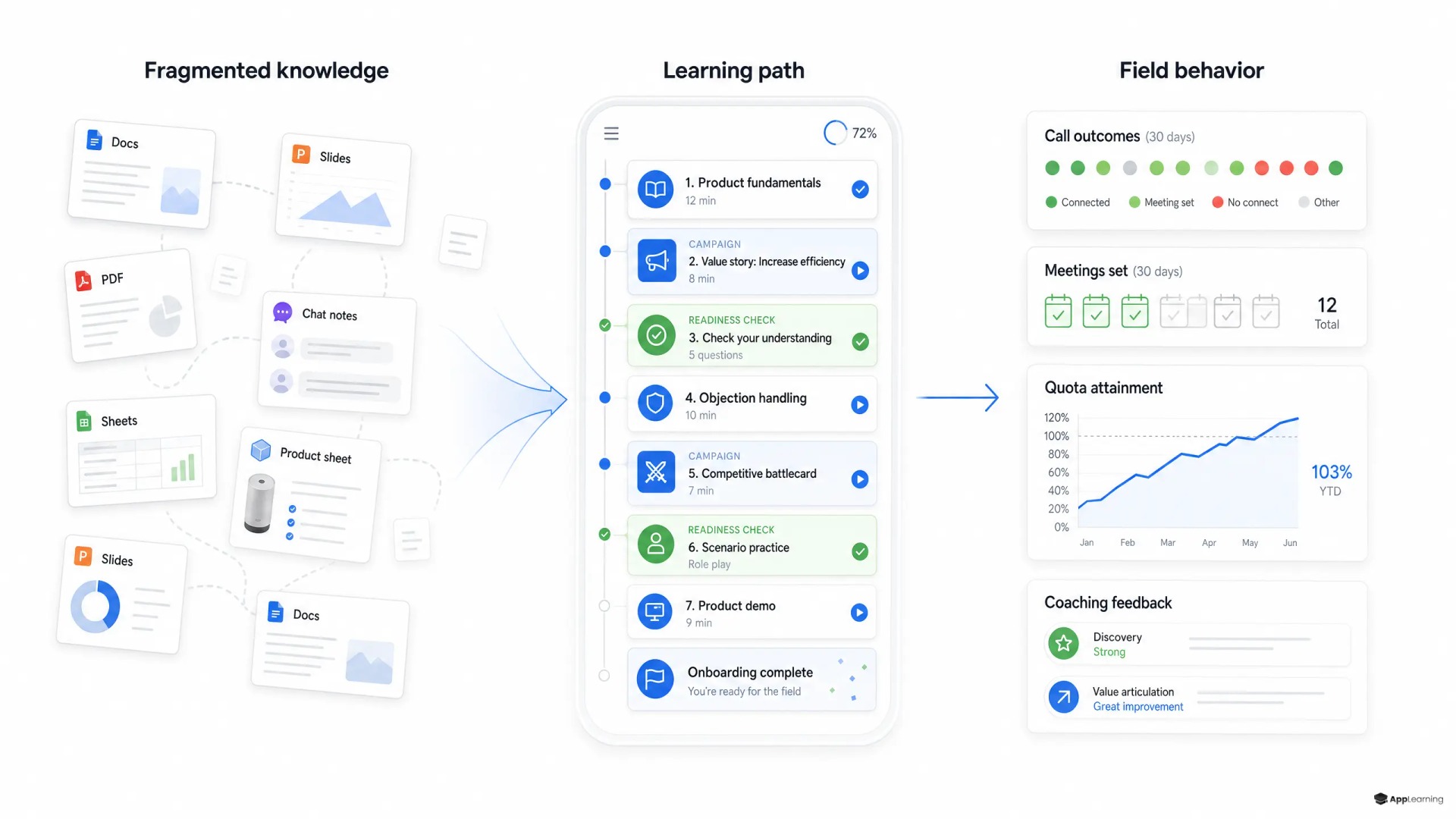
The problem is not always content quality. It is system quality. Product knowledge sits with product teams. Tariff changes sit in campaign decks. Compliance rules sit in policy files. Sales tips sit with experienced managers. Operational steps sit in the CRM, stock system, payment process, or support chat. A new agent has to assemble the job from fragments.
That is why sales onboarding fails before leaders see it in revenue. The Sales Management Association research brief on salesperson onboarding links onboarding effectiveness with structure and consistent application. For a field sales business, that means the path matters as much as the content.
Fragmented knowledge turns into local sales behavior
Fragmentation does not stay inside headquarters. It becomes regional behavior. One manager explains the product benefit one way. Another focuses on price. A third skips the objection script because the team is under pressure to activate fast. Agents copy what is nearest, not what is best.
- A prepaid agent sells the old bundle because the new promotion reached the chat group late.
- A telecom agent cannot explain the difference between two tariff options.
- A first-time seller knows the commission but not the customer qualification step.
- A region reports high activity but low first-sale conversion because agents are active before they are ready.
- Support volume rises because agents ask the same setup and campaign questions again and again.
This is not a people problem. It is an operating model problem. Field sales onboarding must reduce variation before it reaches the customer. If every agent learns in a different sequence, from different files, with different checks, sales quality will vary by region, manager, and day.
First customer contact needs a guided path
A new agent does not need a library. They need the next correct step. Before the first customer interaction, the path should connect registration, KYC or compliance duties, wallet or payment readiness, stock ordering, product explanation, objection handling, and the first sale process.
This sequence is especially important in field sales onboarding because many agents are temporary, part-time, independent, or new to selling. They may work on low-end Android devices, switch locations during the day, and learn between transactions. A desktop LMS, a long PDF, or a one-off classroom session assumes conditions the field does not have.
The useful unit is small and operational. One lesson explains one product point. One quiz checks one risk. One refresher updates one campaign. One task moves the agent closer to the first sale. That is how product knowledge becomes agent sales readiness.
Readiness checks beat completion data
Completion data tells leaders that content was reached. It does not prove that the agent can sell. The Kirkpatrick model separates training evaluation into reaction, learning, behavior, and results. Field teams need the same discipline. A video view is not behavior. A passed readiness check is closer. A successful first sale with low support dependency is closer still.
Readiness checks should be placed before risk, not after failure. If a campaign has a new price, rule, or eligibility condition, agents should pass a short check before they receive the campaign script or incentive. If a product has compliance exposure, certification should gate access. If a region fails the same questions, the refresher should target that gap instead of broadcasting another generic update.
Refreshers matter because memory decays and offers change. Research on the distributed practice effect supports the use of spaced practice over massed learning for retention. In sales operations, that means onboarding should not end after day one. It should continue through campaign updates, objection practice, and short retrieval checks in the weeks when agents start selling.
Good to know
How is sales onboarding different from product training?
Product training explains the offer. Sales onboarding connects the offer with setup, process, compliance, objection handling, first sale behavior, and readiness checks.
Which metric best shows agent sales readiness?
No single metric is enough. The strongest view combines quiz performance, certification status, time to first sale, support dependency, and early conversion by cohort.
Why does field sales onboarding need mobile-first design?
Field agents often learn on low-end phones during the workday, so training must be short, lightweight, easy to resume, and close to the sales workflow.
Where do campaign updates fit in onboarding?
Campaign updates should work like mini-onboarding paths with short explanations, checks, and eligibility logic before agents sell the new offer.
Mobile delivery is part of the system design
Mobile-first is not a cosmetic requirement. It decides whether the system is used. If agents must leave the sales app, download heavy files, search folders, or spend data on long videos, training becomes optional in practice. The design must fit the phone, the bandwidth, the language mix, and the attention span of the workday.
App-Learning supports this model through role-based learning paths, microlearning modules, quizzes, certificates, gamified mechanics, and analytics. The practical move is to turn product docs, campaign notes, tariff sheets, compliance rules, and manager know-how into short mobile steps that agents can complete inside or alongside the existing field workflow.
This matters most when campaigns change fast. A product launch is not finished when headquarters publishes the announcement. It is finished when the right agents understand the offer, pass the check, explain the value, avoid the known mistakes, and start selling with less support dependency.
Build agent readiness into the field app.
TalkEarly metrics expose weak readiness
Leaders should not wait for monthly sales reports to discover weak onboarding. The better signals appear earlier. They show whether knowledge has moved from the system into the field.
- Time from registration to first completed onboarding step.
- Time from signup to first successful sale.
- Quiz pass rate by product, region, manager, and cohort.
- Failed questions by campaign and language.
- Certification status before campaign access.
- Support tickets per new agent in the first seven days.
- Drop-off points in registration, stock ordering, payment setup, and product training.
- Sales conversion by onboarding cohort, not only by region.
These metrics connect readiness with real sales behavior. They show whether a cohort is stuck before payment setup, whether a campaign explanation is unclear, whether a region is over-relying on support, or whether agents are active without being prepared.
The goal is not more training. The goal is a repeatable path from signup to confident selling. When knowledge stays fragmented, every new agent has to build that path alone. When the path is sequenced, checked, refreshed, and visible, sales onboarding becomes an operating system for consistent field execution.