
Key takeaways
- Mobile training must be designed for constrained environments from day one.
- Low connectivity changes content length, media use, sync logic, and UX.
- Short modules and lightweight updates protect completion in the field.
- Readiness checks work best when they connect directly to selling permission.
The field breaks desktop assumptions
A lot of mobile training for sales agents fails before the first lesson opens. The content may be correct. The LMS may have tracking. The campaign deck may be approved. But the system assumes the wrong world: stable data, modern phones, enough storage, quiet time, and a learner who can return later without losing progress.
Field sales does not work like that. An agent may be standing outside a kiosk, moving between customers, borrowing Wi-Fi, using prepaid data, or sharing a low-end Android phone with other apps competing for space. The learning moment is often a two-minute gap before a sale, not a planned training session.
That changes the design target. Training is not a library. It is operational infrastructure. It must help an agent activate, understand the current offer, answer the next customer question, pass the required check, and move toward the first successful sale.
The device is part of the learning design
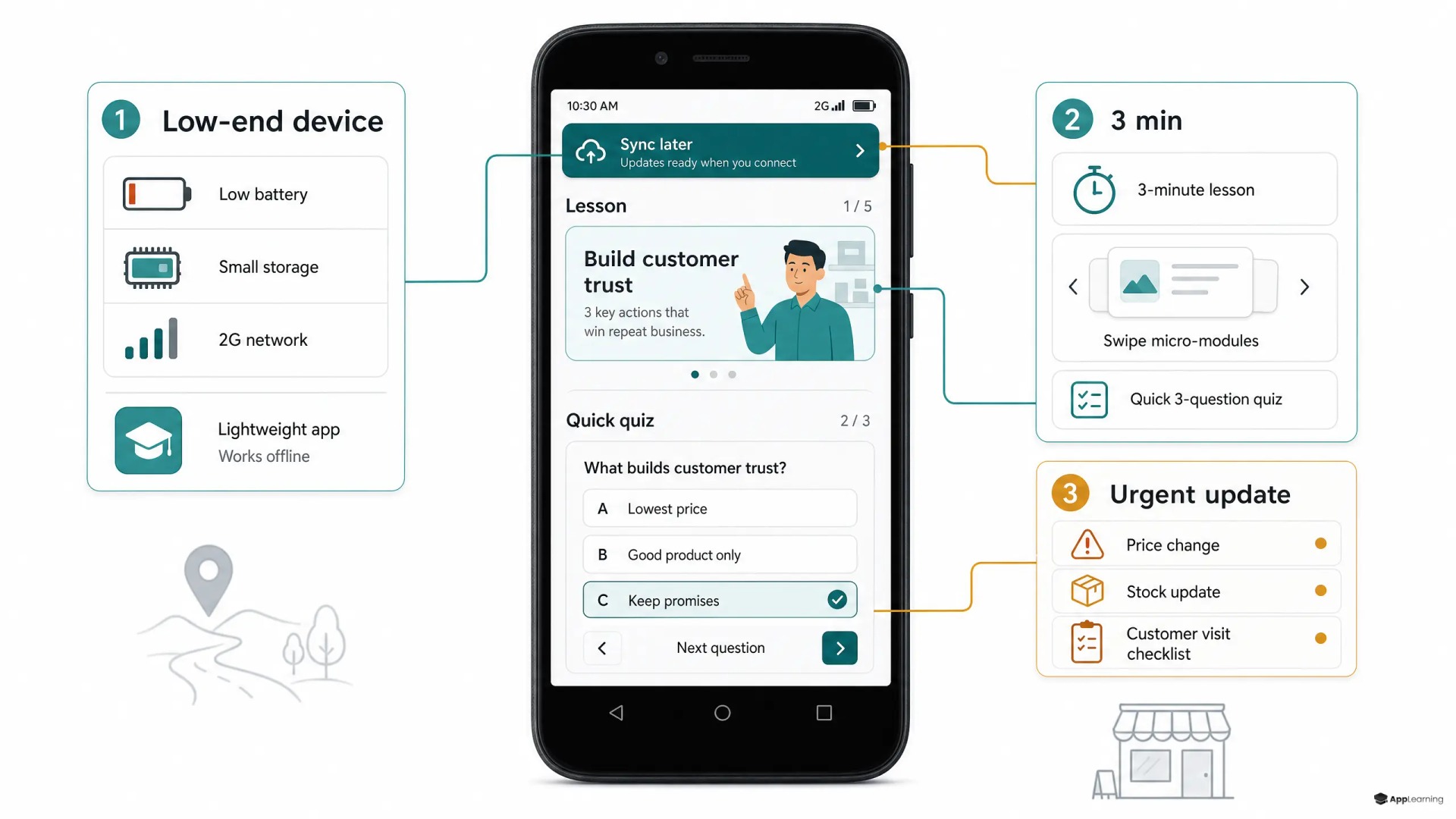
The low-end Android device is not just a delivery channel. It is a design constraint. Google’s Android guidance notes that users often avoid apps that seem too large, especially in emerging markets with spotty 2G or 3G networks and data limits. For field agents, every megabyte competes with WhatsApp, payment tools, customer photos, the field app, and personal storage.
- Keep the initial app footprint small.
- Compress images and avoid mandatory video by default.
- Cache core onboarding, product cards, and readiness checks locally.
- Use text-first content with optional media, not media-first lessons.
- Make sync status visible without forcing the agent to understand technical errors.
- Ship language packs and campaign content in small bundles, not full-course replacements.
A low connectivity training app should read locally first and sync when it can. Android’s guidance for products built for billions recommends teams optimize for low-speed connections and offline working by storing data, queuing requests, and adapting media to network quality. The same logic applies to training. If the agent opens the app with no signal, the next useful action should still load.
Lessons must fit the selling moment
Off-grid agent training should not be built from long compliance modules cut into smaller pieces. It should start from the field action. The lesson exists because the agent must complete registration, order stock, explain a tariff, sell a bundle, handle a rejection, or follow a compliance rule.
UNICEF’s work on digital learning found that offline content was critical even in settings where internet usage was relatively high, because available connectivity was not strong enough for real use at scale. The lesson for sales operations is clear: do not treat offline as a fallback mode. Treat it as the base mode.
- One concept per module.
- A short explanation in plain language.
- A realistic customer conversation or field example.
- One current product or tariff fact.
- One quick check to confirm readiness.
- A clear next step inside the sales workflow.
For teams with mixed literacy and language backgrounds, the interface matters as much as the lesson. Use short sentences. Avoid abstract labels. Show the next task first. Support local languages. Reinforce with icons, audio, or simple dialogue where it helps. The goal is not to make training feel rich. The goal is to make the agent ready to sell correctly.
Updates need a smaller blast radius
Field sales changes fast. Prices shift. Promotions expire. Commission rules change. Compliance wording gets updated. If every change requires a full course rebuild, agents will either learn late or ignore the system.
The better pattern is modular content. A tariff card, campaign pitch, objection response, setup checklist, and readiness question should be separate content objects with version control. Operations teams should be able to update one object, publish it to the right region or agent group, and let the app sync only what changed.
Certification must follow the same rule. A readiness check for a new campaign should not require a heavy exam if the business risk is narrow. Three focused questions, a short scenario, or a required acknowledgement may be enough. Offline mobile training should store completion locally, apply simple unlock rules on the device, and sync evidence when the connection returns.
Good to know
Should sales agents use a separate training app or embedded training?
Embedded training is usually better when agents already work inside a field app. It reduces switching, keeps learning close to the sales task, and allows readiness checks to connect with product access, CRM status, and rewards.
How short should field training modules be?
Most field modules should take two to five minutes. The right length depends on the task, but each module should teach one action and end with a clear next step.
Can certification work without stable internet?
Yes. The app can store questions, rules, attempts, and completion status locally. Results can sync later when the device reconnects, while the agent still sees local progress.
Which content should be available offline first?
Core onboarding, registration steps, current product cards, tariffs, campaign pitches, compliance rules, objection handling, and first-sale checklists should be available before nice-to-have learning content.
App-Learning builds for operational urgency
At App-Learning, we treat field training as part of the operating system for agent productivity, not as a separate education layer. The training experience should sit close to onboarding, CRM, rewards, support, and sales tasks, because agents do not experience those systems separately in the field.
This is where mobile training becomes useful for CEOs and COOs of field agent businesses. The question is not whether agents completed a course. The question is whether the system helped more agents activate, sell the right product, explain it with confidence, and stay aligned when the market changes.
- Cache the first-sale path so new agents can progress without reliable data.
- Push campaign updates as lightweight content, not as new manuals.
- Connect readiness checks to product access, rewards, and supervisor visibility.
- Use AI-supported content workflows to turn new product information into simple field lessons quickly.
- Track progress in the systems operations teams already use.
This is also where a generic LMS usually breaks. It reports training activity, but it does not reduce field friction. A sales-ready learning system has to reduce the support load, simplify onboarding, and make readiness visible before performance problems appear.
Build field training that works where agents sell.
TalkThe rollout test is the real design review
Before rollout, test the training on the weakest common device in the weakest common region. Use prepaid data. Fill the phone storage. Turn the signal off. Ask a new agent to install, open, learn, pass a check, find the current offer, and complete the first sales task.
- The app installs without deleting essential apps.
- The next task loads with no signal.
- A module can be completed in under three minutes.
- A readiness check records offline and syncs later.
- A campaign update reaches the agent without a full app release.
- A supervisor can see who is blocked and why.
If training only works on headquarters Wi-Fi, it is not field training. Mobile training for sales agents works when it respects the real operating environment: constrained devices, unstable connectivity, short attention, urgent updates, and direct commercial consequences. The winning system is smaller, faster, clearer, and closer to the sale.