

Key takeaways
- Difficult features need adoption design, not just release notes.
- Users need explanation, sequencing, and proof before high-friction actions.
- Contextual education bridges the gap between awareness and confident use.
- Adoption strategy should reflect hesitation, not only roadmap priorities.
A product adoption strategy for a hard feature starts with a blunt assumption. Availability is not adoption. The user may want the outcome, but still avoid the action because the concept is unclear, the downside feels large, or the product asks for trust before it has earned it.
Adoption fails when understanding arrives late
In fintech, the gap is normal. Users meet risk language, identity checks, account linking, wallets, transfer rails, tax terms, interest logic, and automated decisions inside flows that also ask them to move money. The OECD warns that digital financial literacy may not be sufficient for safe and informed use of digital financial services, which means confusion is not an edge case. It is part of the market.
The adoption problem is often not feature quality. It is explanation quality. Teams ship the feature, announce it, add a tooltip, and expect usage to follow. But the user is still asking simpler questions. What is this? Why now? What happens if I make a mistake? Can I undo it? Who protects me? Until those questions are answered, the safest action is no action.
Confusion changes the risk profile
Confusion does not only lower conversion. It creates operational drag. Users pause, retry, contact support, ignore lifecycle messages, or use the feature incorrectly. The World Bank describes product-information risks as higher in digital channels when space, format, or interface choices reduce comprehension. That is a product problem, not only a compliance or content problem.
This is sharper in crypto, investing, credit, insurance, open banking, and regulated software. A user may understand the button but not the consequence. Crypto custody, network selection, staking, automated portfolio rebalancing, BNPL repayment terms, credit limit changes, and data-sharing consent all require more than discoverability. They require confidence.
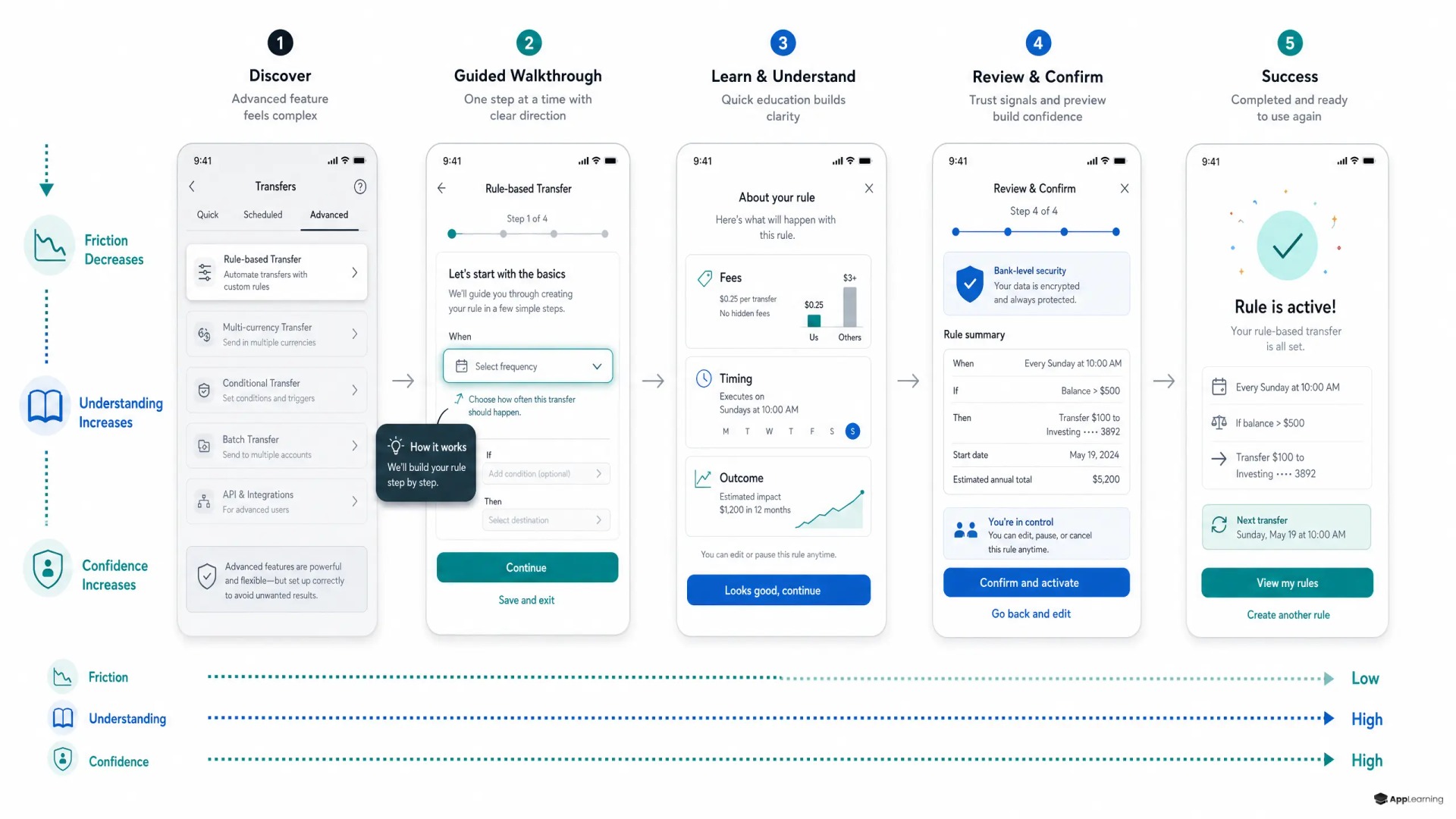
Teach before the heavy click
Advanced features need staged exposure. Nielsen Norman Group’s work on progressive disclosure makes the principle clear. Show the core path first, reveal complexity when the user is ready, and avoid making novices scan options they cannot yet evaluate.
- Start with the user job, not the feature name.
- Explain the concept before asking for commitment.
- Show risk, cost, reversibility, and expected timing before the action.
- Use small checks for understanding before irreversible steps.
- Trigger education from behavior, not from a generic launch campaign.
- Let users return to the lesson when hesitation appears again.
Context matters. Generic tutorials are easy to skip because they interrupt the task. NN/g’s guidance on help and documentation favors timely, task-relevant help over broad pushed explanations. In adoption terms, this means the best learning moment sits near the decision point, not in a help center five clicks away.
Good to know
How is adoption education different from onboarding?
Onboarding helps a user start. Adoption education helps a user understand a specific feature well enough to use it correctly, especially when the feature involves risk, money, data, or compliance.
Where should teams place education for complex features?
Place education near the decision point. Use short explanations before commitment, deeper lessons for users who need context, and reinforcement after the first successful action.
Which metric best proves education improves adoption?
No single metric is enough. Pair comprehension, first successful use, repeat use, retention, and reduced support demand to see whether education changed behavior.
Metrics must track confidence, not noise
Complex feature adoption cannot be measured by impressions and clicks alone. Those numbers show exposure, not understanding. A better measurement system separates awareness, comprehension, qualified action, correct usage, repeat usage, and support burden.
- Eligible-user exposure to the feature
- Lesson or explainer completion near the feature
- Comprehension checks before high-friction actions
- Start-to-success rate for the full workflow
- Cancel, retry, error, and support-contact rates
- Repeat usage after the first successful action
- Retention lift among educated users versus uneducated users
The key is segmentation. A low adoption rate among all users may be fine if only a narrow group is ready. A low adoption rate among users who reached the trigger moment is a warning. That is where education, UX, pricing, risk language, or trust signals need work.
Build education into the moments where users hesitate.
PlanThe product journey becomes the classroom
Features that need guided adoption support usually share one pattern. The user must build a mental model before the product can create value. Examples include recurring investment plans, crypto savings products, multi-currency transfers, card controls, business lending workflows, fraud settings, account aggregation, portfolio analytics, insurance coverage changes, and tax reporting tools.
App-Learning works on that operating layer. The platform turns subject matter into short lessons, quizzes, guided paths, progress data, and product entry points. In the Invity Bitcoin Academy case, education was embedded into the app so users could learn core Bitcoin concepts inside the product journey instead of leaving the experience to decode static content elsewhere.
The strongest adoption systems do not ask users to become experts. They reduce the amount of uncertainty needed for the next good action. That is the real job. A complex product earns adoption when it teaches at the moment of hesitation, proves the next step is safe enough, and lets confidence compound through use.