

Key takeaways
- Adoption begins before usage metrics appear in dashboards.
- Users move faster when the next meaningful action is clear.
- Onboarding, in-app education, and lifecycle guidance need one operating model.
- Feature exposure creates awareness, not sustained product adoption.
Most product adoption plans start too late. Teams watch for login, click, or feature-view events, then try to push discovery inside the product. By then, the user has already made important judgments about effort, risk, and trust. In fintech, that judgment is sharper because the first real action may involve identity, money movement, permissions, tax exposure, or market risk.
Adoption starts in the first decision
A strong product adoption strategy begins before the first feature click. It sets expectations about what will happen, why information is needed, what the user should do next, and how success will show up. The FCA’s consumer understanding guidance is useful here because it treats communication design, testing, monitoring, and governance as one end-to-end process. Product teams should take the same view of adoption.
Feature exposure is not adoption
Feature exposure tells you that a user saw something. Adoption tells you that the user changed behavior and repeated a valuable action. A crypto user who sees staking, a treasury user who opens a forecast screen, or a banking user who views card controls has not adopted anything yet. Adoption begins when the user completes a meaningful action and understands why it matters.
- Feature seen
- Feature tried
- First successful outcome
- Repeated value event
- Related workflow becoming habitual
Education becomes infrastructure
Onboarding should not be a front-loaded lecture. It should route the user to the smallest valuable action. In-app education should explain the concept at the decision point, not five screens earlier. Lifecycle guidance should bring users back to the same value path with consistent language. This is where progressive disclosure matters: Nielsen Norman Group describes it as a way to focus novice users on useful features while deferring complexity until it is needed.
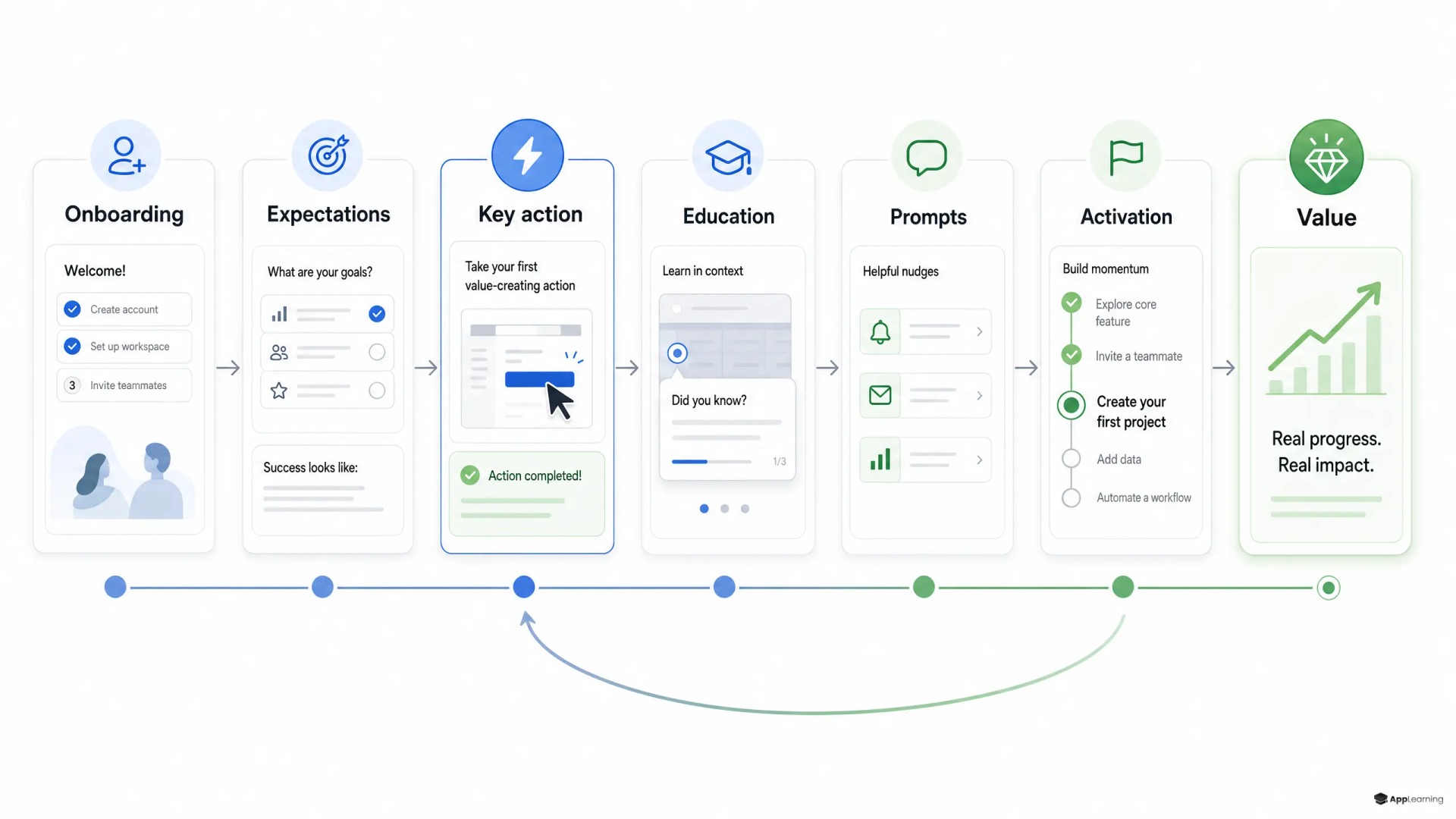
Signals that show movement
Adoption improves when users understand the next step and trust the path. Product, growth, content, and CX teams should measure that directly, not infer it from page views.
- Drop-off before the first meaningful action
- Time from signup to first value
- Comprehension checks at high-risk steps
- Help searches and support contacts by journey stage
- Repeat use of the core workflow
- Activation lift among users exposed to education
Good to know
When should a product adoption strategy begin?
It should begin before the first feature click, with expectation-setting, trust-building, and a clear next meaningful action.
How is adoption different from feature discovery?
Discovery means a user saw or opened a feature. Adoption means the user gained value from it and repeated the behavior.
Which teams should own adoption education?
Product should define the value path, Growth should test movement, Content should shape clarity, and CX should feed back real user confusion.
Complex products need sequenced confidence
Financial products are not hard only because interfaces are dense. They are hard because users must build a mental model while making consequential choices. The OECD reports that average digital financial literacy scores remain below the level needed for safe and informed use of digital financial services across surveyed economies. That means many users are learning the product and the category at the same time.
Good adoption systems do not remove all depth. They sequence it. A lending product can explain affordability before repayment mechanics. A wallet can explain custody before advanced trading. A business banking tool can show one useful cash-flow action before asking for full configuration. The goal is not to make users feel busy. The goal is to make them feel able.
Build adoption around the first value moment.
PlanEducation tied to activation outcomes
This is the App-Learning angle. User education becomes a growth lever when it is modular, embedded, and instrumented. For fintech teams, that means turning complex topics into onboarding steps, in-app moments, and lifecycle messages that are connected to activation, trust, and retention. The output is not more content. It is a learning system that moves users toward value.
The best product adoption strategy is a sequencing system. It aligns promise, trust, instruction, action, and proof. The product feels simpler not because it is less capable, but because it asks for the right decision at the right time.