

Key takeaways
- Fast onboarding still needs sequencing, structure, and clear ownership.
- Agents need confidence from practice, not only instructions.
- Readiness checks should happen before first field execution.
- A mobile academy makes field sales onboarding repeatable across regions.
Speed without sequence creates noise
Fast-moving sales teams often use a simple logic. Recruit the agent, register the account, send product information, add the agent to a chat group, then push for the first transaction. It feels fast because the agent is technically active. It is slow because every missing step comes back as support calls, failed stock orders, wrong customer promises, and uneven execution across regions.
Great sales onboarding does the opposite. It gives agents the right knowledge in the right order. Access before selling. Stock before pitch. Product fit before objection handling. Compliance before campaign launch. Speed comes from removing ambiguity, not from removing structure.
The first week needs a fixed operating path
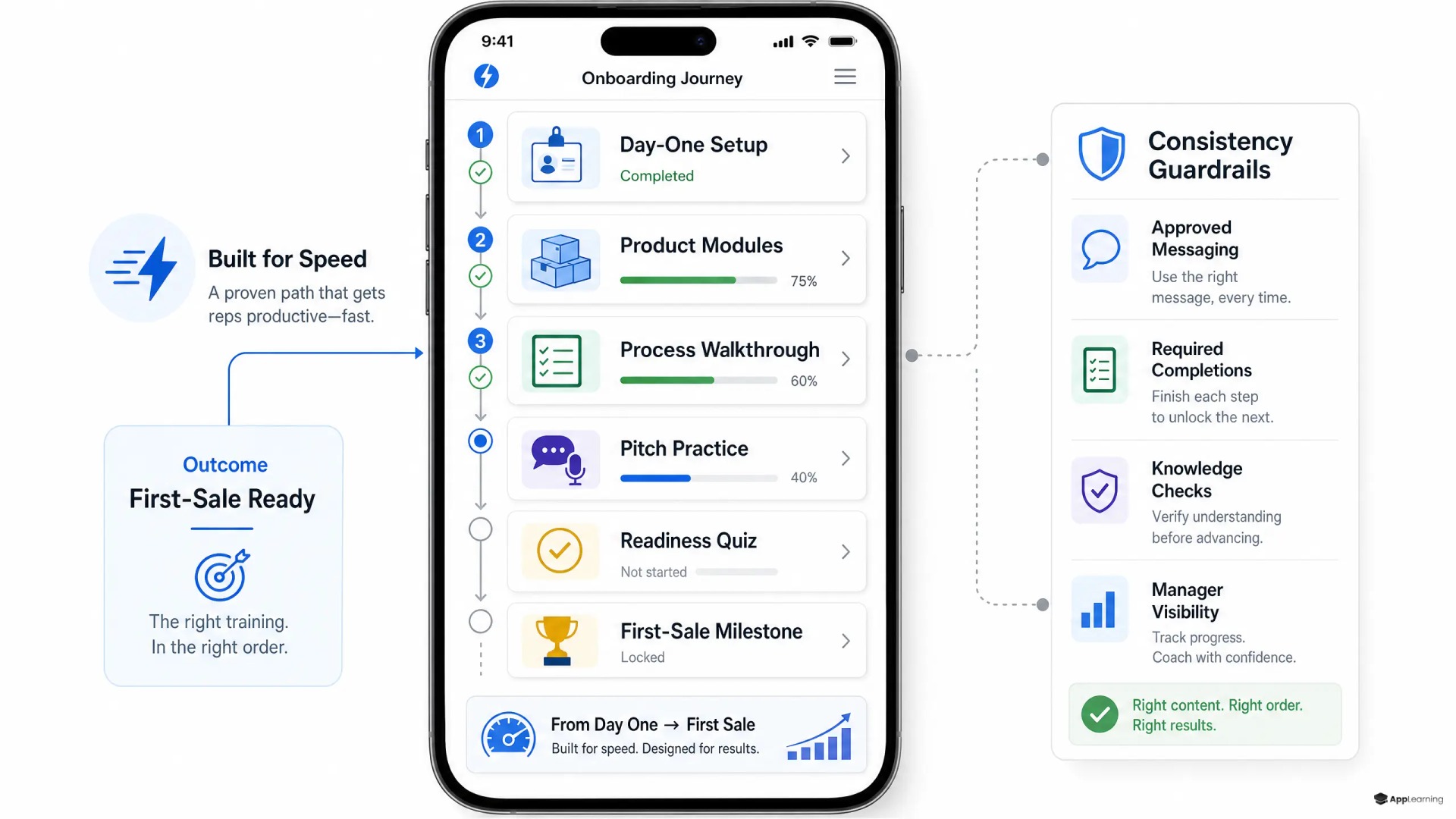
The first days should not be a content dump. They should move the agent from signup to first successful sale through a short path that mirrors the real job. This is one of the sales onboarding best practices leaders often skip when growth pressure rises.
- Confirm identity, account access, device readiness, and payment setup.
- Explain the core product offer before tariff exceptions and edge cases.
- Show how stock is ordered, activated, tracked, and paid for.
- Teach one simple customer conversation before advanced selling techniques.
- Simulate the first sale before sending the agent into the field.
- Certify product, process, and compliance readiness before campaign access.
This order matters because new agents are usually not failing from lack of information. They fail because the information arrives in the wrong sequence, in the wrong format, and without a clear next action.
Confidence comes from safe practice
Instructions create awareness. Practice creates confidence. A Frontiers review of retrieval practice describes how actively recalling information usually improves long-term retention more than restudying the same material. For sales onboarding, that means agents should answer, choose, speak, and simulate before they sell.
Readiness checks should be practical. Can the agent explain the offer in local language? Can they choose the right bundle for a customer scenario? Can they complete a mocked registration? Can they identify a compliance risk? These checks are not school tests. They are operational gates that protect revenue, brand trust, and customer experience.
Distributed teams need a mobile academy
Field sales onboarding has harder constraints than office onboarding. Agents may use low-end Android devices, weak connectivity, expensive data, and shared support channels. The GSMA’s State of Mobile Internet Connectivity 2024 highlights device affordability, digital skills, data affordability, and connectivity experience as barriers to stronger mobile internet use.
That reality changes the design. A heavy LMS, long video library, or desktop portal will not reach the field reliably. A mobile academy should use small modules, offline-friendly content, local language, icons, audio, simple quizzes, campaign cards, and embedded help inside the field app. UNESCO’s policy guidelines for mobile learning point to mobile technology’s value for immediate feedback and learning that can happen anywhere, which is exactly the operating pattern field teams need.
Good to know
How long should sales onboarding take in a field agent business?
It should be short enough to activate agents quickly and structured enough to prove readiness before field execution.
What should be certified before a new agent sells?
Core product knowledge, payment and stock process, customer pitch, registration flow, and campaign compliance should be checked first.
Why do legacy LMS tools fail in field sales onboarding?
They are often too heavy, too separate from the field app, and poorly suited to low-end devices and weak connectivity.
The academy becomes the operating layer
At App-Learning, we treat onboarding as part of the field operating system, not as a separate training project. The academy guides the agent from signup to first sale, updates tariffs and promotions in real time, checks readiness before new campaigns, and gives managers visibility into who is ready, stuck, or inactive.
AI-supported content systems can help turn product updates into short lessons, scenarios, and checks. But the control point stays human. Commercial, compliance, and operations teams still approve what goes live. The gain is speed with governance, not uncontrolled automation.
Build a mobile academy your agents can actually use.
TalkThe launch metrics expose the real bottleneck
Leaders should not judge sales onboarding by completion alone. Completion only says the agent reached the end of a path. The better question is whether the path produced field readiness and productive activity.
- Time from signup to verified account.
- Time from verified account to first stock order.
- Time from stock readiness to first successful sale.
- Readiness pass rate by region, product, and language.
- Retry patterns on product, process, and compliance checks.
- Support tickets per new agent cohort.
- Campaign update reach and certification before launch.
- Sales quality, complaints, and reversals after first sale.
Great sales onboarding is not a welcome journey. It is a control system for growth. When product, process, and pitch knowledge arrive in the right order, new agents activate faster, managers coach with evidence, and distributed teams execute with the same standard even when the market changes every week.