

Key takeaways
- Ramp time depends on clarity, not just hiring speed.
- Structured learning reduces repeated manager explanations.
- New hires perform faster when company context arrives in sequence.
- A startup learning platform makes onboarding measurable and repeatable.
Hiring velocity is not execution velocity
Many startups treat hiring as the bottleneck. Once the offer is signed, they expect output to follow. That works at ten people, when the founder, CTO, or first sales lead can explain the company in real time. It breaks at 50 people and above.
New hire ramp time in a startup is not mainly a motivation problem. It is a clarity problem. People need to know the product, the customer, the language, the decision logic, the tools, the quality bar, and the unwritten rules. The SHRM Foundation’s onboarding guide defines onboarding as helping new hires adjust to the social and performance aspects of the job so they can become productive contributors quickly. That does not happen through a folder of links and a welcome call.
The real drag hides inside informal knowledge
Slow ramp usually starts before the new hire starts. The company has knowledge, but it sits in people, Slack threads, old Notion pages, sales decks, product specs, and founder explanations. The new employee receives fragments. The manager fills the gaps. The same explanation happens again next month.
This creates three costs. First, the new hire waits for answers instead of doing useful work. Second, managers lose time to repeated context transfer. Third, onboarding quality depends on who happens to be available. Two people can join the same startup in the same role and receive a different version of the company.
A platform turns onboarding into an operating system
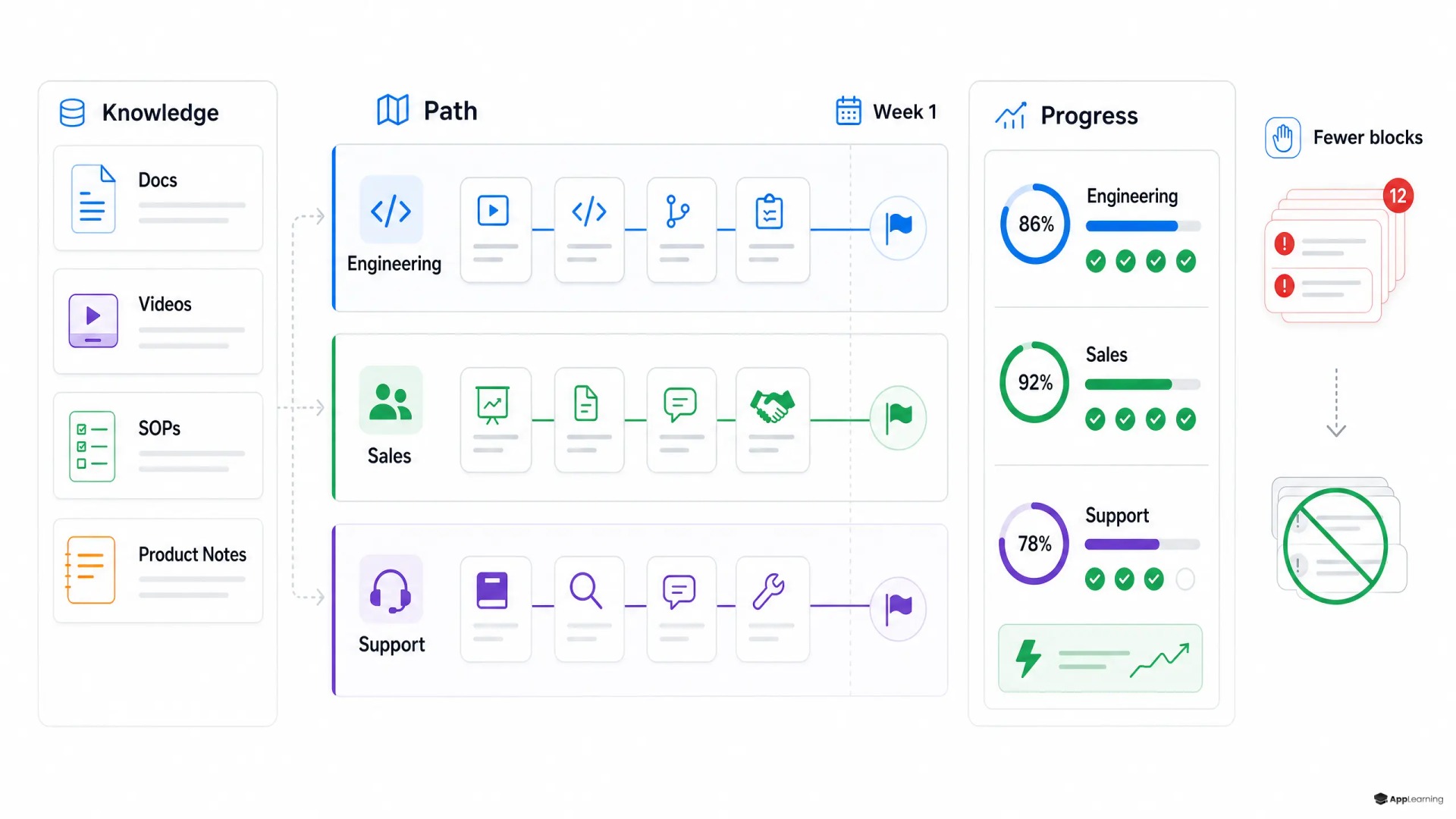
A startup learning platform is not a content library with a nicer interface. It is an operating system for context. It takes the knowledge a person needs and puts it into a role-specific sequence. The sequence matters because new hires cannot use advanced process detail before they understand the customer, the product logic, and how the company makes decisions.
A strong first 30 days usually includes a small number of structured paths:
- Company context and strategy in plain language
- Product, customer, and market basics
- Role-specific workflows and examples
- Tool setup and operating rituals
- First tasks with clear success criteria
- Checkpoints for questions, feedback, and proof of progress
Gallup argues that formal onboarding requires a structured curriculum, not just orientation tasks. For a startup onboarding platform, that means every module should answer one operational question. What does this person need to understand, do, decide, or practice next?
Manager support becomes targeted instead of repetitive
A platform does not remove the manager from onboarding. It removes the manager as the search engine. The manager should not spend week one explaining where the product roadmap lives, what the main customer segments are, or how a handoff works. Those answers should be available, sequenced, and checked.
The manager’s time should go into judgment, feedback, and calibration. Gallup found that when managers take an active role in onboarding, employees are 3.4 times as likely to feel the process was successful. The practical lesson is clear. Do not replace manager involvement. Protect it from low-value repetition.
Good to know
When should a startup introduce a learning platform for onboarding?
Usually when onboarding starts depending too much on managers or founders. A practical trigger is around 50 employees, multiple departments, or repeated hiring for similar roles.
Does a startup learning platform replace manager onboarding?
No. It should handle repeated context, standard knowledge, and progress tracking so managers can focus on coaching, feedback, and role-specific judgment.
What should be built first in a startup onboarding platform?
Start with one high-volume role. Build a 30-day journey covering company context, product knowledge, role workflows, first tasks, and checkpoints.
How can founders measure whether ramp time is improving?
Track time to first independent task, completion of core modules, repeated questions, manager readiness ratings, and the quality of early work.
The App-Learning pattern for lean teams
Most startups do not need a large L&D function. They need a simple way to convert existing knowledge into usable learning journeys. App-Learning approaches this as a systems problem. Start with the documents, decks, Looms, playbooks, and expert explanations the company already has. Break them into short modules. Add checks for understanding. Connect each module to an action the new hire must complete.
This is where AI-supported content systems help. They can turn long internal material into modular onboarding steps, draft quizzes, create scenarios, and surface gaps in the knowledge base. The human work is still essential. Leaders decide what matters, what good looks like, and where the journey should branch by role.
Make onboarding easier to run and easier to improve.
StartRamp time needs observable signals
If onboarding is a system, ramp time must be visible. SHRM’s onboarding process guidance highlights components such as preboarding, orientation, foundation building, and mentoring or buddy systems. Founders should translate those components into signals they can review without running a status meeting for every new hire.
- Time to complete core onboarding modules
- Time to first independent task
- Number of repeated manager questions
- Confidence score at days 7, 14, and 30
- Manager rating of role readiness
- Quality of first shipped work
- Gaps added back into the learning journey
The last metric is often the most important. Every onboarding cycle should improve the next one. If a new hire gets stuck, the system should capture the missing explanation. If three people ask the same question, the journey is incomplete.
Fast-growing startups do not scale by explaining the company live to every new employee. They scale by turning the best explanation into a repeatable path. A startup learning platform shortens ramp time because it makes context easier to find, easier to follow, and easier to improve. The result is not more training for its own sake. It is less confusion between hiring and real contribution.