
Key takeaways
- AI weakens content production as L&D’s main strategic claim.
- L&D gains influence by owning capability signals and knowledge flow.
- Regulated teams need structured learning tied to role readiness.
- Short role-based journeys prove more than large content libraries.
AI has changed the economics of workplace learning. A content-first L&D team used to solve a real bottleneck: business teams needed courses, scripts, videos, quizzes, and translations. Now a subject-matter expert can draft much of that material with AI. The new bottleneck is not production. It is judgment, governance, application, and proof.
That shift matters most in regulated finance and crypto environments. More content does not reduce risk by itself. The stronger AI in L&D strategy is to know which roles need which capability, where knowledge breaks down, and whether people are ready for the decisions their job requires.
The content factory loses its moat
The Transformation Triangle report, published by Eglė Vinauskaitė and Donald H Taylor in May 2026, builds on a three-year research programme into AI, workplace learning, and performance. It is based on interviews with senior L&D leaders across roughly 20 organisations and frames the core issue clearly: if AI is already part of work, L&D must reconsider its role.
A 19 May 2026 Learning News summary described the report as an argument that AI is accelerating the decline of content-led L&D functions. The point is not that content disappears. Policies, onboarding paths, product explainers, AML refreshers, and manager guides still matter. The point is that producing them is no longer enough to define the function.
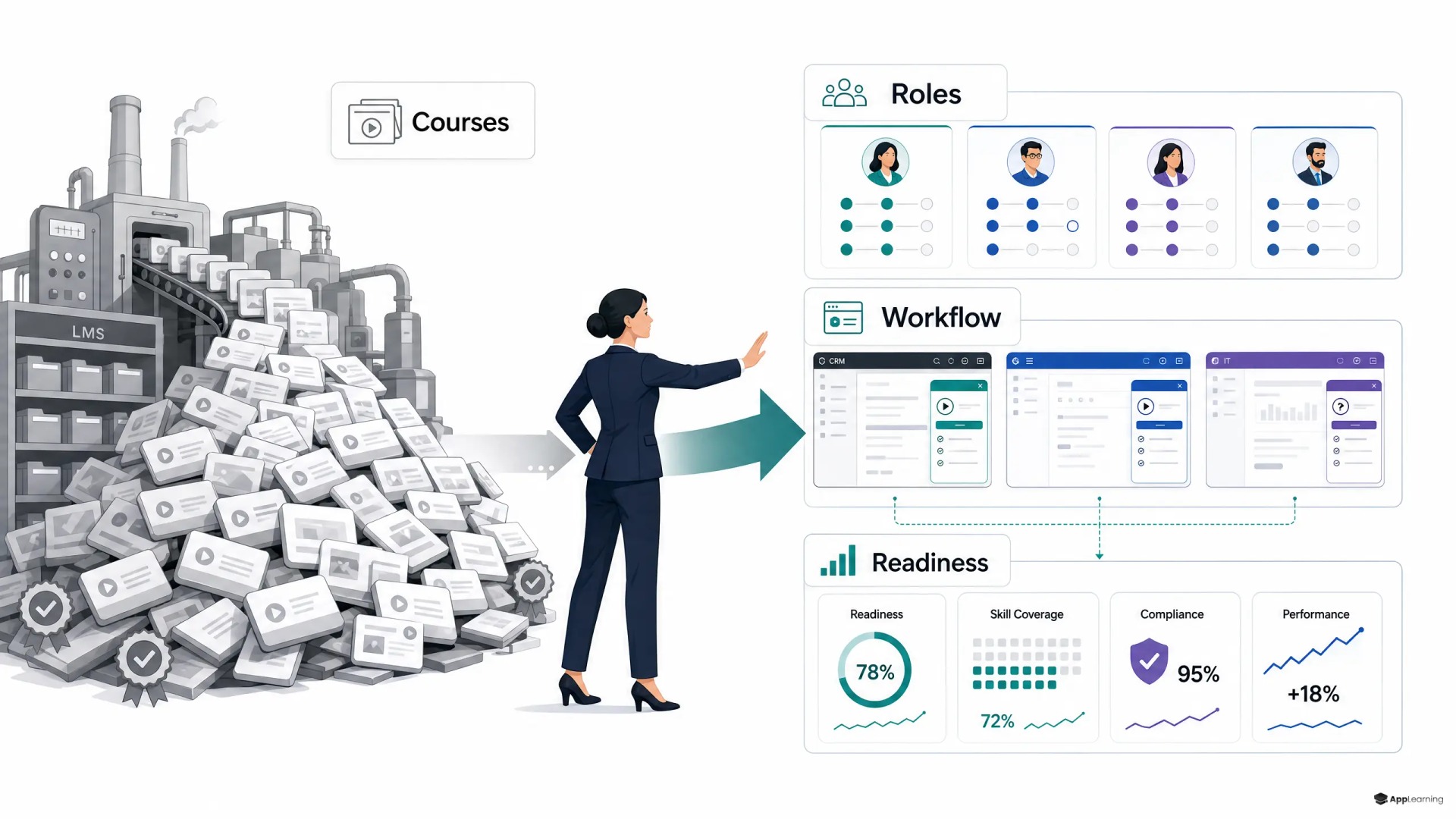
When production becomes cheap, the question changes. L&D must stop asking, “Which course should we build?” and start asking, “Which capability must be visible, repeatable, and auditable in this role?” That is the real L&D operating model shift.
Three roles replace the production queue
The Nodes framework offers three directions that move L&D beyond the training request queue. Together, they describe a more strategic workplace learning AI strategy:
- Skills Authority turns L&D into the owner of capability data, skill gaps, role expectations, and development signals.
- Enablement Partner makes internal expertise easier to find, package, share, and apply across teams.
- Adaptation Engine treats performance as a system problem, not as a default reason to assign training.
For a finance or crypto L&D lead, this is practical. A compliance analyst, customer support agent, fraud specialist, relationship manager, and product lead do not need the same learning path. They need different signals of readiness. They face different decisions. They create different risks when they misunderstand policy, customer context, transaction patterns, or escalation rules.
Regulation keeps structure but raises the bar
Regulated employers cannot abandon structured learning. FINRA Rule 3310 requires member firms’ anti-money laundering programmes to include ongoing training for appropriate personnel. That wording already points beyond generic annual modules. The training has to fit the people whose decisions affect the control environment.
Completion data is necessary, but thin. It proves exposure. It does not prove that an employee can spot a suspicious pattern, explain a customer risk profile, apply a new custody process, or escalate a sanctions concern. Role-based workforce readiness needs richer evidence: scenario responses, quiz outcomes, confidence signals, manager checks, renewal status, and gaps by team or region.
Readiness is built in moments
The unit of design should not be the course library. It should be the moment where weak knowledge creates cost, risk, delay, or poor customer outcomes. Common moments include first-week onboarding, a new product launch, a policy change, a failed QA check, a fraud trend, a regulatory update, or a manager preparing someone for a higher-risk workflow.
Each moment needs five parts: a clear role expectation, approved source material, a short learning or practice activity, evidence of understanding, and a feedback loop. AI can help convert source material into drafts, examples, summaries, and checks. Human owners still decide what is correct, what is material, and what counts as ready.
Good to know
Does AI make L&D teams less necessary?
No. It makes content production less defensible as the main value of L&D. The higher-value work is capability design, governance, enablement, and measurement.
Should regulated companies still use structured courses?
Yes. Structured learning remains important for onboarding, compliance, and audit evidence. The difference is that courses should map to roles, risks, and readiness signals.
What should L&D measure beyond completions?
Measure assessment quality, scenario performance, knowledge gaps, renewal status, confidence, manager validation, and readiness by role, team, and region.
Where does App-Learning fit into this model?
App-Learning helps turn approved knowledge into short, role-based journeys with quizzes, certificates, analytics, and rollout control for regulated teams.
Execution lives close to work
This is where the App-Learning angle is operational. App-Learning’s employee learning platform is built around role-aligned learning paths, short lessons, assessments, progress tracking, and team readiness views. That matters because the strategic model only works when it becomes a repeatable operating layer, not a slide in an L&D strategy deck.
The Anti Fraud Academy case shows the same principle in a regulated crypto context: a static compliance plan became short, scenario-based learning with certification and analytics. The value was not only faster content production. It was a clearer path from expert knowledge to employee action to visible evidence.
Build readiness into regulated learning without adding content sprawl.
DiscussThe new mandate is evidence
AI will keep making learning content easier to generate. That will tempt teams to ship more. Regulated L&D leaders should resist that reflex. The stronger position is to own the system that connects roles, risks, knowledge, practice, and evidence. In that model, L&D is not a content factory. It is the function that helps the organisation see whether people are ready for the work that matters.