
Key takeaways
- Visible cognitive costs are easier to measure than emerging AI-enabled capabilities.
- Passive answer delivery and active scaffolding are different learning products.
- Unaided assessments are necessary to detect dependency and skill erosion.
- New metrics should capture question quality, exploration, judgment, and transfer.
- AI pilots need a recoverable non-AI path before scaling.
The evidence is clearer on the loss side
Most AI learning debates start in the wrong place. They ask whether AI improves speed, completion, or learner satisfaction today, or whether it weakens established skills. Those are useful questions, but they are also biased toward what current assessments can already see. Carlo Cordasco’s recoverability argument names the asymmetry: the costs of a new technology are often legible with old measures, while the best long-term benefits may depend on practices that do not exist yet.
That matters for finance and crypto L&D teams. Compliance learning still needs recall, judgment, escalation discipline, and independent reasoning. But AI may also create new work habits: better questions, faster scenario exploration, stronger critique of weak explanations, and better transfer between policy, product, and client context. If the measurement system only checks old capability, the organization will see cognitive offloading in education before it sees new competence.
Offloading is real and design decides the damage
The risk is not theoretical. The PNAS field experiment compared a standard GPT-4 tutoring interface with a safeguarded tutor that used hints and teacher-designed constraints. The unrestricted tutor improved assisted practice but hurt later unaided exam performance. The guarded version avoided the same deficit. That is the core lesson for AI tutor evaluation: answer delivery and safeguarded AI tutoring are not variants of the same product. They are different instructional systems.
Workplace evidence points in the same direction. A Scientific Reports study found that passive AI use, such as copying generated content, reduced self-efficacy, ownership, and meaning, while active collaboration, such as drafting first and refining with AI, preserved those outcomes. The operational conclusion is simple. Do not evaluate AI by access alone. Evaluate the interaction pattern.
New competence has weak instrumentation
Conventional learning analytics are good at counting activity. They are weaker at detecting whether a learner can frame a problem, challenge an output, detect a hallucination, or decide when not to use AI. For regulated teams, those are not soft skills. They are control capabilities. An AI learning strategy should therefore add measures that sit between completion data and final assessment.
- Question quality across attempts
- Evidence use and source-checking behavior
- Ability to explain why an AI answer is weak
- Transfer from training cases to new business scenarios
- Confidence calibration before and after AI support
- Delayed retention without AI access
Recoverability belongs in the governance model
AI in education governance should not be reduced to policy wording. In Europe, the European Commission’s AI Act guidance treats certain education and vocational uses that shape access or professional life as high-risk, with expectations around risk mitigation, logging, documentation, human oversight, robustness, and monitoring. Even where a corporate learning use is not formally high-risk, the governance logic still applies.
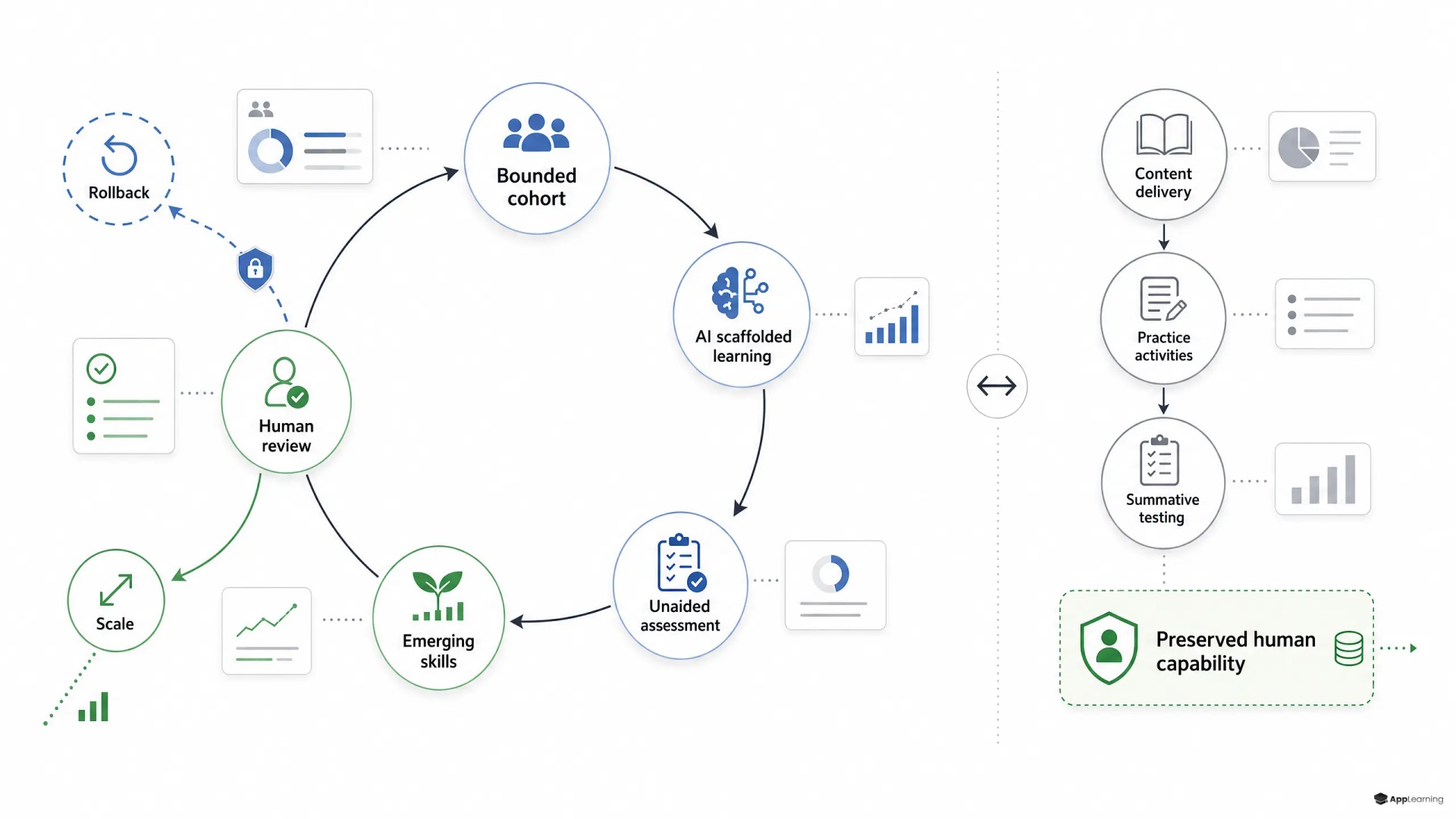
The same operating rhythm appears in NIST’s AI Risk Management Framework Core, which frames AI risk management around govern, map, measure, and manage. Reversible AI experimentation turns that rhythm into a learning product principle. Preserve the old route while testing the new one. Keep enough human capability, assessment design, and instructional knowledge alive so the organization can reverse course without rebuilding from zero.
Good to know
Should AI be banned from compliance training?
Not by default. Compliance training should protect independent judgment, but that is better achieved through bounded pilots, unaided assessments, and rollback criteria than through a blanket ban.
Which learning moments should remain unaided?
Any moment that proves core capability should remain unaided. This includes final knowledge checks, scenario judgment, escalation decisions, and tasks where employees must show they can act without AI support.
What does rollback mean in an AI learning pilot?
Rollback means the organization can return learners to a non-AI path, preserve instructor knowledge, keep assessment integrity, and stop or redesign the AI module if dependency or skill erosion appears.
How should L&D teams compare AI and non-AI paths?
Use matched cohorts, shared learning objectives, common unaided assessments, delayed retention checks, and qualitative review of how learners used the AI support.
A pilot that can be undone
A responsible AI learning pilot should look less like a launch and more like a controlled systems test. The goal is not to prove AI is good. The goal is to learn where it helps, where it hides dependency, and where rollback is still possible.
- Define a bounded cohort with a clear role, risk level, and learning need.
- Keep a control path that uses the current non-AI learning design.
- Separate scaffolded AI support from unrestricted answer generation.
- Run unaided assessments that test recall, judgment, and transfer.
- Add a delayed retention test after the training window closes.
- Set rollback criteria before launch, including erosion thresholds and escalation rules.
Build an AI learning pilot you can measure and reverse.
PilotApp-Learning as the control layer
This is where App-Learning fits the work. Not as a blanket AI layer, but as a controlled experimentation layer for modern L&D. Teams can pilot AI-supported modules with bounded cohorts, compare scaffolded and non-AI paths, retain independent assessments, monitor engagement and outcome data, and preserve conventional learning routes while evidence develops.
For finance and crypto companies, this is the safer modernization path. It respects compliance without freezing the learning system. It gives employees better learning experiences without pretending productivity gains are the same as capability gains. And it gives leaders a practical way to test AI without betting the entire training architecture on an effect they cannot yet measure.
AI learning products should not be judged only by the skills they weaken or the time they save today. The real standard is whether the organization can learn from the experiment without losing the human capability it still needs. Reversibility is not caution dressed up as delay. It is the condition that makes serious experimentation possible.