

Key takeaways
- AI ethics training is now a bank-wide capability issue.
- Employees need role-specific practice, not only policy documents.
- Training should test judgment around risk, data, and escalation.
- Readiness analytics show where responsible AI adoption is weak.
AI use has left the pilot group
Bank AI ethics training is moving from specialist governance teams into the daily work of front-line staff, analysts, product teams, operations, and leaders. NatWest’s bank-wide AI and Data Ethics accreditation is a clear signal: eight e-learning modules, a collaborative session, practical guidance, and rollout from June to October 2026. The point is not that every employee becomes an AI expert. The point is that every employee who touches AI must understand the judgment calls that come with it.
Regulators are also testing AI in live financial settings, not only in innovation labs. The UK FCA’s AI Live Testing programme includes firms working on risk management, monitoring, and responsible deployment. That raises the bar for HR and L&D. AI adoption is no longer only a technology rollout. It is a workforce readiness problem.
Policy does not create judgment
Policies are necessary. They define prohibited use, escalation routes, data boundaries, and ownership. But a policy does not teach a relationship manager what to do when a generated customer explanation sounds plausible but cannot be verified. It does not teach an analyst when bias may enter a model-assisted credit review. It does not teach an operations employee when an AI agent’s suggested action needs a human stop.
The EU AI Act makes this more concrete. The European Commission’s Article 4 guidance on AI literacy says providers and deployers should consider staff knowledge, experience, training, system context, and the people affected by AI use. This is not legal advice. It is an operational lesson: AI literacy for finance teams must be contextual, not generic.
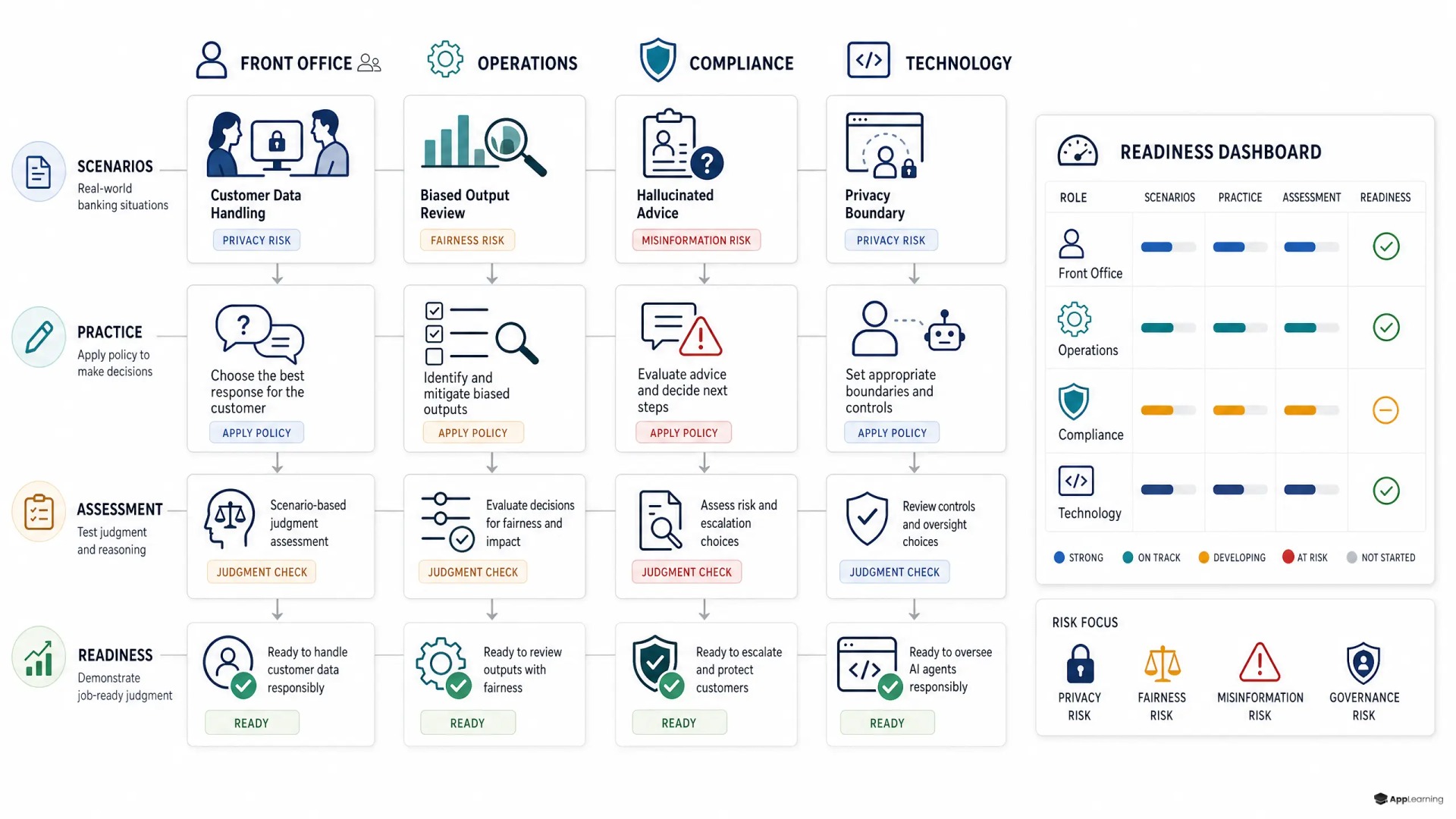
The bank needs rehearsed decisions
Responsible AI training for banks should work like risk practice, not policy reading. Employees need AI ethics scenarios where they must choose, justify, and receive feedback. This matters even more as AI agents enter enterprise workflows. NIST’s 2026 work on securing AI agent systems describes systems that can plan and take autonomous actions affecting real-world environments, with distinct security risks when model outputs connect to software functions.
- Customer data: deciding what can enter a prompt, summary, or retrieval workflow.
- Bias: spotting unfair patterns in AI-assisted lending, complaints, fraud, or onboarding outputs.
- Hallucinations: checking generated explanations before they reach customers or internal decision records.
- Escalation: knowing when uncertainty, risk, or customer impact requires human review.
- Agent actions: approving, blocking, or limiting tools that can write, send, update, or trigger workflows.
OWASP’s Top 10 for Agentic Applications names risks such as agent behavior hijacking, tool misuse, and identity or privilege abuse. For L&D, the lesson is simple. Training must include oversight behavior, not just AI awareness.
Good to know
What should bank AI ethics training include?
It should include role-specific scenarios on customer data, bias, hallucinations, escalation, privacy, and AI agent oversight, supported by short explanations and measurable practice.
Is AI literacy only a compliance topic?
No. Compliance sets the floor, but AI literacy also affects customer outcomes, operational risk, employee confidence, and the safe use of AI tools in daily work.
How can finance L&D teams measure responsible AI readiness?
They can measure scenario performance, escalation quality, risky prompt behavior, confidence versus competence, and readiness gaps across roles, teams, and AI use cases.
Readiness is a control, not a completion rate
Completion data tells leaders who clicked through a module. It does not show whether a team can apply policy under pressure. Role-based AI training should measure readiness by role, tool exposure, risk domain, and decision quality. The OECD’s work on an AI-ready public workforce separates the needs of general employees, leaders, and digital or data professionals. Banks can use the same logic for capability mapping.
- Baseline AI literacy by role and AI tool exposure.
- Scenario pass rates across privacy, bias, hallucination, and escalation cases.
- Decision confidence compared with actual judgment quality.
- Unsafe prompt, data handling, or approval patterns observed in simulations.
- Team-level gaps where AI tools are deployed faster than readiness improves.
This turns AI literacy into management information. HR and compliance can see where policy is understood, where people overtrust AI, where escalation is weak, and where refresher training is needed after a tool, regulation, or internal standard changes.
Build responsible AI training your finance teams can practice.
Learn moreResponsible AI training becomes a learning system
This is where App-Learning’s approach fits regulated teams. Abstract policy can be converted into practical decisions, quizzes, branching scenarios, manager prompts, and readiness analytics. A customer-facing role should not receive the same AI ethics scenarios as a model risk team. A leader deciding governance thresholds needs different practice from an analyst checking AI-generated summaries. The learning system must reflect the operating model.
The banks that handle AI well will not be the ones with the longest acceptable-use policy. They will be the ones whose people can recognise risk early, ask better questions, challenge confident outputs, protect customer data, and know when to stop the machine. Practice is the bridge between responsible AI intent and responsible AI behavior.