

Key takeaways
- Ease of authoring and governance reinforce each other when controls sit inside the workflow.
- Subject-matter experts, L&D, Legal and Design need distinct authority and responsibilities.
- AI-generated and AI-modified material must stay visible, attributable and reviewable.
- Publishing should be a controlled state transition rather than an unrestricted button.
Creation moves closer to the work
No-code course authoring changes the bottleneck. A product expert can turn a new process, policy or market update into learning while the knowledge is still fresh. For finance and crypto companies, that matters when procedures, product terms and compliance guidance move faster than a central content team can rewrite them.
But easier creation also expands the number of people who can introduce an outdated claim, an unapproved disclosure or an inaccessible interaction. Governance added after the course is finished becomes a slow chain of messages, duplicate files and unclear ownership. Strong AI authoring governance puts the controls in the editor. The NIST Generative AI Profile identifies governance and content provenance as central concerns for generative AI systems.
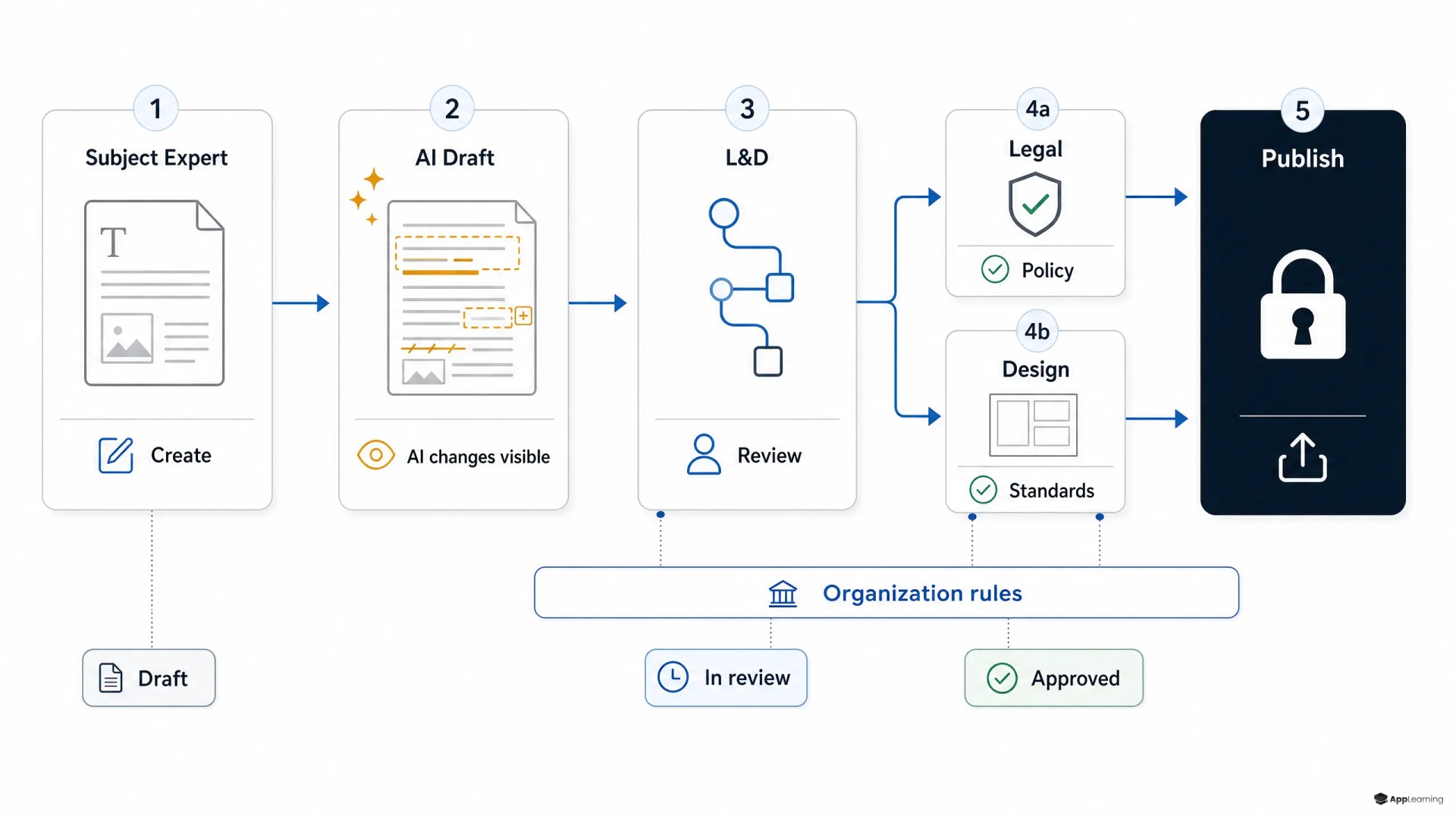
Four roles prevent one-size-fits-all authority
The answer is not to turn every subject-matter expert into an instructional designer or compliance officer. It is to give each function a bounded role, with permissions that match its accountability. NIST’s AI RMF core similarly calls for policies that define differentiated roles and responsibilities for human-AI oversight.
- The expert owns factual accuracy, operational examples and the source material behind the lesson.
- L&D owns learning logic, assessment quality, audience fit and the L&D review workflow.
- Legal or Compliance owns mandatory language, regulated claims, disclosures and restricted topics.
- Design owns reusable templates, brand consistency and accessible interaction patterns.
These roles should not create four queues for every minor edit. They should create a clear routing model. A low-risk text correction may need only expert and L&D review. A new product claim or conduct rule can automatically require Legal approval. Design can enforce approved templates and accessibility guardrails, using the testable success criteria in WCAG 2.2 as a practical reference point.
AI output must remain inspectable
AI should not act as a hidden ghostwriter. A reviewer needs to see whether a block was drafted by AI, rewritten by AI, translated by AI or materially changed by a human. That record should persist when content moves from draft to review, not disappear when the author accepts a suggestion.
Responsible AI learning content needs more than a disclaimer. Administrators should be able to enable or disable individual AI functions, restrict which approved knowledge sources an assistant may use, and set organization-wide rules for sensitive topics. Reviewers need the original prompt or source context where it matters, a visible change comparison, and an explicit decision to accept, revise or reject the output. This makes AI assistance faster without making its contribution unaccountable.
Good to know
Should Legal review every course update?
No. Route reviews by risk. Legal should review regulated claims, mandatory disclosures, policy interpretation and other defined triggers, while L&D and subject-matter experts can handle lower-risk updates within approved rules.
Can subject-matter experts publish content directly?
Yes, if the organization assigns that right for a defined scope and the content has completed its required review path. Direct creation does not require unrestricted publishing.
What counts as a material AI change?
Treat changes to claims, policy meaning, legal wording, assessment answers, learner-facing guidance or source-backed facts as material. The system should flag them for the appropriate review rather than silently overwriting approved content.
Publishing becomes a controlled transition
Enterprise content approval should be a state machine, not a single unrestricted button. A useful path is Draft, In review, Changes requested, Approved and Published. Every state needs a named owner, clear entry criteria and a record of the decision. Any material change after approval should either reopen the required review or create a new approved version.
Version history is essential when a learner, manager or auditor asks which guidance was live on a specific date. It should show who changed what, when they changed it, which version was approved and which rules applied. The EU AI Act’s requirements for high-risk systems do not apply to every learning-authoring use case, but their emphasis on logging and effective human oversight is a sound operating model for regulated content workflows.
- Limit editing, approval and publishing rights by role and content scope.
- Apply mandatory terminology, disclaimers and review dates as reusable policy checks.
- Keep sensitive knowledge sources available only to authorized groups.
- Record approval decisions and preserve prior published versions.
Build a governed authoring workflow with App-Learning.
DiscussSpeed works when accountability stays intact
App-Learning can give subject-matter experts a direct path from knowledge to learning while preserving the controls that regulated organizations need. Experts can create in the same system where L&D structures learning, Legal reviews risk-sensitive material, Design protects reusable standards and administrators define permissions and policy checks.
That is the practical balance for modern learning operations. Decentralize creation because knowledge sits across the business. Centralize the rules because trust, compliance and learner experience cannot depend on who happened to press publish. The best authoring system does not choose between speed and control. It makes controlled speed the default.