

Key takeaways
- A Bitcoin treasury equity is not the same as holding Bitcoin.
- Leverage and financing obligations can create selling pressure in weak markets.
- A NAV premium needs an equally clear explanation of discount risk.
- Scenario-based learning helps users compare direct and corporate Bitcoin exposure.
The appeal of the treasury wrapper
Bitcoin treasury companies attracted investors by offering something spot Bitcoin does not: a corporate vehicle that can raise capital, buy Bitcoin and seek to increase Bitcoin per share over time. When the company’s shares trade above the value of its net assets, new equity can be issued at a premium and converted into more Bitcoin. That loop can make a treasury equity look like an amplified Bitcoin position rather than a conventional operating company.
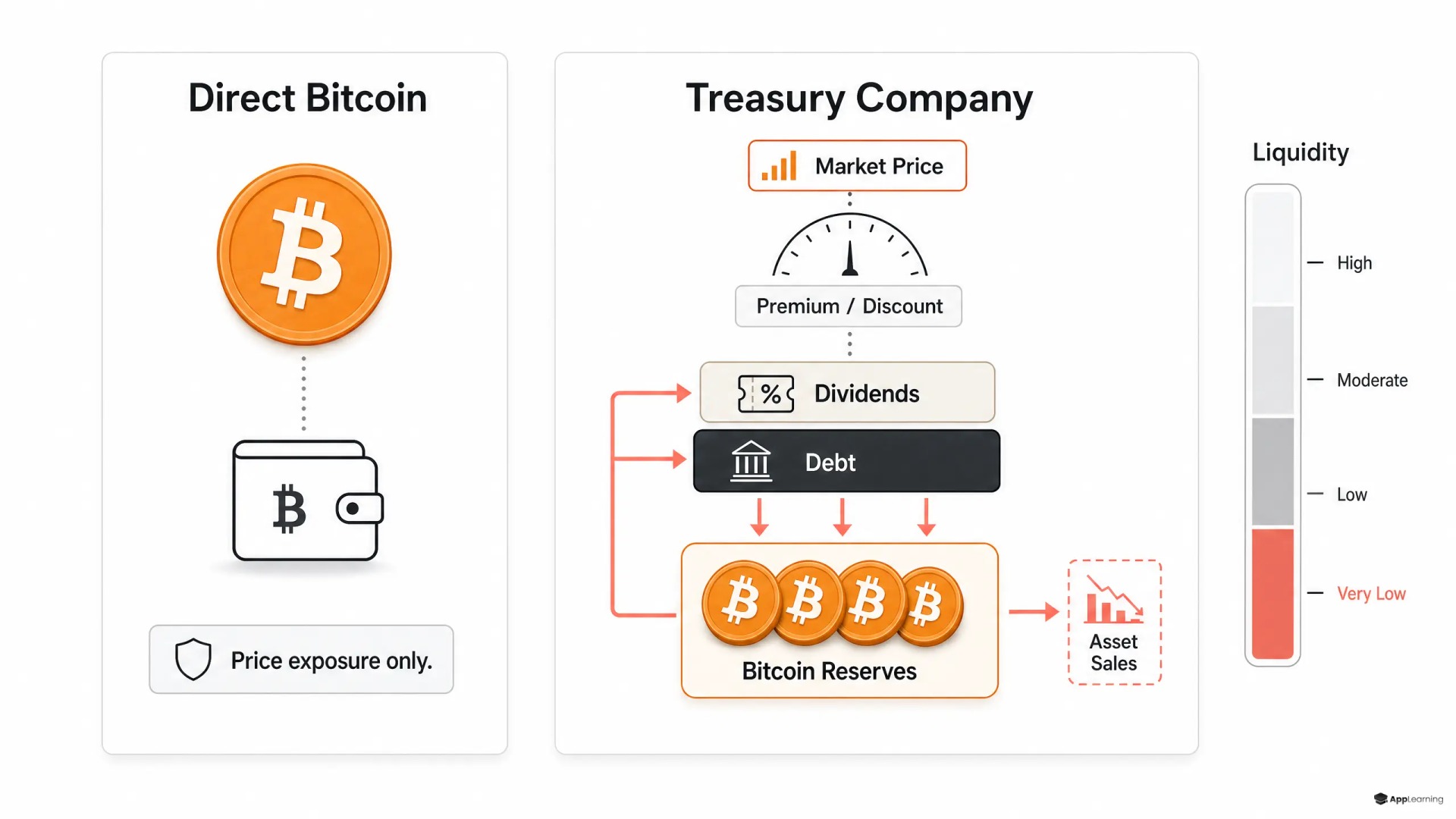
But amplification is not a free feature. It is a financing model. Debt, preferred stock, equity issuance and investor borrowing can all add leverage to the system, as B. K. Meister’s 2025 paper on Bitcoin treasury companies explains. A user who understands only the Bitcoin thesis misses the mechanism that determines whether the vehicle can keep buying, must dilute shareholders or needs to preserve cash.
The reversal exposed the funding loop
The 2026 reversal made the hidden side of the model visible. Strategy’s reported Bitcoin sales were not a verdict on Bitcoin itself. They showed that a company holding Bitcoin also has cash obligations that direct holders do not. Preferred distributions, interest expense, reserve targets and security repurchases must be funded on schedule, even when the market is weak.
This is the point that Bitcoin treasury company education often skips. A falling share price can compress a premium to net asset value. Once the market shifts to a discount, issuing common equity may no longer be an attractive way to acquire Bitcoin. At the same time, tighter credit conditions can make debt more expensive or unavailable. The company then has fewer good choices and less room for error.
The mechanics behind the Bitcoin narrative
Bitcoin investor education for these products should separate the asset from the issuer. Bitcoin has no board, dividend policy or refinancing calendar. A treasury company has all three. Users need a working model of five moving parts.
- Bitcoin holdings and cash reserves, including which assets can meet near-term obligations.
- Debt, preferred stock and dividend terms that create recurring claims on the company’s cash.
- Market net asset value, or mNAV, which compares the share value with the value of Bitcoin and other net assets.
- Dilution risk when the company issues common or preferred equity to raise capital.
- Liquidity and refinancing risk when markets no longer support new issuance on acceptable terms.
The NAV premium Bitcoin story therefore needs two charts, not one. The first shows why a premium can support accretive fundraising. The second shows what changes when that premium narrows or turns into a discount. Without both, users may mistake a capital-markets cycle for a permanent property of the product.
Good to know
Is a Bitcoin treasury company the same as owning Bitcoin?
No. The company may hold Bitcoin, but its shares also reflect debt, preferred-stock obligations, cash reserves, operating costs, dilution and the market’s valuation of management’s capital-allocation strategy.
Why does a premium to net asset value matter?
A premium can allow a company to issue equity at a value above its underlying net assets and use the proceeds to buy more Bitcoin. If the premium disappears or becomes a discount, that fundraising route can become less attractive and more dilutive.
What should a risk-learning path explain before a user buys?
It should explain the Bitcoin holdings, cash reserves, financing obligations, mNAV, dilution routes, liquidity needs and the scenarios that could lead management to issue securities or sell Bitcoin.
Downside scenarios make risk usable
Risk disclosures rarely teach a decision. Scenarios do. A useful digital asset treasury risk lesson starts with a simple shock: Bitcoin falls 30%, the equity’s mNAV moves from 1.8x to 0.8x, and the next preferred distribution is due before capital markets reopen on favorable terms. Users should then trace the choices available to management: use reserves, issue shares, raise new credit, reduce buybacks or sell Bitcoin.
The learning goal is not to predict which choice management will make. It is to show that each choice transfers pressure somewhere: to the balance sheet, existing shareholders, preferred holders or the Bitcoin stack. This also gives users a clean comparison between direct Bitcoin exposure and a corporate security whose return depends on Bitcoin, financing access and management decisions.
Build risk literacy into each Bitcoin decision.
ExploreRisk literacy belongs inside the product
Bitcoin product education works best when it appears at the decision point. A broker can place a two-minute mNAV explainer beside a treasury equity. A Bitcoin platform can trigger a short scenario before a user follows, buys or adds the product to a watchlist. A financial publisher can turn earnings releases and capital raises into interactive explainers rather than static commentary.
App-Learning can provide the operating layer for this work: modular lessons, visual balance-sheet simulations, short knowledge checks and analytics that show where users confuse spot Bitcoin with corporate exposure. Teams can localize the same learning path across markets while keeping compliance, product and editorial language aligned.
The strongest Bitcoin products do not ask users to accept complexity on trust. They show how the structure works when the trade is going well and when funding, liquidity and market premiums fail at the same time. That is the standard downside literacy should meet.