

Key takeaways
- Real-value learning rewards create a funding dependency inside the product.
- Reward caps reduce exposure but do not show available payout capacity.
- Balance alerts must arrive before the funded reward pool reaches zero.
- The LMS needs a clear learner state for temporary reward unavailability.
The balance is part of the experience
LMS gamification changes character when learning rewards have real economic value. A badge can fail quietly. A reward that represents Bitcoin, a voucher, loyalty value, or a cash-equivalent cannot. It depends on a funded pool, a payout path, eligibility rules, and a team that can respond when capacity changes. At that point, incentive-based learning is not only a content or engagement feature. It is an operational system.
The failure mode is simple. In one live reward-based academy, learners claimed the available units until the funded reward pool reached zero. Additional rewards could not be paid until a new funding transfer arrived. The learning content still worked, but the promise attached to the interaction did not. For the learner, that is an LMS reliability issue. It should not surface as an unexplained finance task happening somewhere outside the product.
The reward lifecycle needs named controls
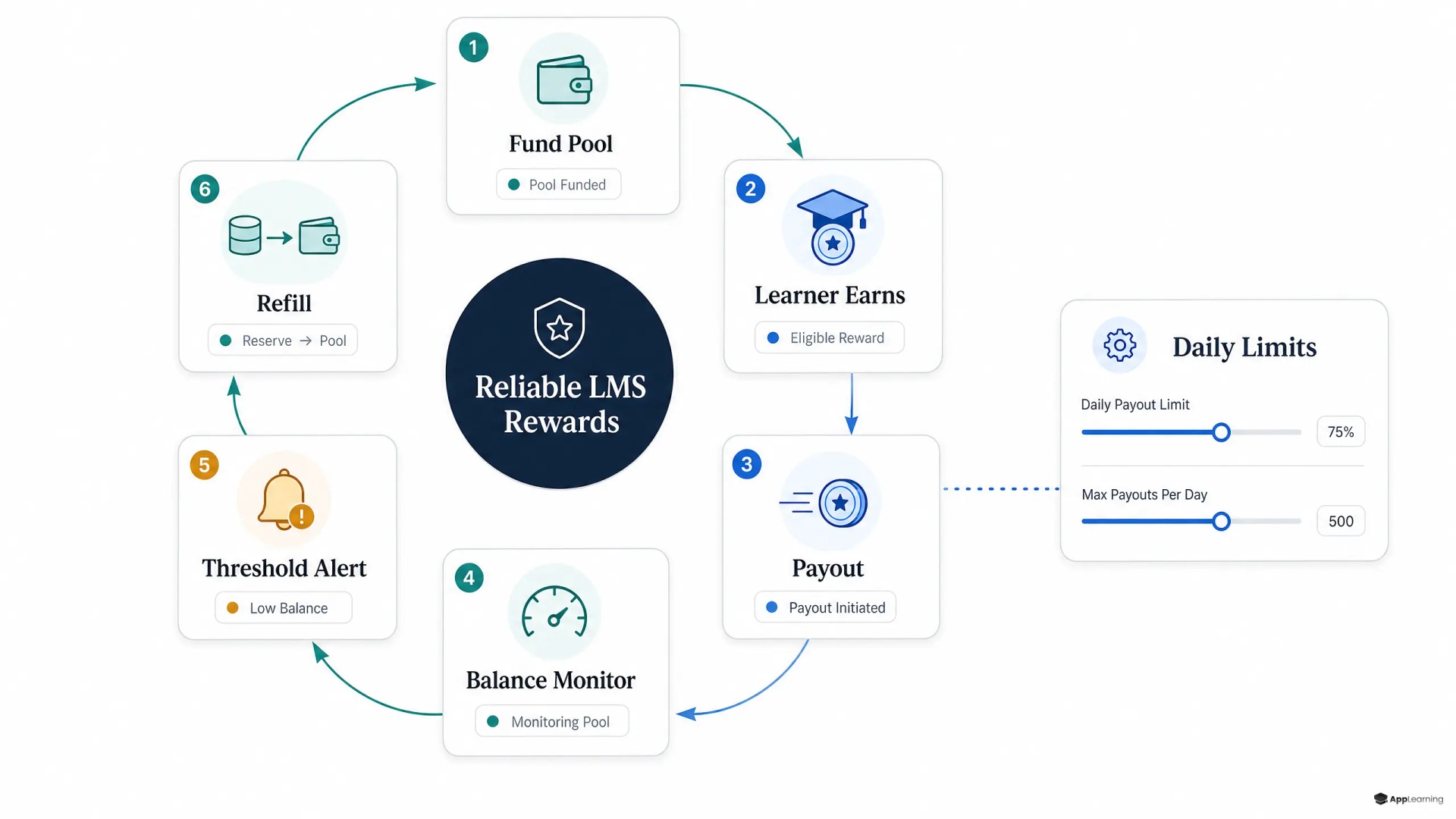
Reward operations begin before a learner taps a quiz answer or spins a wheel. A robust flow has four linked stages: funding, earning, payout, and refill. Each stage needs a clear state, owner, and event record. If those controls sit in different tools without a shared view, teams lose the ability to see whether the academy can honour its next reward.
- Fund the reward pool and record the available payout capacity.
- Apply earning rules when a learner completes an eligible interaction.
- Issue or queue the payout and retain a traceable outcome.
- Refill the pool before demand reaches the learner-facing limit.
Caps constrain exposure but cannot guarantee capacity
Interaction limits, reward limits, daily caps, and probability settings are necessary controls. They restrict how often a learner can enter a reward loop and set an upper bound on potential issuance. They also give product and growth teams room to tune motivation without opening an unlimited cost channel.
But a cap answers a different question from a balance. A cap asks how much value may be issued under the rules. A balance asks whether value can be issued now. A campaign can stay fully within every configured limit and still exhaust its pool faster than expected after a traffic spike, a successful lifecycle push, or a higher completion rate. Treating caps as a substitute for balance monitoring creates a blind spot.
- Track configured limits and actual reward events separately.
- Calculate depletion risk from recent payout velocity, not only planned campaign volume.
- Assign an accountable owner for funding approvals and refill execution.
- Test configuration changes against available balance before publishing them.
Good to know
Who should own reward operations in a fintech academy?
Product should own the learner journey and reward rules. Finance or treasury should own funding approval and execution. Operations needs a named owner for monitoring, alerts, and incident response.
Are daily reward caps enough to control reward spend?
No. Caps limit potential issuance, but they do not reveal whether the current pool can fund the next eligible payout. Teams need both controls and live balance visibility.
What should learners see when a reward pool is empty?
They should see a clear, intentional status that preserves their progress and explains whether eligibility is paused, queued, or replaced with a non-monetary outcome.
Observability must reach the learner journey
The operational view should show current balance, rewards issued, failed or queued payouts, and the estimated time to depletion at the current run rate. Threshold alerts should notify the responsible team early enough to approve and execute a refill, rather than after the pool has already run dry. The useful alert is not simply zero balance. It is the warning that gives operations time to prevent zero balance.
The academy also needs a deliberate fallback state. Do not let a learner complete the expected action and discover that the reward is unavailable through a broken flow or an empty prize outcome. Decide in advance whether the system pauses reward eligibility, preserves earned entitlement for later payout, or offers a non-monetary alternative. Then show that state clearly, preserve learning progress, and explain what happens next without asking support to reconstruct the event manually.
Make reward operations part of your academy design.
DiscussAcademy infrastructure includes payout readiness
App-Learning treats the academy as a product layer, not a detached course catalogue. Its platform combines learning paths, quizzes, analytics, and XP, leaderboards, and rewards, which creates the foundation for connecting engagement design with operational controls. For a fintech team, that means reward rules can sit alongside configurable limits, payout observability, threshold alerts, and defined fallback behaviour.
That is the standard academy rewards infrastructure should meet. Learning rewards can drive a meaningful first action and make complex financial products more tangible. But the incentive only builds trust if the system can fund, monitor, and explain it with the same care used to design the lesson. The reward pool is not back-office plumbing. It is part of the learner promise.