

Key takeaways
- Responsible AI fails when principles are not translated into work habits.
- Employees need practice in checking outputs, protecting data, and escalating concerns.
- Role-based AI training creates stronger evidence than generic policy sign-off.
- Readiness should show repeated behaviour, not only completed modules.
Responsible AI training is behaviour work
Most responsible AI programs start in the right place and fail in the wrong one. They define principles, publish acceptable-use rules, approve tools, and ask employees to confirm that they have read the policy. Then the real risk appears in daily work. A relationship manager pastes client context into a public tool. A compliance analyst trusts a summary without checking the source. A product team uses AI to speed up documentation but removes the judgement step that used to catch weak assumptions.
That is the gap responsible AI training has to close. AI governance training cannot stop at awareness. It has to build repeatable actions for each role: what to check, what not to enter, when to slow down, when to ask for help, and how to document judgement. For finance and crypto firms, this is not a learning preference. It is the operating layer between fast adoption and controlled use.
The research points to the human layer
The new IBE and Acteon research is useful because it does not treat AI ethics as a document problem. It found a recurring gap between what organisations aspire to in principle and what happens day to day, including training that often focuses on tool use rather than critical evaluation of outputs and ethical application.
Principles and frameworks do not automatically lead to behaviour change unless people know how to translate the ideas into practical, everyday actions.
This matters because policy language can create false confidence. If a policy says employees remain accountable, but training never lets them practise accountability under time pressure, the rule stays abstract. If guidance says sensitive data must be protected, but employees never rehearse borderline examples, they will improvise. AI behavior change happens when the employee has seen the situation before, in a form close enough to their work to recognise it.
Three tensions decide whether governance holds
The IBE and Acteon report names three tensions that leaders need to manage rather than pretend to solve. Each tension creates a training requirement.
- Enablement versus control. Too much control drives shadow AI. Too much enablement removes friction where scepticism is needed.
- Tool approval versus human accountability. An approved tool can make employees feel the output is approved too.
- Efficiency versus culture. Speed gains can erode expertise, review habits, and confidence to challenge weak outputs.
These tensions show why role-based AI training is different from a generic AI literacy module. A trader, recruiter, engineer, analyst, and customer support specialist do not face the same prompts, data boundaries, review duties, or escalation paths. One policy can set the standard. Training has to translate the standard into the decisions each group makes.
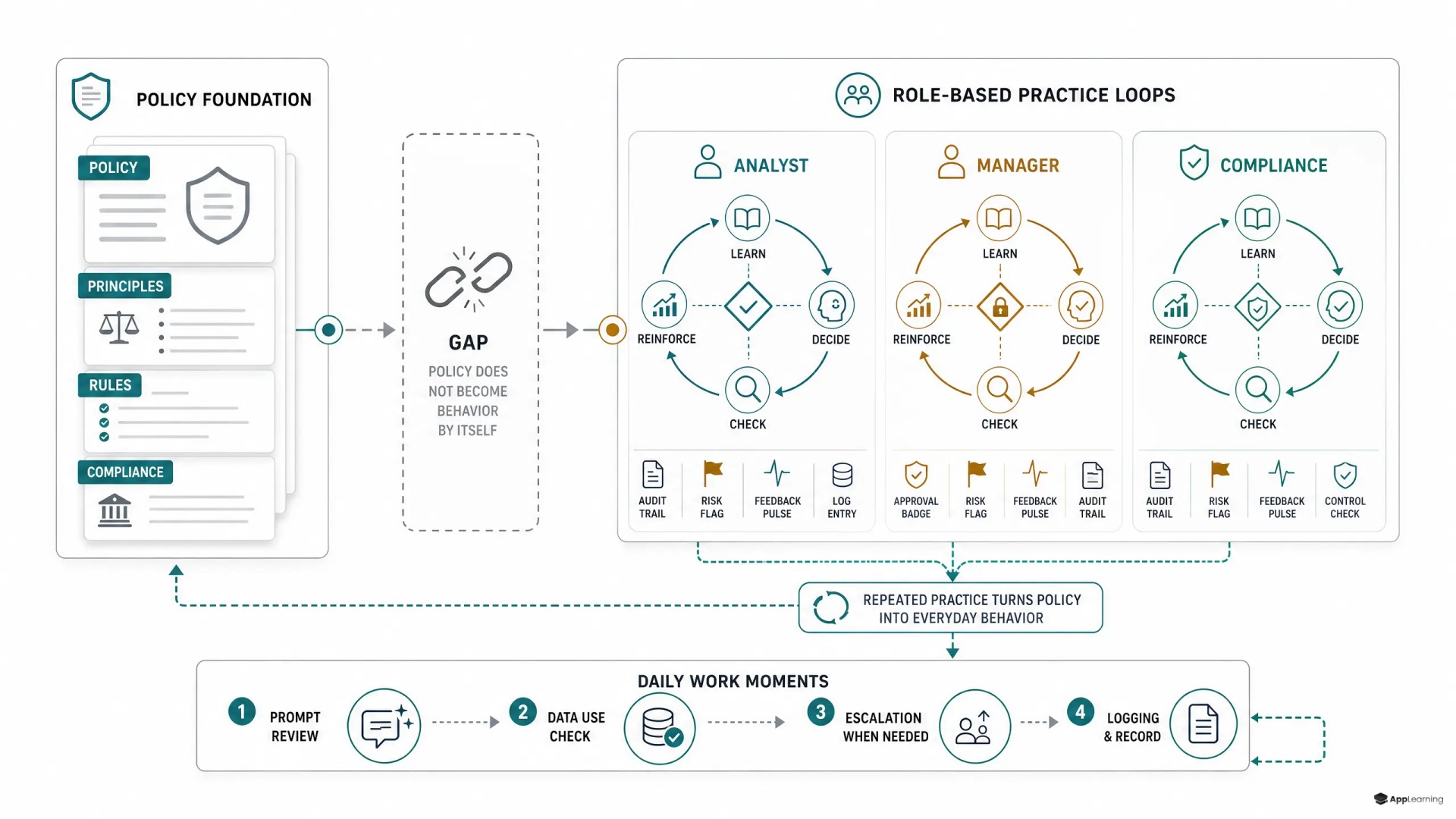
Practice loops make AI guidance usable
The UK Cabinet Office makes a similar operational point in The People Factor, which frames successful GenAI rollout around cultural, organisational, and human factors, not only technical implementation. The practical implication for L&D is clear: design learning around workflow moments, not around policy chapters.
A responsible AI practice loop should be short enough to repeat and concrete enough to observe. The loop looks like this:
- Trigger the real scenario, such as summarising customer records or drafting a client response.
- Ask the employee to choose the next action, not just recall a principle.
- Show the consequence of overtrust, oversharing, or unclear accountability.
- Require a check, such as source validation, data classification, peer review, or escalation.
- Reinforce the habit later through spaced prompts, manager discussion, and refreshed examples.
This is where microlearning has value. Not because short content is automatically better, but because responsible use depends on repeated cues in the flow of work. A ten-minute scenario every few weeks can do more for judgement than an annual module that explains every AI risk once.
Good to know
Why is responsible AI training different from AI literacy training?
AI literacy builds general understanding of AI concepts, risks, and limits. Responsible AI training should go further by turning those ideas into role-specific actions employees can practise and repeat in real workflows.
Which teams need role-based AI training first?
Start with teams that handle sensitive data, customer decisions, regulated communications, code, financial analysis, fraud, onboarding, or compliance workflows. Their AI mistakes can create direct operational, legal, or reputational risk.
What should leaders measure beyond completions?
Measure scenario performance, repeated practice, output-checking behaviour, data-handling decisions, escalation confidence, manager reinforcement, and evidence that training matches each role’s AI risk exposure.
Readiness evidence goes beyond completion
Regulated teams need proof that governance is working. Completion data is part of that proof, but it is weak on its own. Europe’s Article 4 AI literacy duty requires providers and deployers to take measures for staff and others using AI on their behalf, taking account of knowledge, training, context, and affected persons. That pushes learning evidence toward role, risk, and context.
A stronger evidence model for responsible AI readiness includes a role-to-risk map, scenario results by team, repeated practice records, data-handling checks, output-verification behaviour, escalation patterns, manager reinforcement, and refresh cadence. This gives HR, L&D, compliance, and risk leaders a shared view. They can see where the policy is understood, where judgement is weak, and where a workflow needs better controls.
NIST’s AI RMF Core also treats governance as a continuous requirement and calls for defined roles and responsibilities for human-AI configurations and oversight. In learning terms, that means the training record should show more than attendance. It should show whether people can perform the oversight expected of their role.
Build responsible AI habits your teams can prove.
StartA learning system for regulated AI adoption
At App-Learning, this is the useful design frame for finance and crypto companies: convert policy into measurable behaviour. The learning system should connect onboarding, compliance refreshers, AI tool rollout, manager reinforcement, and audit-friendly evidence. It should be easy to update when tools, risks, or rules change. It should also respect the reality of regulated teams, where employees need clarity without being buried in policy language.
Responsible AI training works when it makes the right action easier at the point of use. That is the standard leaders should apply. If employees can practise how to question outputs, protect sensitive data, and escalate concerns before the live moment arrives, AI governance becomes more than a framework. It becomes a set of habits the organisation can see, improve, and trust.