

Key takeaways
- Short lessons need structure to create measurable business value.
- Corporate buyers should evaluate assessment and analytics, not only format.
- Microlearning supports compliance and onboarding when modules are reusable.
- App-Learning fits teams that need modular learning paths, not isolated content snippets.
Best microlearning platforms: how corporate buyers should compare them
The best microlearning platforms for corporate training give buyers more than short videos: they support role-based delivery, assessment, analytics, and content updates. Research on spacing and retrieval practice supports repeated recall over passive review, while a systematic review and meta-analysis of microlearning found positive academic effects but frames microlearning as small, planned units, not random fragments.
For corporate buyers, platform fit depends on the training job: onboarding, frontline performance, compliance refreshers, or broader academy programs. In regulated finance and crypto teams, OECD’s 2025 adult learning report notes that much adult training is short and compliance or safety driven, which may be insufficient for fast-changing labour markets. The answer is not longer courses. It is a tighter learning operating model.
Three enterprise platform models behind one label
Most corporate microlearning platforms fall into three models. Microlearning apps optimize for mobile access, nudges, and frequent use. LMS modules package short lessons inside a broader tracking and administration layer. Academy platforms connect modules into role-based paths, certificates, customer education, partner education, and recurring capability programs. Enterprise buyers should compare how each model reaches desk-based and frontline employees, fits identity and HR systems, and reports adoption across roles, regions, and entities.
A polished mobile feed can improve engagement, but enterprise adoption needs more than clicks. An LMS can track completion, but enterprise evaluation should also test activation, return frequency, and adoption by role, region, and cohort. Completion without evidence does not prove readiness. An academy can scale learning, but only if content updates, approvals, and analytics are built into the operating rhythm.
A practical shortlist for regulated teams
Best does not mean the most features. Best means the platform shape matches the training job. For corporate microlearning platforms, the useful shortlist looks like this.
- 5Mins.ai suits teams that want AI-assisted, role-based microlearning for compliance, leadership, and upskilling, with delivery through workplace tools and LMS connections.
- EdApp retired on March 31, 2026, with its training features moved into SafetyCulture. Treat EdApp as a legacy or migration reference, not a current standalone shortlist option.
- Axonify fits large frontline operations that need microlearning connected with task execution, coaching, and readiness insights.
- iSpring Learn works when the priority is a familiar LMS and authoring workflow that can break existing training into shorter modules.
- Go1 is useful when the content library, compliance coverage, and integrations matter more than building every lesson internally.
- Docebo fits enterprise teams that need learning paths, AI features, skills data, security standards, and broader LMS or LXP governance.
- App-Learning fits finance and crypto teams that need modular academies for onboarding, compliance, customer education, or partner education, with short lessons, quizzes, certificates, and gamified mechanics.
Enterprise governance and adoption are buying criteria
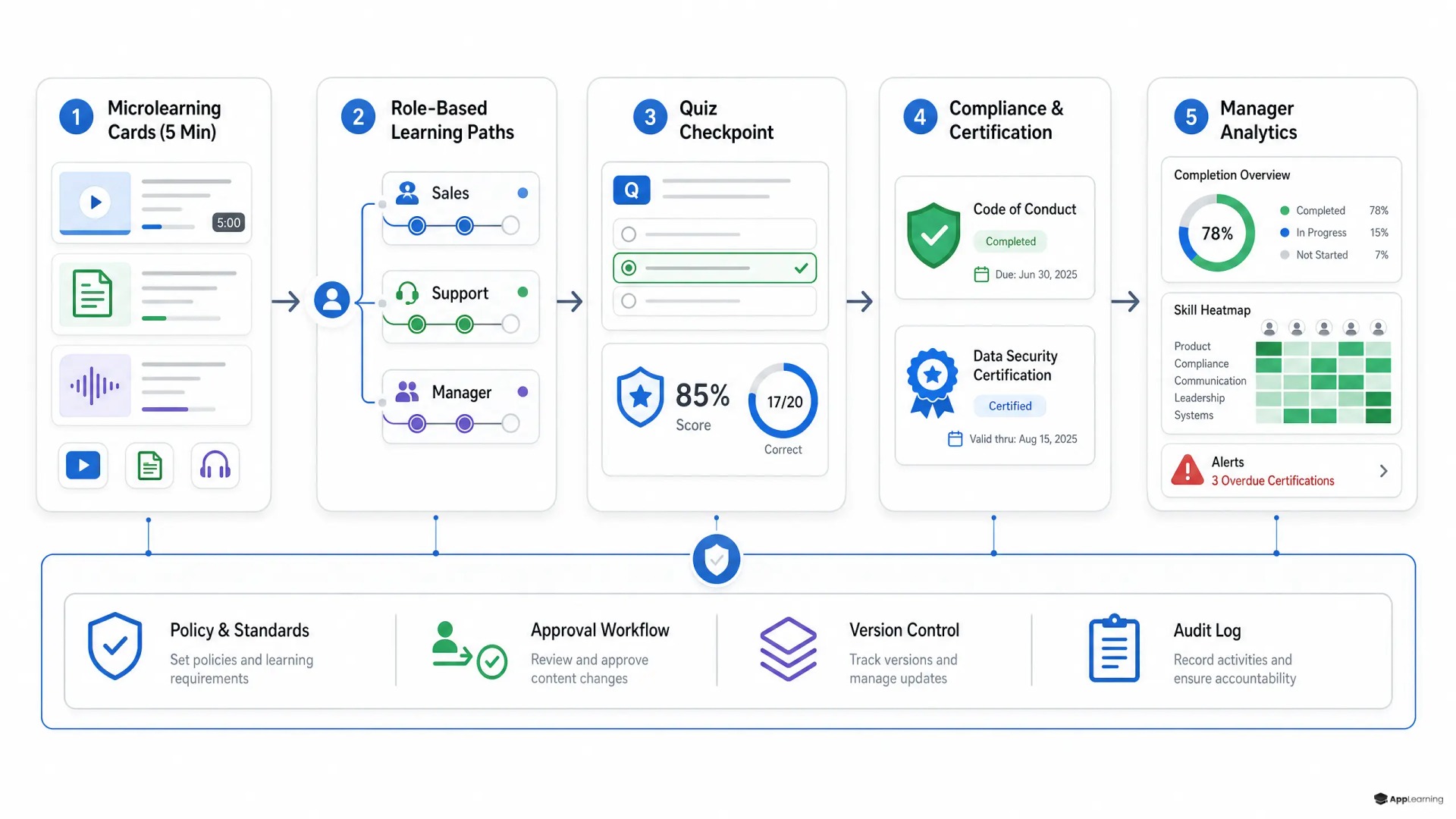
Microlearning software for companies should be tested against the way the business actually changes. In a regulated firm, policies move, products shift, risks appear, and procedures need retraining. That makes governance more important than lesson length.
- Role fit: every module maps to a role, responsibility, risk, or business process.
- Assessment: questions test decisions, not only recall of policy wording.
- Analytics: dashboards separate rollout adoption from learning outcomes, including invited-to-activated learners, weekly and monthly active learners, return frequency, path progress, and knowledge gaps by team, role, region, and cohort.
- Reuse: modules can be rebuilt into onboarding, refreshers, certifications, and manager briefings.
- Updates: owners, approval status, version history, and review dates are visible.
For a US securities firm, FINRA Rule 1240 requires a continuing education program with annual evaluation, a written training plan, role-relevant topics, and records of content and completion. For crypto teams in Europe, ESMA has published criteria for knowledge and competence of staff providing information or advice under MiCA. These examples point to the same operational requirement: the learning system must show who was trained, on what, against which standard, and with what result.
Good to know
Which corporate microlearning platform is best for a regulated finance team?
The best choice depends on your operating model. If you need a large content marketplace, start with Go1. If you need enterprise LMS governance, look at Docebo or iSpring. If you need a modular academy for finance or crypto onboarding, compliance, and customer education, App-Learning is a strong fit.
Can microlearning replace an LMS?
Sometimes, but not by default. A microlearning app can replace a lightweight LMS when assignment, tracking, assessment, certificates, and reporting are strong enough. In larger regulated firms, it often works better as a structured layer connected to HRIS, SSO, or an existing LMS.
Which mobile engagement and adoption metrics matter in enterprise evaluation?
Measure invited-to-activated learners, weekly and monthly active learners, return frequency, path starts and progress, overdue training, and adoption by role, region, and cohort. Pair those signals with assessment accuracy and knowledge gaps so mobile activity is not mistaken for capability.
Onboarding and compliance share the same backbone
Onboarding and compliance look different on the calendar. Operationally, they are the same design problem: make role-critical knowledge usable before risk appears. A new analyst needs product context. A custody operations employee needs secure process recall. A support agent needs escalation rules. A manager needs conduct expectations. Short modules work when they sit inside this chain.
- Week-one onboarding paths by function and seniority.
- Policy refreshers triggered by regulatory or internal changes.
- Product launch briefings with short checks for understanding.
- Incident post-mortems converted into reusable prevention modules.
- Manager enablement paths for risk, feedback, and escalation routines.
Build training people can prove.
TalkThe buying checklist
- Can we assign learning by role, region, entity, and risk profile?
- Can each module connect to a policy, process, competency, or outcome?
- Can assessments test realistic decisions and not only memory?
- Can we separate mobile engagement and rollout adoption from assessment results and operational readiness?
- Can managers act on analytics without exporting spreadsheets?
- Can compliance review and approve content updates?
- Can modules be reused across onboarding, refreshers, and certifications?
- Can the platform integrate with HRIS, LMS, SSO, and collaboration tools?
- Can we prove completion, score, version, and recertification history?
- Can the vendor support our content model, not just host our files?
The best corporate microlearning platform is not the one with the shortest lessons. It is the one that turns short learning into a controlled system: role-based, measurable, updateable, and reusable. In regulated finance and crypto environments, that is the difference between content people click through and training the business can trust.