
Key takeaways
- Small and mid-market teams need fast setup, easy adoption, and low admin burden.
- Enterprise LMS complexity can slow adoption before training proves value.
- Training often spans employees, customers, partners, and compliance.
- App-Learning fits teams that need structured academies without a full L&D operation.
What lean L&D teams need from an LMS
At 50 to 250 people, training stops being a nice internal habit and becomes an operating system. New hires need the same baseline. Managers need fewer repeated explanations. Customer-facing teams need product knowledge that does not sit in one senior person’s head. Yet many growing startups do not have a full L&D function, an instructional designer, or months for implementation.
The best LMS for small and mid-market teams, including companies with 11 to 50 employees, is not the platform with the longest feature list. It is the one that is easiest to set up and adopt: fast to deploy, simple enough for a lean L&D team without a dedicated LMS admin, and clear for employees from day one. As the company grows, it should add roles, reporting, compliance evidence, and multiple audiences without forcing enterprise process too early.
- Capture company knowledge before it becomes manager dependency.
- Assign onboarding by role, team, or location.
- Track completion and basic knowledge checks.
- Support both employee training and customer education when needed.
- Let non-specialist admins update content without technical help.
Three platform shapes compete for the same job
The first shape is the simple LMS. Tools such as TalentLMS for small business and iSpring Learn focus on course delivery, user management, learning tracks, quizzes, certificates, and reporting. This is often the right starting point when the main use cases are employee onboarding, compliance, product knowledge, and internal training.
The second shape is the course and academy platform. LearnWorlds’ customer education platform and Thinkific Plus are stronger when training is also part of customer activation, partner enablement, or paid education. These platforms usually care more about branded academies, learner experience, content packaging, and external audience management.
The third shape is the open or hosted learning system. MoodleCloud pricing shows how Moodle can be used in a ready-to-go hosted model, while Moodle Workplace targets more structured workplace learning. This route can be cost-effective and flexible, but it needs clear ownership. If nobody owns setup, plugins, content structure, and support, flexibility becomes drag.
LMS and Moodle options for lean mid-market teams
- TalentLMS fits teams that want a conventional SMB training platform with fast setup, familiar admin workflows, and broad internal training coverage.
- iSpring Learn fits teams that need employee training, learning paths, mobile access, and a stronger link between authoring and delivery.
- MoodleCloud fits cost-conscious teams that want Moodle without self-hosting, as long as someone can own configuration.
- LearnWorlds fits customer education, branded academies, interactive content, and external learning journeys.
- Thinkific Plus fits customer, partner, or community education where learning supports adoption, retention, or revenue.
- App-Learning fits startups that need a structured academy experience, not just a place to upload courses.
Where App-Learning fits
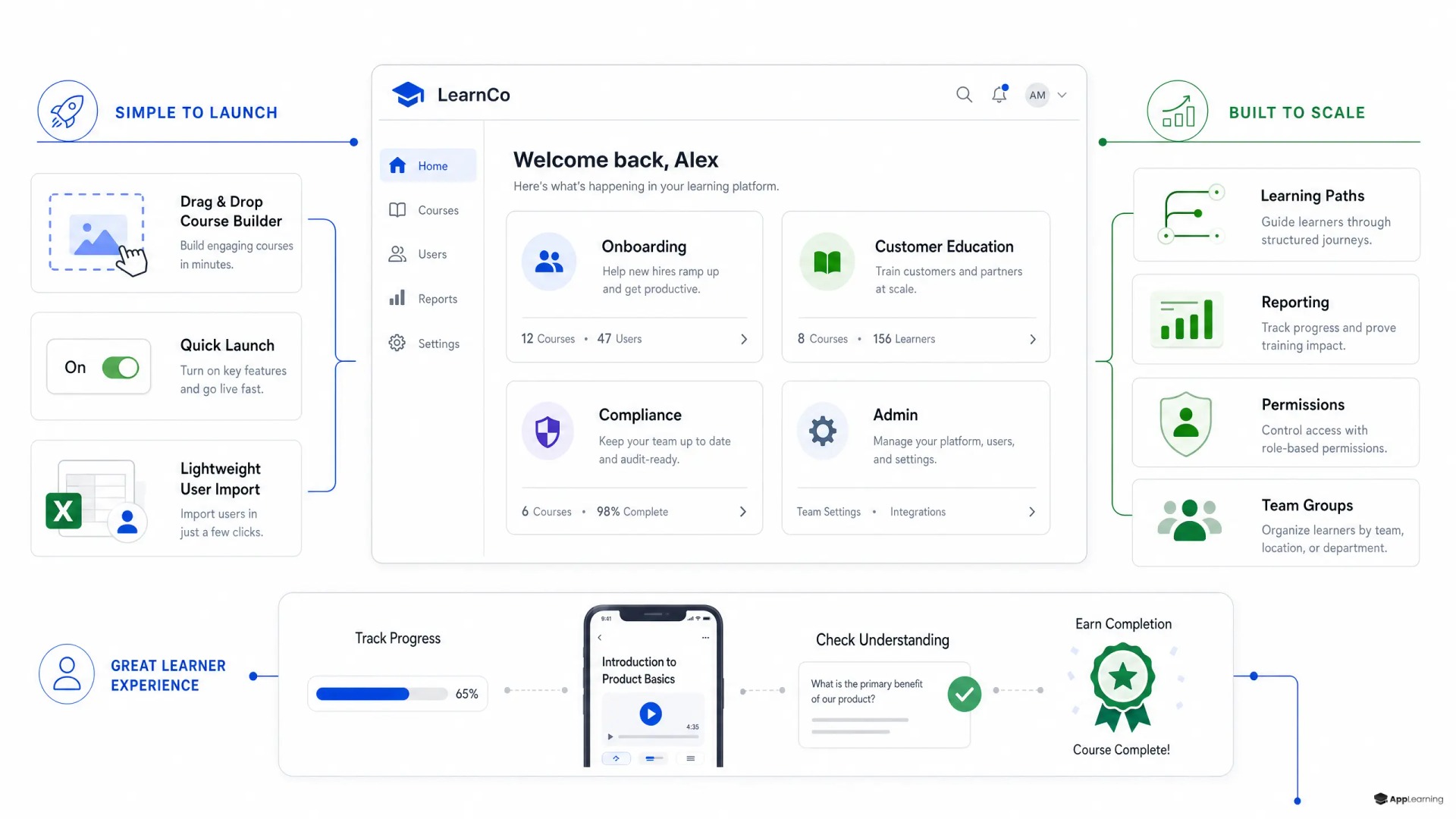
App-Learning sits closer to the academy model than to a blank LMS. App-Learning’s academy platform is built for internal and external audiences, with branded academies, role-based learning paths, micro-lessons, quizzes, certificates, analytics, and CMS-style updates. That matters for founders because the bottleneck is rarely only software. The real bottleneck is turning raw company material into learning people actually finish.
This makes App-Learning a practical fit when a team wants to professionalize onboarding, product training, compliance basics, or customer education without hiring an L&D department first. It is less relevant if the only need is a low-cost SCORM repository. It is stronger when the company has docs, slides, product notes, and internal know-how that need to become structured paths with measurable progress.
Good to know
What is the best LMS for small business?
The best option is usually the one that launches quickly, needs little admin work, supports role-based onboarding, and gives managers basic visibility into completion and knowledge gaps.
When should a startup choose an academy platform instead of a standard LMS?
Choose an academy platform when learning must support more than internal compliance. Customer onboarding, partner training, product education, and branded learning journeys often need an academy model.
Which Moodle option fits a mid-sized business?
MoodleCloud is the easier starting point for a mid-sized business that wants hosted Moodle without self-hosting. Moodle Workplace fits more structured workplace learning. Either option still needs a clear owner for configuration, content structure, updates, and learner support.
How should founders compare LMS pricing?
Compare license cost, setup work, content production, admin time, learner support, reporting needs, and the cost of switching later. The cheapest first invoice is not always the lowest operating cost.
The pricing trap is rarely the first invoice
For a small team, the visible subscription price is only one part of the cost. The hidden costs are setup, content production, manager time, learner support, and system maintenance. The current TalentLMS pricing, LearnWorlds plans, MoodleCloud pricing, and iSpring Learn pricing pages show how different the headline models can be before content and administration are included.
A cheap platform becomes expensive when nobody uses it. A feature-rich platform becomes expensive when every change needs a specialist. A simple platform becomes expensive when you outgrow its reporting, audience segmentation, or content model after six months. The right comparison is not just monthly price. It is total operating load.
A checklist that prevents rework
- Name the first audience before choosing the tool.
- Define the first 90-day learning outcomes by role.
- List existing content sources and decide who will convert them.
- Check whether training is internal, external, or both.
- Decide which reports leadership actually needs.
- Test the learner experience on mobile before buying.
- Confirm who owns updates after launch.
Build your academy without adding L&D overhead.
TalkThe system has to survive the next hiring wave
The right LMS choice should make the company calmer. New hires know where to start. Managers stop repeating the same explanations. Customer-facing teams learn the product from one source of truth. Compliance evidence becomes easier to collect. Knowledge moves from people’s calendars into a system the company can improve. For small and mid-sized teams, that is the real test. Choose the platform that reduces operational dependence while giving the business enough structure to grow.