

Key takeaways
- External learners need cleaner access, stronger branding, and less internal language.
- Segmentation and permissions decide whether external training scales or becomes manual work.
- Training analytics should connect to activation, retention, support, and partner performance.
- App-Learning fits teams building branded academies for trust, enablement, and growth.
External learners judge the system before the course
A learning platform for external audiences has a different job than an employee LMS. Employees may tolerate HR language, mandatory catalogs, and clunky login flows because they have to. Customers, partners, franchisees, and community members do not. If access feels confusing, the training loses credibility before the first lesson loads.
This matters sharply in fintech and crypto. The product may be useful, but users often meet it through risk language, KYC steps, unfamiliar financial concepts, and moments of doubt. An external training platform has to reduce that friction. It should feel like part of the product and brand, not like a side portal owned by an internal operations team.
Internal LMS logic breaks outside the firewall
External training is often called extended enterprise learning. Docebo defines it as training for audiences outside the company, including customers, channel partners, resellers, dealers, franchises, and members, in its extended enterprise product material. That definition is useful because it shows the real operating problem. These audiences have different contracts, goals, permissions, languages, and success metrics.
An employee LMS usually starts from internal identity, hierarchy, compliance assignment, and HR reporting. External education starts from trust, speed, relevance, and brand continuity. A customer partner training platform must answer different questions. Who can self-register. Which partner sees which catalog. Which customer segment needs onboarding versus advanced product education. Which completion data should flow into CRM, product analytics, or customer success systems.
The best fit depends on the audience
There is no single best platform for every external academy. The right shortlist depends on the audience you need to move and the operational model behind it.
- App-Learning fits fintech, crypto, and complex product teams that need branded microlearning academies with short lessons, quizzes, certificates, gamified mechanics, and analytics, as described on the App-Learning platform.
- Skilljar fits mature customer education teams that need academies, certifications, SSO, monetization, Salesforce or Gainsight workflows, and analytics connected to customer outcomes through its customer training platform.
- Thought Industries fits organizations treating customer, partner, member, or professional education as a business system, with personalization, monetization, and data connections described in its customer learning platform.
- Docebo fits enterprise extended enterprise programs with many external groups, custom environments, delegated administration, ecommerce options, and multi-domain complexity in its extended enterprise setup.
- LearnUpon fits teams that want one LMS for multiple audiences, with portals for different learner groups and embedded course access through LearnUpon Anywhere.
- TalentLMS fits smaller or mid-sized programs that need fast setup, centralized administration, and separate customer or partner spaces through branches with their own URL, branding, users, rules, and catalogs in the TalentLMS branch model.
Segmentation is the operating model
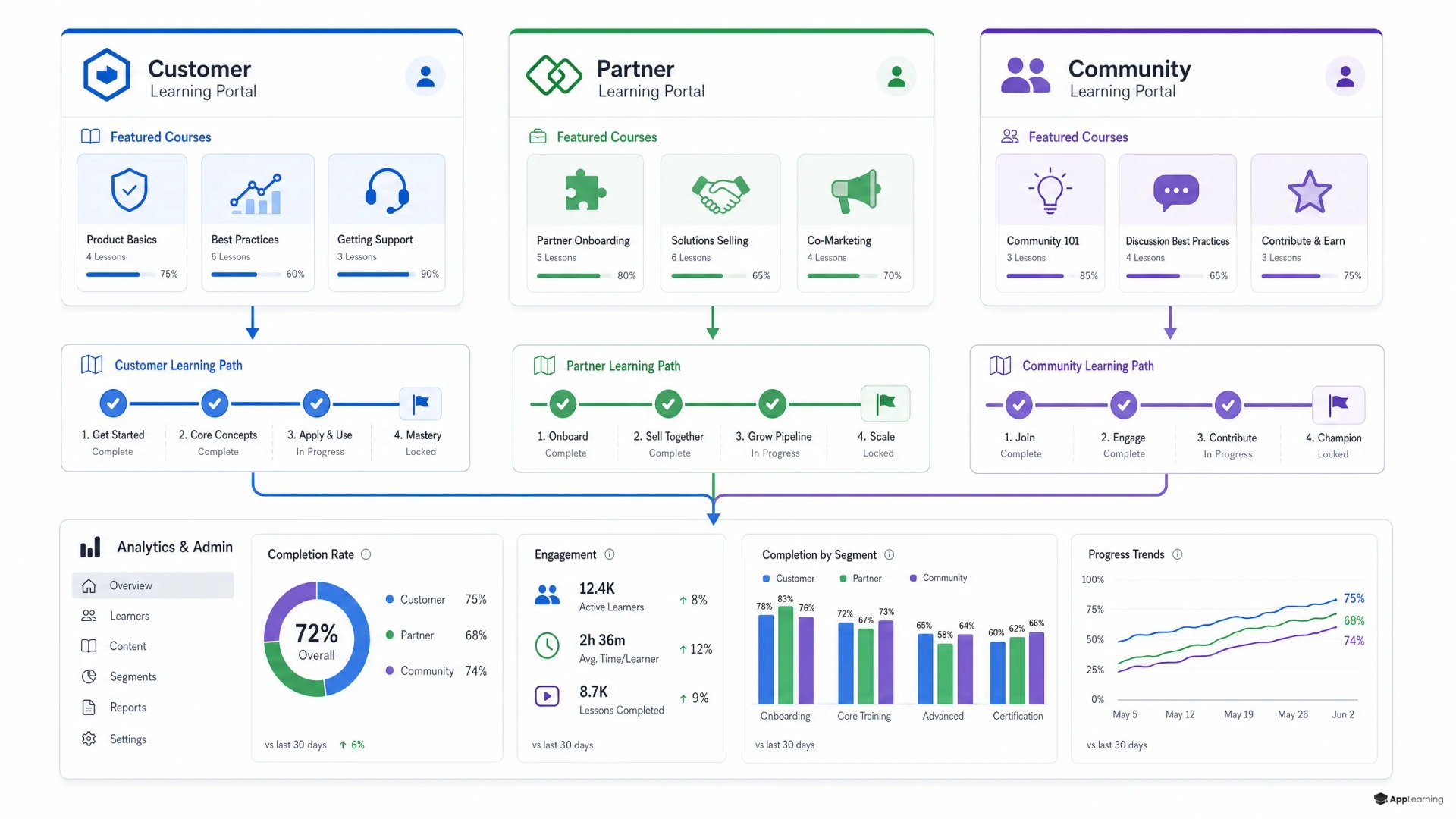
External education fails when every learner sees the same academy. Customers need product confidence and faster time to value. Partners need positioning, sales readiness, certification, and update training. Franchisees need operating standards. Communities need lightweight entry points, badges, and reasons to return. The platform must separate these journeys without forcing the team to copy content into six systems.
Good segmentation is more than groups. It covers login method, catalog visibility, content language, certificate rules, reporting rights, notifications, and data exports. In regulated fintech, it also helps keep claims, risk explanations, and product education aligned to the right market and user type.
Good to know
Can an internal LMS be used for customers and partners?
Yes, but only if it supports separate branding, permissions, access rules, catalogs, and reporting. If the external experience still feels like an employee system, it will usually underperform.
Which platform is best for fintech customer education?
For activation, trust-building, and product education, prioritize branded microlearning, embedded access, quizzes, analytics, and fast content updates. App-Learning is a strong fit for this pattern, especially when education supports onboarding and retention.
What should an external academy measure?
Measure access friction, lesson starts, completion, drop-off, quiz performance, certificate progress, repeat engagement, and links to activation, retention, support tickets, product usage, or partner revenue.
Do external learners need certificates?
Certificates help when proof matters. They are useful for partner readiness, franchise standards, regulated topics, professional education, and customer communities where visible progress increases motivation.
Analytics must leave the LMS
Completion rate is not enough. External training should show whether education changes behavior. For a fintech product leader, that means tracking learning against activation, feature adoption, support demand, trust signals, retention, and lifecycle conversion. Skilljar explicitly frames training data as part of account health, business metrics, and customer workflows through Salesforce, Gainsight, data connectors, and native analytics in its product overview.
The same principle applies to partner and franchise programs. A certificate has limited value if it cannot be connected to sales readiness, channel quality, compliance exposure, or partner performance. The learning platform should not become another closed dashboard. It should feed the systems where teams already make decisions.
A practical fit checklist
- Can external users access training without employee credentials.
- Can each audience get its own branded entry point.
- Can catalogs, paths, and certificates be segmented cleanly.
- Can partners or client admins manage assigned learners safely.
- Can learning moments be linked or embedded inside product journeys.
- Can reports show drop-off, quiz performance, completion, and learner progress.
- Can data export to CRM, BI, support, or customer success tools.
- Can the content team update lessons quickly after product or policy changes.
See how a branded academy could support your external learners.
BookThe right platform makes the outside feel intentional
External audiences notice when training is an afterthought. They feel it in the login flow, the wording, the lesson length, the certificate, and the follow-up. The best external academy makes learning feel like part of the relationship. It gives users confidence, gives partners consistency, gives communities structure, and gives the business usable evidence that education is moving outcomes.