

Key takeaways
- Gamification defaults do not behave the same across learner cohorts.
- Visible balances and invisible limits can create contradictory learner feedback.
- Event tracking should precede changes to caps, probabilities, or ticket costs.
- Learning outcomes, return behavior, and reward cost belong in one view.
Defaults are not decisions
Reward limits, ticket costs, and prize distributions look like settings. In practice, they shape learner behavior. They decide whether a user keeps going, returns tomorrow, trusts the academy, or feels blocked by an arbitrary rule. Research on gamification has long shown that effects depend on context and users, which makes every reward rule a product hypothesis, not a universal best practice.
This matters most in fintech education. A user may be learning staking, risk, fees, fraud prevention, or portfolio basics while also trying to understand a product. If the academy adds rewards, the mechanic must support comprehension and return behavior. A daily cap can create healthy pacing in one audience and unnecessary friction in another.
One reward screen carries three jobs
Teams often treat LMS reward mechanics as one feature. They are not. A reward screen blends engagement mechanics, economic controls, and learning progression. A meta-analysis of gamified learning found small positive effects across cognitive, motivational, and behavioral outcomes, while also showing that motivational and behavioral effects vary by design conditions. The operational lesson is simple. Do not tune a reward variable until you know which job it is failing.
- Engagement mechanics make effort visible and give learners a reason to continue.
- Economic controls protect prize budgets, abuse limits, and campaign pacing.
- Learning progression keeps attention on the educational path, not only the reward loop.
If these jobs are not separated, teams solve the wrong problem. They raise a limit when the message is unclear. They lower a ticket cost when the module sequence is too long. They change prize odds when the real issue is that the learner does not understand why a reward action stopped working.
The limit learners cannot see
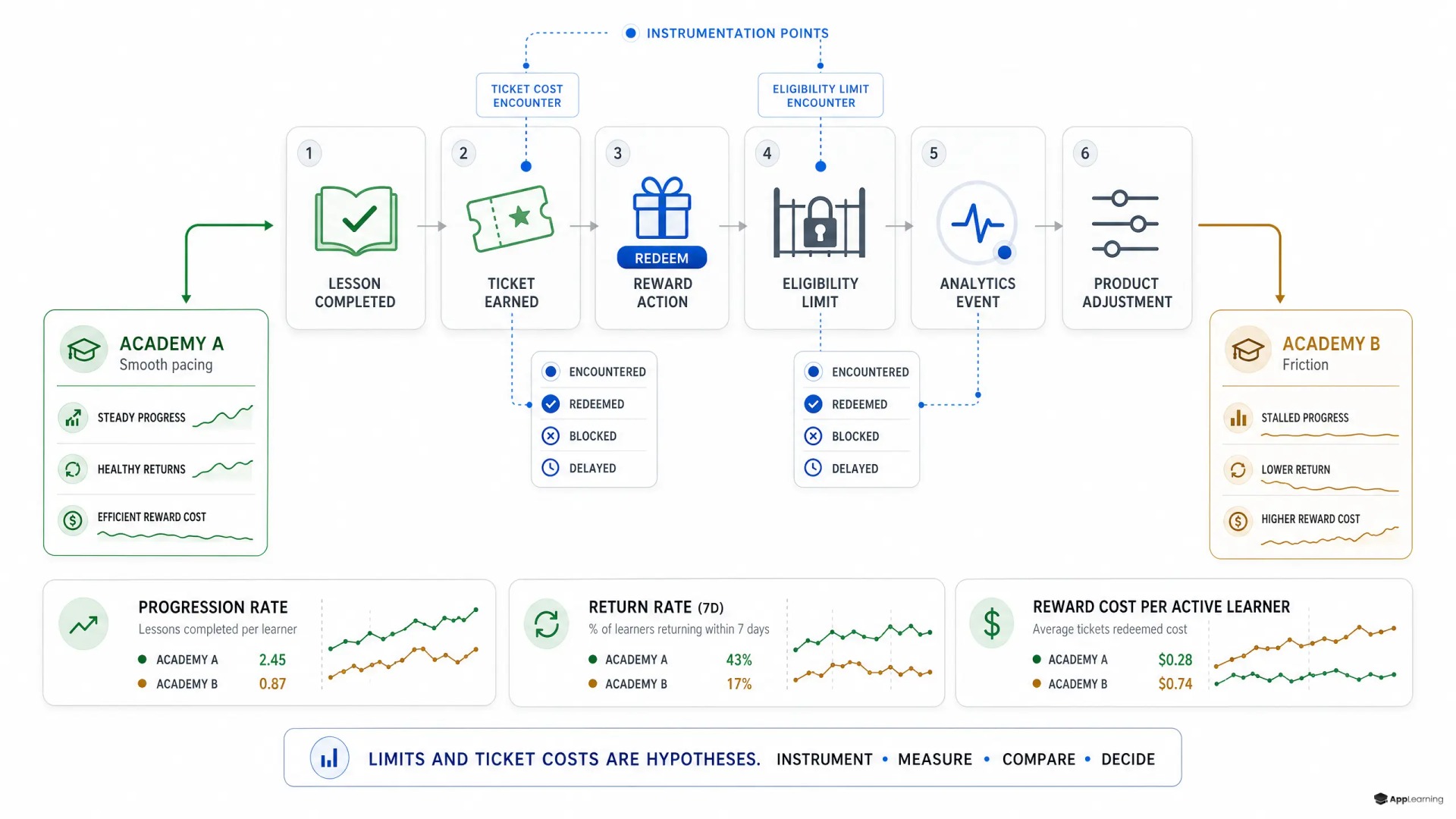
A common failure mode is a visible balance with an invisible eligibility rule. The learner sees tickets, attempts, or points still available. The system sees that a separate daily reward limit has been reached. To the learner, the interface says yes and the rule says no. That contradiction turns a pacing mechanism into a trust problem.
A recent branded academy implementation exposed this exact mismatch. Learners could still see unused actions after reaching a separate daily eligibility limit. The limit had been introduced to reduce rapid reward extraction and encourage return visits. One cohort reached it much more often than the broader user base because its reward pattern was different. The team did not treat the threshold as proven. It clarified the message and added a dedicated analytics event to measure how many learners reached the limit, when it happened, and which cohort was affected.
That is the work of learner engagement analytics. The platform should not only report completions. It should show where rules touch the learner journey. SoLAR defines learning analytics as the collection, analysis, interpretation, and communication of learner data that creates actionable insights to enhance learning. Reward events belong in that same logic.
Good to know
Why should reward limits be treated as hypotheses?
Because the same limit can produce different behavior across cohorts. It may create useful pacing for one group and unnecessary friction for another.
What should teams measure before changing reward settings?
Teams should measure limit reach, return behavior, learning progression, cohort differences, and reward cost before changing caps, prize odds, or ticket costs.
How does this apply to fintech academies?
Fintech users often need education before they feel confident using the product. Reward mechanics should support activation, trust, and retention without interrupting comprehension.
What makes configurable gamification useful?
Configuration is useful when it is paired with analytics. Teams need to adjust mechanics based on observed learner behavior, not preference or complaint volume alone.
Measure the rule encounter before changing the rule
Before changing caps, probabilities, or ticket costs, instrument the moment where the rule is encountered. Learning gamification analytics should answer four questions before the product team argues about the new threshold.
- Limit reached. Which learner, cohort, module, reward type, and balance state triggered the stop?
- Return behavior. Did the learner come back later, continue learning without rewards, or exit?
- Progression. Did the limit interrupt a learning sequence, a quiz attempt, or only a prize action?
- Cost. What reward liability sits behind each completed module, retained learner, or verified learning outcome?
Learning data standards already point in this direction. 1EdTech Caliper provides a structured way to collect learning and usage data from digital resources. The same discipline should apply to configurable gamification. Track the event first. Interpret the pattern second. Tune the rule third.
This does not mean capturing everything. It means capturing the minimum data needed to improve the learning system. The OECD’s work on classroom analytics makes the same governance point by recommending data minimalism where analytics may drift into control. A fintech academy should be even stricter. Measure the rule, not private curiosity.
Build reward loops you can measure.
TalkConfiguration needs a feedback loop
Configurable gamification is valuable because reward rules should change across academies, markets, campaigns, and learner cohorts. But configuration without evidence only moves the problem. It gives teams more switches while leaving them blind to the effects. A growth team can lower ticket costs and increase activity. A product team can raise a cap and reduce complaints. Neither change is necessarily good if comprehension drops, reward cost rises, or academy retention does not improve.
App-Learning connects the two sides that should not be separated. Teams can configure reward mechanics, but the platform also needs to show who reaches a limit, when it happens, and whether the mechanic supports learning progression or merely interrupts it. For fintech and crypto products, that link is not cosmetic. Education is part of activation, trust, and retention. The reward layer should help users understand the product, not distract them from it.
The best reward systems are not the most generous or the most restrictive. They are the ones teams can observe clearly. A cap is not good because it is strict. A prize distribution is not good because it is exciting. A ticket cost is not good because it feels balanced in a planning sheet. These mechanics become good when the data shows that they pace learning, protect the reward economy, and keep users moving toward understanding. Learning rewards should be measured before they are tuned.