

Key takeaways
- Gamification effects depend on the learner, task and product context.
- Leaderboards can motivate progress or create damaging negative feedback.
- Adapt progression, feedback and challenge before adding more rewards.
- Measure mechanic-level learning outcomes, not engagement totals alone.
The reward layer cannot fit every learner
Points, badges and streaks can make a learning flow visible. They cannot make a universal motivational system. A user who wants to understand Bitcoin custody may value a clear path to mastery. Another may want quick reassurance before making a first transfer. A third may see a public ranking and leave. When all three receive the same rewards, gamified learning design starts to optimise the mechanic rather than the learner.
The evidence supports a careful view. An eight-week online-learning study found that a player-type-based personalized gamification condition outperformed a one-size-fits-all condition on motivational, behavioural and cognitive outcomes. But a separate controlled study of gamified review assessments found no significant overall motivational difference between its personalised and standard designs. The implication is not that personalised gamification always wins. It is that the fit between mechanic, learner and context determines the result.
Learner signals beat static personas
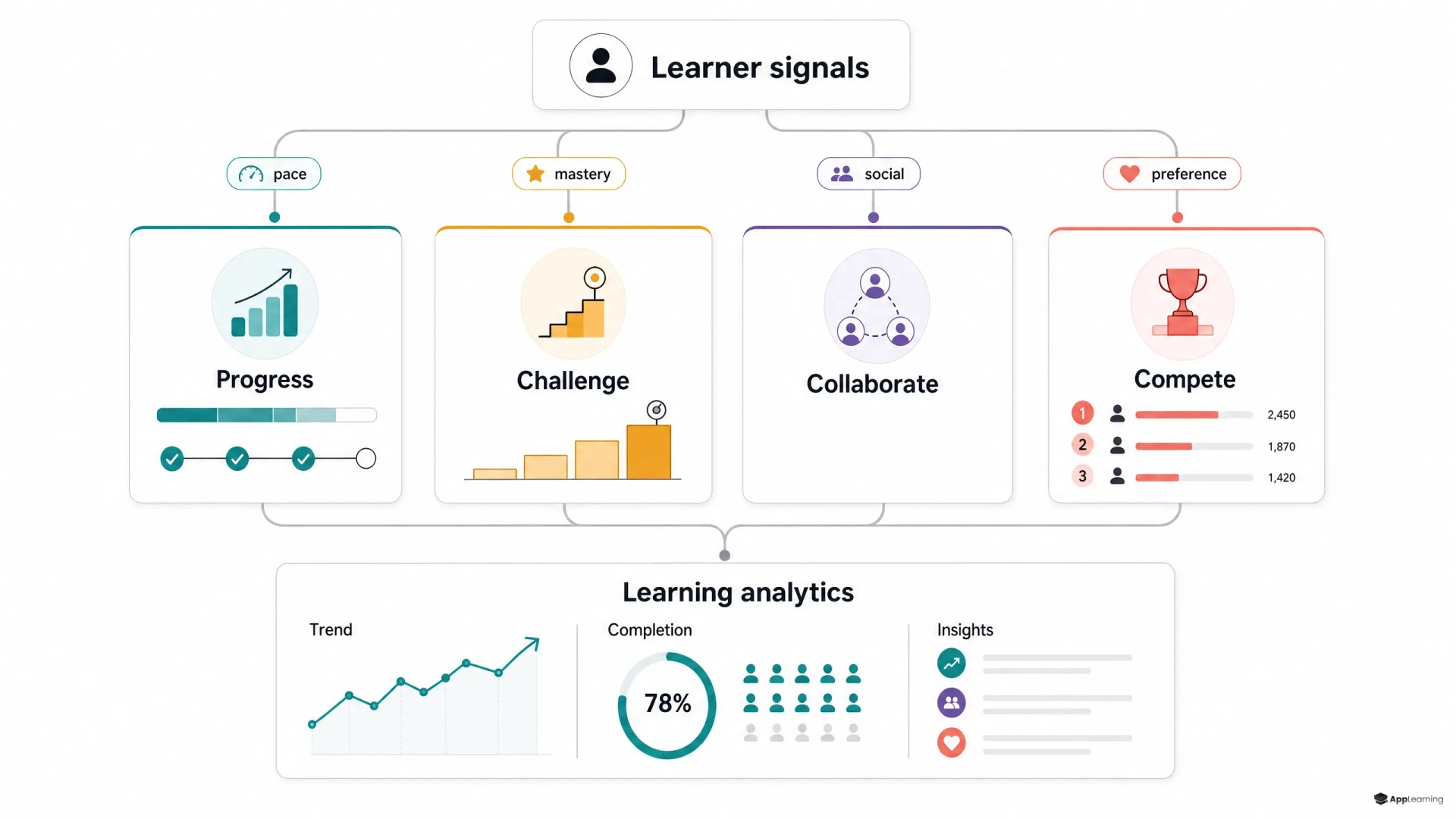
A useful system does not need to assign every user a permanent player type. It needs to observe whether the current learning journey is working. In fintech learning gamification, the relevant signals are often practical: prior knowledge, confidence before a lesson, repeated errors, time spent on a concept, skipped explanations, quiz retries, return visits and use of the related product feature.
These signals reveal a current learning state, not a fixed identity. A new user who fails a quiz on transaction fees needs clearer feedback and a shorter retry loop. A user who passes quickly needs fewer explanations and a harder scenario. Someone who repeatedly pauses before a security step may need a guided simulation, not another badge. This is learner engagement personalization with a learning purpose.
Mechanics need different operating modes
Adaptive gamification should vary a small set of mechanics with a clear instructional job. It should not turn every screen into a game.
- Progression should unlock the next concept after demonstrated understanding, while offering a recap route after repeated errors.
- Feedback should shift from concise confirmation to worked explanations when a learner shows uncertainty or misconceptions.
- Challenge should rise with demonstrated mastery and fall when friction signals suggest overload or confusion.
- Competition should be optional and local. Personal-best goals, small cohorts or cooperative milestones are safer defaults than a permanent global leaderboard.
- Rewards should recognise meaningful learning actions such as completing a security simulation or correcting a misconception, not empty tapping or time spent.
Competition deserves particular restraint. In a 2026 experiment with 427 participants, higher and improving leaderboard positions were linked with stronger intrinsic motivation, while negative leaderboard feedback could be more harmful than no feedback. The study found negligible effects on cognitive performance. A leaderboard is therefore feedback design, not proof of learning.
Good to know
Is adaptive gamification the same as personalized gamification?
Personalized gamification can use a fixed profile or stated preference. Adaptive gamification goes further by changing mechanics in response to observed learning behaviour and context.
Which mechanic should a fintech product adapt first?
Start with progression and feedback. They are closely tied to comprehension and can improve a learning journey without introducing the social risk of public competition.
What should teams measure beyond completion?
Measure pre- and post-knowledge, misconception correction, retries, later feature adoption, support contacts and whether users complete key actions correctly.
Personalization needs a narrow data contract
The goal is not to collect a detailed psychological profile. Start with data the learning experience already creates and can explain: diagnostic answers, quiz accuracy, retries, completion patterns, feature-specific knowledge gaps and voluntary mechanic choices. Keep the adaptation rules legible. For example, two failed attempts can trigger a worked example; sustained success can unlock an applied scenario; opting out can hide social comparison.
This approach limits over-personalizing. It also makes the system testable. Product teams can begin with three or four learner states, such as new and uncertain, progressing, stuck, and ready for application. A rules-based model is often enough to prove value before adding predictive models. Users should be able to control social features, and every adaptation should serve a defined learning objective.
Turn complex product education into confident customer action.
TalkLearning evidence closes the product loop
Completion rate is not the outcome. A user can finish a lesson, collect a reward and still misunderstand spread, withdrawal limits or private-key responsibility. Mechanism-level analytics should connect exposure to a mechanic, learning behaviour, knowledge evidence and the later product action. That makes it possible to see whether a progress bar improved recall, whether an explanation reduced support demand, or whether a simulation increased confident feature adoption.
This is where App-Learning can move beyond a standard content layer. Embedded lessons, quizzes and in-app journeys can be instrumented as product experiments, then adapted without forcing fintech teams to build an education operation from scratch. The durable opportunity is not more points and badges. It is an adaptive learning system that turns financial complexity into informed action, one learner state at a time.