

Key takeaways
- White-label delivery creates ongoing operational responsibilities after launch.
- Authentication and app distribution dependencies have lifecycles of their own.
- Cloud pricing changes can alter academy economics without changing a feature.
- Managed academy contracts should make maintenance ownership explicit.
The academy surface is not the operating system
A white-label academy looks simple when it works. A fintech customer opens the app, sees the brand, finishes a Bitcoin module, answers a quiz and understands the next product step. That visible experience supports activation, retention and customer confidence.
The operating system behind it is less visible. White label LMS maintenance includes app distribution, authentication clients, SSO redirects, runtime configuration, content delivery, email authentication, monitoring and cost controls. If this layer is unmanaged, the course can remain unchanged while login, delivery or trust breaks.
Distribution and identity have their own clocks
App stores do not treat launch as a permanent state. Google Play’s 2026 rules say new apps and app updates must target Android 16 by August 31, 2026, while older target levels can restrict availability for new users on newer devices. Apple also states that if a Developer Program membership expires, apps are no longer available for download.
Identity has the same lifecycle problem. Google’s OAuth policy says it may delete unused OAuth clients after at least six months of inactivity, with a limited restore window. For a managed academy platform, this is not an admin detail. It is login continuity.
Configuration now touches unit economics
Remote configuration used to feel like harmless plumbing. In a mobile learning platform, it can control language rollout, feature flags, curriculum variants, partner placements and onboarding paths. When pricing changes, the same feature can carry a different cost profile.
This is where LMS operations become product work. Fetch intervals, caching, environment separation and release rules affect both reliability and margin. A bad configuration pattern may never change a learner-facing screen, but it can increase cloud spend or throttle delivery.
Domain trust is part of learning delivery
Academies send verification emails, password resets, completion messages and reactivation nudges. Gmail says messages that miss current sender requirements might be rejected or sent to spam, and its table includes SPF, DKIM, TLS, DNS, DMARC and alignment conditions.
DMARC is now standards-track through RFC 9989. That matters because domain authentication is not just a marketing concern. In financial education, every delivery failure can weaken trust in the product itself.
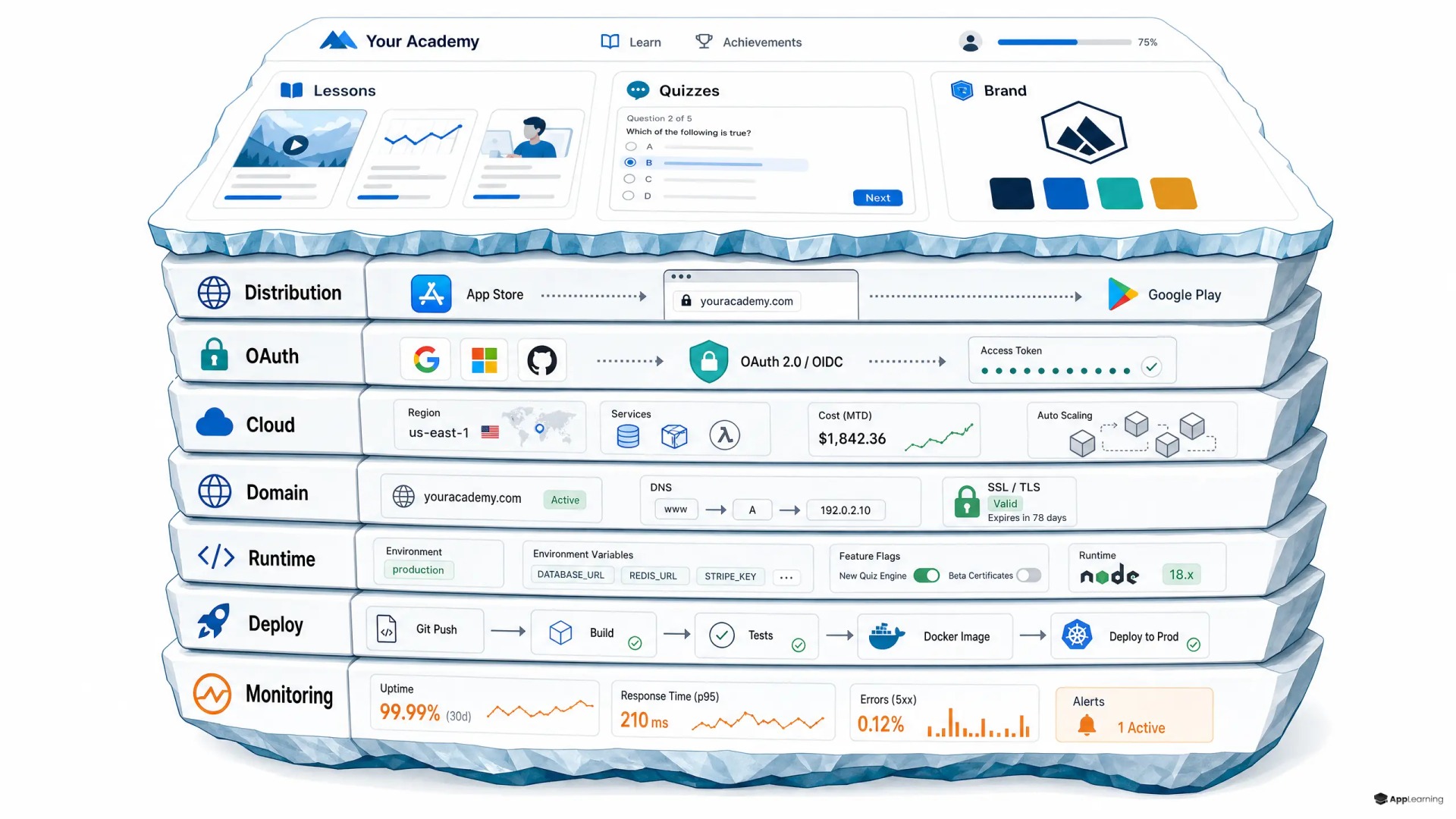
The invisible work sits in recurring queues
- Review app store and SDK policy changes before deadlines become release blockers.
- Monitor OAuth clients, secrets, redirect URIs and consent-screen requirements.
- Control remote configuration usage, caching and billing thresholds.
- Maintain SPF, DKIM, DMARC, DNS and sender reputation for academy mail.
- Separate staging and production dependencies so tests do not damage live access.
- Document ownership for alerts, renewals, audits and emergency fixes.
Good to know
Who should own white label LMS maintenance?
The managed academy partner should own platform monitoring, policy review, release dependencies, authentication, configuration and domain-security checks.
Why does this matter for fintech product teams?
Financial products already carry cognitive load. If the learning layer fails, activation, trust and support volume can all move in the wrong direction.
Can an internal team manage the invisible layer?
Yes, if ownership, alerting, documentation and release capacity are explicit. Without that, maintenance becomes reactive work for the core product team.
Launch is the wrong finish line
The riskiest handover says the academy is live and the project is done. That leaves a product lead with a branded learning product but no clear owner for distribution notices, authentication warnings, domain records or cloud cost drift. The core fintech team then becomes the fallback maintenance team.
This is the difference between a themed LMS and a managed academy platform. One delivers an interface. The other protects the operating conditions that let education keep working inside a fast-moving product.
A managed academy has named ownership
App-Learning works as the academy technology partner behind the branded experience. The client gets an embedded learning product that fits the brand, market and activation journey. App-Learning owns the operational layer that keeps login, delivery, configuration, security and platform economics stable over time.
A managed contract should make that ownership explicit. It should define who watches vendor policy changes, who checks authentication lifecycles, who manages release dependencies, who reacts to pricing changes and who validates domain security after DNS or mail-provider changes.
Build the academy without inheriting the maintenance load.
TalkThe brand stays simple because the stack is managed
Learners should not see the maintenance layer. Product teams should not have to rediscover it during an outage. A branded academy is valuable only if it remains available, trusted and economically stable after launch. That is why mobile learning platform maintenance is part of product architecture, not aftercare.