
Key takeaways
- Local educators create trust and contextual relevance.
- Hands-on wallet practice beats passive Bitcoin content.
- Digital reinforcement improves consistency across markets and languages.
- Analytics show where learners still struggle after workshops.
Trust is the first interface
Bitcoin education fails when it treats knowledge as a PDF problem. New users are not only asking what a seed phrase is. They are asking whether the product is safe, whether the educator is credible and whether one mistake can cost them money. The OECD work on crypto-asset users warns that low digital financial literacy makes people more vulnerable to crypto-asset risks.
Self-custody training is more sensitive than normal onboarding. A user can reset a password. They cannot treat private keys, recovery words or irreversible transactions with the same mindset. Good wallet education must therefore change behavior, not just explain terms. It must help the learner practise the exact decisions they will face when they secure, receive, send and recover funds.
Local educators carry the context
The Trezor Academy programme is useful because its model is concrete: free in-person sessions led by local Bitcoin experts, a structured path from Bitcoin basics to safer usage and hands-on workshops with onchain and Lightning wallets. This is not generic content distribution. It is Bitcoin community education built around people, places and repeated contact.
That is what localized Bitcoin learning does well. The facilitator can answer the question people are afraid to type into a support form. The group can surface local myths, exchange realities and security habits. The learner can see another person complete the wallet action in front of them. Trust becomes embodied before it becomes digital.
The room does not scale the system
Meetups are strong at trust formation but weak at continuity. Once the room clears, the sponsor loses visibility. Did learners remember the recovery process? Did they understand the trade-off between an exchange balance and self-custody? Did the Lightning exercise create confidence or only a good moment in the workshop?
Trezor is clear that the Academy is not an online course but an in-person meetup model. On July 23, 2026, the same public schedule listed June 2026 entries for Nigeria and Burkina Faso and July 2026 series in South Africa, Uruguay and Bolivia, including Bolivia sessions on July 21, July 22 and July 23. The schedule proves reach. It also shows the operational challenge: every location needs consistency after the local event ends.
Good to know
How can a Bitcoin company use local workshops without losing product consistency?
Use local educators for trust and context, then connect each workshop to a standardized mobile learning path with approved content, practice tasks, quizzes and analytics.
Is digital learning a replacement for local Bitcoin educators?
No. The Trezor Academy model is built around in-person sessions, and the stronger digital role is reinforcement after the trusted local interaction.
What should be measured after a Bitcoin education workshop?
Measure lesson completion, quiz accuracy, repeated misconceptions, confidence changes, delayed recall, wallet task completion and follow-on adoption of relevant product features.
The loop after the workshop
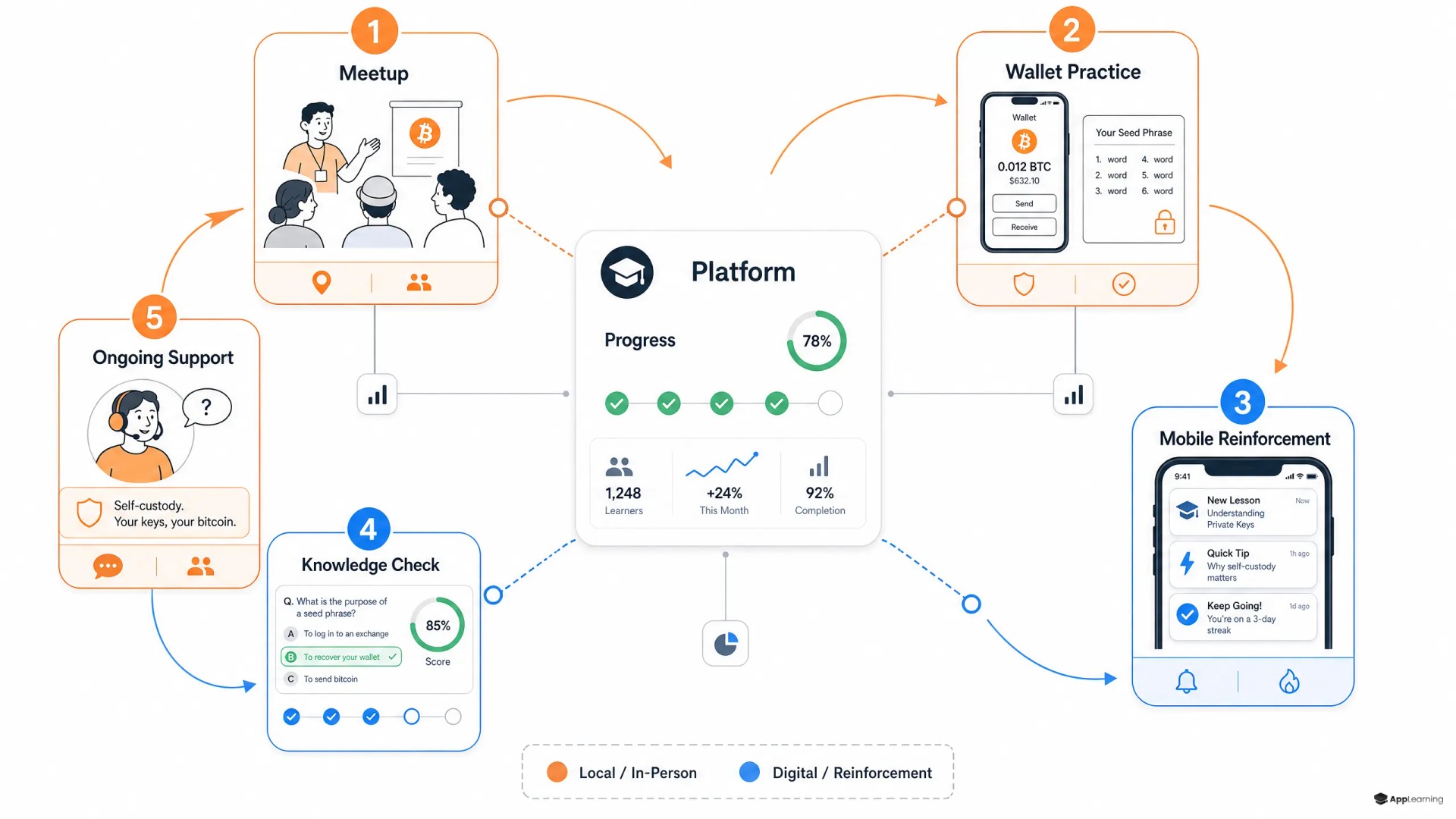
The scalable model is not an online course replacing the facilitator. It is a local-to-digital loop that keeps the educator in the trust role and gives the sponsor a measurable learning system.
- Workshop: the local facilitator creates context, answers questions and guides the first wallet actions.
- Practice: learners complete small wallet tasks with clear safety boundaries.
- Reinforcement: a mobile path repeats key concepts through short missions and scenario questions.
- Assessment: quizzes and confidence checks show whether the learner can apply the lesson.
- Support routing: the product team sees where confusion remains and updates content fast.
The learning science is not mysterious. A review by Dunlosky and colleagues found strong support for practice testing and distributed practice. For a Bitcoin education platform, that means fewer long lectures and more short checks: identify a phishing pattern, choose the safer backup option, explain when to use cold storage and repeat the action later.
Analytics make the loop operational. The xAPI specification describes how learner activity can move between learning technologies, but the product principle is simple: track the moments that predict safe usage. Completion alone is weak. Better signals include quiz accuracy, repeated errors, delayed recall, confidence shifts and feature adoption after the lesson.
Build the learning layer your Bitcoin users keep.
TalkWallet education as partnership infrastructure
A wallet company does not need to own every local group. It needs repeatable education operations around those groups. The Trezor Academy study materials already point in this direction with videos, slide decks, translated resources and brand assets that make local delivery less fragile.
The partnership model is straightforward. Local educators keep the relationship. The Bitcoin or wallet company provides curriculum standards, product-safe explanations and clear security boundaries. App-Learning adds the mobile reinforcement layer after the workshop, with modular lessons, localization workflows, gamified practice, progress tracking and analytics for sponsors.
This also fits the security nature of self-custody. NIST SP 800-50 Rev. 1 frames cybersecurity learning as a lifecycle with metrics and regular improvement, not as a one-off training event. Bitcoin companies should treat self-custody education the same way. Teach, observe, reinforce, measure and update.
Bitcoin education scales when trust and system design stop competing. The facilitator earns attention. The wallet exercise creates consequence. The digital layer keeps the lesson alive after the room empties. That is the local-to-digital loop Bitcoin companies need if they want users who do more than complete onboarding. They understand what they are holding and how to hold it safely.