

Key takeaways
- Complexity becomes a growth issue before teams call it an education issue.
- Static help content cannot build confidence across different user knowledge levels.
- A customer education platform connects learning paths to activation and adoption goals.
- Bitcoin products need education at moments of hesitation, not only in an academy.
- The right platform improves user understanding and internal content operations.
Complexity becomes visible in the funnel
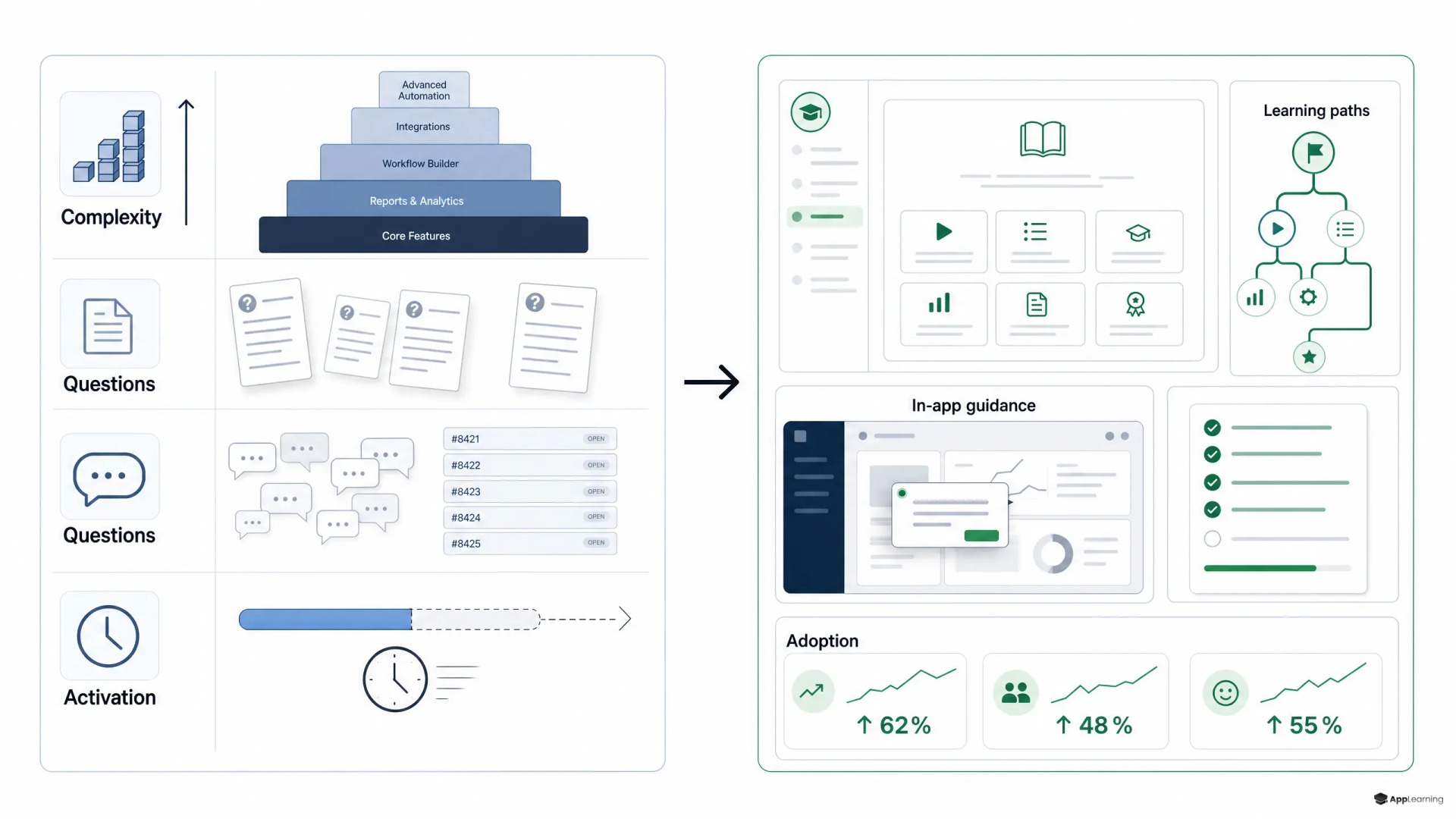
The trigger for a customer education platform is not a larger content backlog. It is the moment product complexity starts to tax growth. Users still sign up, but they hesitate before the first meaningful action. They read support articles, then ask support the same beginner questions. They see advanced features, but do not build enough confidence to use them.
This is common in Bitcoin products. The product may be clear to the team, but the user is handling new mental models at once: volatility, custody, private keys, fees, savings plans, wallets, recurring buys, tax concerns, scams, and regulation. A complex product can create value and doubt at the same time. Research on product complexity shows that feature count, feature heterogeneity, and feature interdependence can all shape adoption because customers weigh expected capability against the effort of learning and use in consumer product adoption.
Support content solves incidents, not progression
A help center is useful when the user knows the task and meets a problem. It is weak when the user does not yet know what matters, what to trust, or what action to take next. Static support content explains isolated issues. Education has to create progression.
That progression matters in trust-heavy journeys. The OECD reports that, across 39 economies in 2023, only 55% of crypto-asset holders understood that such assets were not legal tender in their jurisdiction, and it highlights the need for stronger digital financial literacy among crypto users in its 2025 report on crypto-asset users. For a Bitcoin company, that gap shows up as onboarding friction, support load, and weak conviction after the first transaction.
The user is not only learning where to tap. They are deciding whether the product is safe, whether Bitcoin makes sense, whether a recurring buy is responsible, and whether self-custody is too risky. FINRA’s investor guidance lists risks such as fraud, theft, regulatory uncertainty, and limited protections for some crypto assets, which makes education part of the trust layer rather than a marketing add-on in crypto asset risk guidance.
A platform turns content into an operating system
A customer education platform changes the operating model. The team stops publishing disconnected explainers and starts managing learning journeys against product outcomes. The unit of work becomes a path, not an article.
- Beginner, intermediate, and advanced tracks for different knowledge levels
- Contextual lessons triggered from onboarding, wallet setup, or first purchase flows
- Quizzes that show whether users understand core concepts before high-stakes actions
- Localization workflows for new countries, languages, and regulatory contexts
- Analytics that connect lesson progress with activation, feature adoption, and retention
- Reusable content modules that product, support, compliance, and growth teams can maintain together
This is where platform architecture matters. App-Learning’s academy model combines content production, learning management, and an engagement layer for branded web and mobile academies, with features such as learning paths, quizzes, certificates, SSO, API options, deep links, and embeds described on the App-Learning platform site. For a product team, the point is not to own another content repository. It is to make education deployable inside the product journey.
Education improves activation by reducing uncertainty
Activation depends on confidence. A user who understands why a savings plan exists is more likely to complete setup. A user who understands custody trade-offs is less likely to abandon a wallet flow. A user who knows what volatility means is less likely to churn after the first price swing.
The evidence base supports the operational logic. In the public cloud field experiment cited above, proactive customer education reduced first-week churn, cut first-week questions by 19.55%, and raised longer-term usage. That does not mean every Bitcoin product will see the same numbers. It does show that education can change product behavior when it reaches users early enough and teaches the actions that unlock value.
The buying signals are operational, not cosmetic
Teams usually wait too long because they treat education as a content problem. The stronger signal is operational drag. A customer education platform becomes worth evaluating when these patterns repeat across cohorts or markets.
- Onboarding completion drops before the first buy, deposit, or wallet setup
- Support tickets cluster around the same beginner concepts
- Users activate once but do not return or build a habit
- Advanced features stay unused because they require explanation
- Compliance reviews slow every new educational asset
- Country expansion creates duplicated localization work
- Product teams avoid education work because internal bandwidth is limited
- Growth experiments fail because users lack the confidence to act
Good to know
When does a Bitcoin company need a customer education platform?
A Bitcoin company should evaluate a platform when onboarding friction, repeated beginner support questions, weak feature adoption, or low post-transaction retention point to a user confidence problem rather than a pure UX problem.
Is a help center enough for customer education?
A help center is useful for troubleshooting, but it rarely creates structured progression. Customer education needs guided paths, contextual triggers, quizzes, analytics, localization, and a clear link to activation goals.
How should education connect to product analytics?
Learning data should be compared with activation, first purchase, wallet setup, recurring buy adoption, support volume, and retention. The goal is to see whether user understanding changes product behavior.
Can customer education stay outside the app?
Some academy content can live outside the product, but high-impact Bitcoin education should also appear in context. The most important lessons should be available at the exact moment a user hesitates.
Bitcoin education belongs inside the product
A Bitcoin customer education platform should not feel like school bolted onto an app. It should appear when the user needs it. Before the first purchase, it can explain volatility, fees, and long-term saving behavior. Before wallet creation, it can explain private keys and recovery. Before recurring buys, it can explain dollar-cost averaging without giving investment advice. Before self-custody, it can test whether the user understands irreversible transactions.
Gamification can help when it supports mastery instead of distraction. Points, streaks, rewards, quizzes, and progress maps work best when they guide the user through real product decisions. App-Learning has applied that model in Bitcoin education through short lessons, quizzes, a glossary, certificates, and Learn-to-Earn mechanics in Simple Bitcoin. The commercial value is not the game layer by itself. It is the behavior it helps create: more informed users, fewer repeated questions, and more confident product adoption.
Build customer education into the product journey.
PlanThe platform decision is a growth systems decision
The question is not whether users need more explanations. They do. The real question is whether those explanations are part of the growth system. If education sits outside the product, teams cannot reliably use it to reduce hesitation, qualify understanding, support localization, or improve activation. If it sits inside the product journey, it becomes an adoption layer.
Product complexity is not a defect. In Bitcoin, it is often the source of the value. But unmanaged complexity turns into delay, doubt, and churn. A customer education platform becomes essential when the product has outgrown static support and needs a repeatable way to turn understanding into action.