

Key takeaways
- AI-generated content does not solve motivation by itself.
- Gamification must reinforce practice, not decorate the learning flow.
- Personalization matters only when it creates repeat action.
- Learning engagement analytics must connect activity to transfer.
AI tutors hit the activation wall
AI tutors have made explanation cheap. A fintech can now generate a plain-language answer about repayment logic, wallet security, portfolio risk or staking rewards in seconds. That is useful. It is not the same as learning. A June 2026 piece in The Atlantic captured the core failure: access to AI tutoring can rise while regular use stalls. The bottleneck is not content supply. It is the user’s willingness to return, practice, test judgment and apply the concept inside the product.
Motivation is the missing infrastructure
Digital learning often fails at the same point as fintech onboarding. The first explanation is clear enough. The next action is weak. Users read, nod, close the app and never build the mental model needed to trust the product. For growth teams, this is an activation problem. For learning designers, it is a motivation design problem.
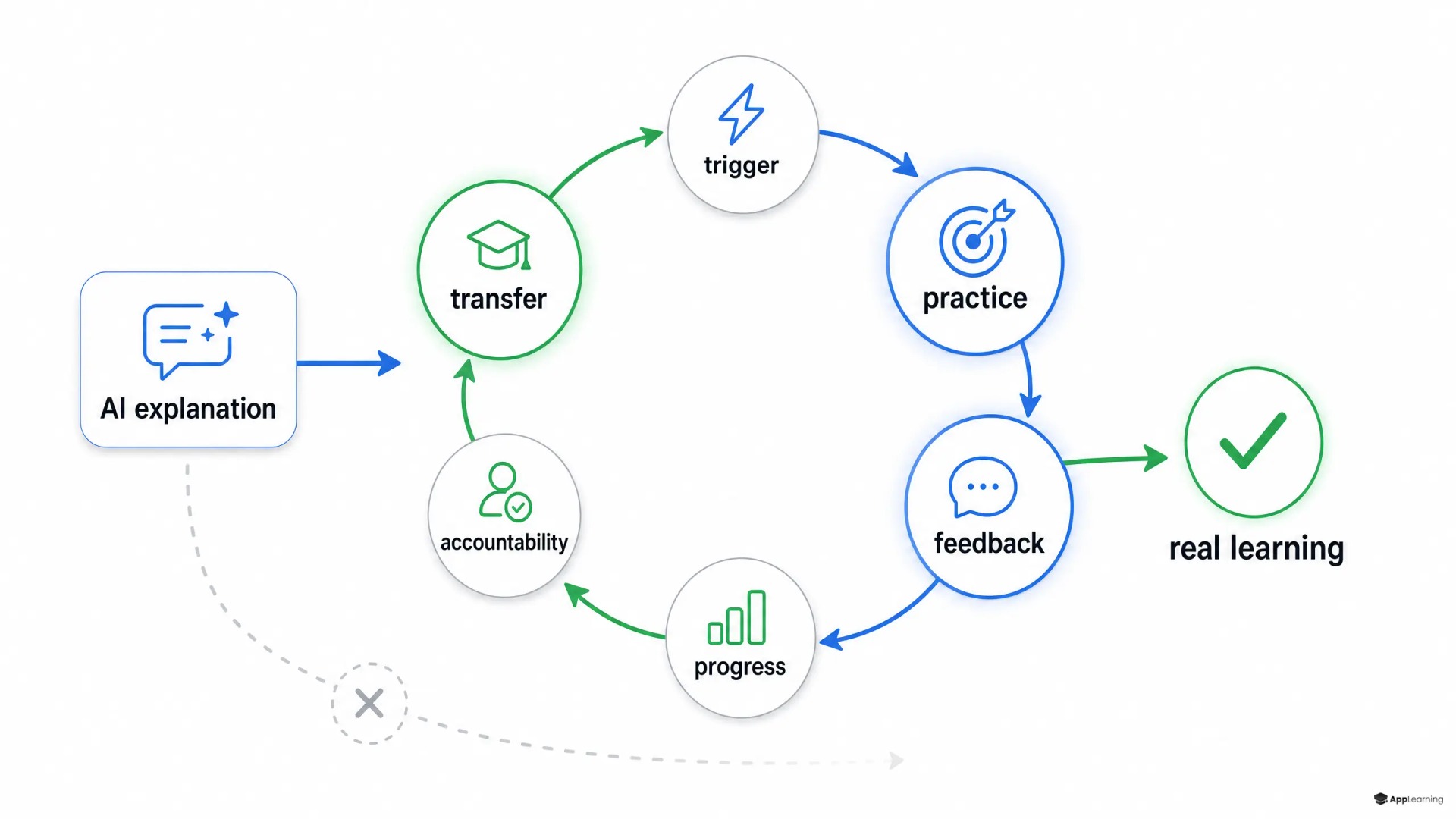
Motivation design gives the learning flow a behavioral system. It defines triggers, sequence, effort, progress, feedback, social proof and accountability. It asks a practical question: what should the user do next, and why would they do it now? An AI learning platform without this layer becomes a help desk with unlimited answers. It supports the motivated minority and misses the users who most need guidance.
Game mechanics must protect practice
Gamified learning works when the mechanics make practice easier to start and harder to abandon. Bad gamification makes users chase points while avoiding the skill. A Learning at Scale study on gamification misuse found risks around competitiveness, overindulgence in play and herding. In fintech education, that risk is serious. A user should not speed through a crypto-risk module for a badge while missing the difference between yield, volatility and custody.
- Progress should show mastery, not screen consumption.
- Rewards should mark useful effort, not empty clicks.
- Feedback should correct decisions close to the moment of practice.
- Social proof should normalize completion and careful behavior.
- Challenges should rehearse product moments users will actually face.
The stronger pattern is quieter. A learner-preference study found that learners value progress bars, concept maps, immediate feedback and achievements when they support the learning process. That is the line to hold. Game mechanics are not entertainment. They are scaffolding for repeated action.
Personalization has to create the next action
AI is still valuable. It can adapt language, difficulty, examples and feedback. The Open TutorAI paper shows where the field is moving: modular tutoring, onboarding, learning paths, multimodal interaction and learner analytics. But personalization is not the end state. A personalized explanation must lead to a concrete next step: answer this scenario, compare these options, explain this risk back, complete this product setup, or revisit the concept after a real transaction.
For fintech and crypto teams, this changes the brief. Do not ask the AI tutor to produce more articles. Ask it to support a journey: diagnose the user’s starting point, trigger the right micro-lesson, adapt the practice, give feedback, and return the user to the product with more confidence and better judgment.
Good to know
Why are AI tutors not enough for fintech education?
They can explain complex topics, but users still need prompts, practice, feedback and reasons to return.
Where does gamification help most?
It helps when it supports mastery signals, scenario practice, progress visibility and timely feedback.
What should product teams measure?
Measure completion, return frequency, accuracy, confidence, support impact and product behaviors after learning.
Measurement turns education into a growth lever
At App-Learning, the motivation layer is designed to make user education measurable. Content completion alone is too weak. The useful signals are completion, return frequency, quiz accuracy, confidence shifts, scenario performance and applied behavior in the product. If a wallet-safety module does not change setup behavior, it has not transferred. If an investing lesson raises confidence but not accuracy, it may be creating risk.
Learning engagement analytics should connect the journey to activation and retention. Which lessons reduce support tickets? Which simulations improve first meaningful action? Which cohorts return after spaced reminders? Which concepts predict churn when misunderstood? These questions move education out of the content calendar and into the product operating system.
Build a fintech education flow that users finish.
PlanThe advantage moves from content to transfer
AI tutors will keep improving. Explanations will become faster, cheaper and more fluent. That will not be enough. The next advantage belongs to teams that design the conditions for effort: clear triggers, visible progress, useful feedback, social accountability and proof that users can apply what they learned. In complex fintech products, education wins when it changes behavior, not when it produces another explanation.