
Key takeaways
- Tokenization changes fund operations and access more than the underlying investment product.
- Wallets, transfer rules and settlement add new investor decisions.
- Legal ownership and redemption mechanics must be explained in plain language.
- Embedded education can reduce confusion before it becomes support demand or unsuitable use.
Tokenized funds are not simply conventional funds with a new interface. They introduce a new investor journey around eligibility, wallets, transfer controls, settlement and redemption. Product teams that treat this as a technical upgrade will create an avoidable confidence gap. Tokenized fund education is part of the product design.
Fund Distribution Moves Onchain
Tokenization is moving into asset management because it can place regulated fund shares in digital, programmable environments. The Investment Company Institute’s July 2026 asset-management perspective frames the opportunity around distribution, transfer and use of fund interests—not a move into crypto speculation. Potential benefits include new digital channels, fractional access, streamlined operations and better connection to wallet-based financial services. But each benefit changes the customer experience, which makes investor understanding an operational requirement.
This is already visible in regulated products. The May 2026 prospectus for JPMorgan OnChain Liquidity-Token Money Market Fund describes token balances that correspond to fund shares and can be used to submit transaction requests on a blockchain. The infrastructure is real. So is the need to explain it without turning every investor into a blockchain specialist.
The Product Is Familiar but the Journey Is Not
A tokenized share may still represent an interest in a regulated fund with the same investment strategy, risk profile and governance. Yet the form of ownership matters. The SEC’s statement on tokenized securities makes clear that tokenization models can differ in structure and in the rights afforded to holders. Investors need to know whether they hold the share directly, hold an entitlement through another party, or use a token that triggers an offchain ownership update.
The distinction is not academic. In the JPMorgan fund’s disclosed model, the transfer agent’s investor register is the official ownership record, and legal ownership transfers only when that register is updated. A token transfer can therefore be a visible event in a wallet without being the final legal event an investor assumes it is. That is the kind of detail tokenized securities onboarding must make clear at the moment it matters.
The Operational Knowledge Gap
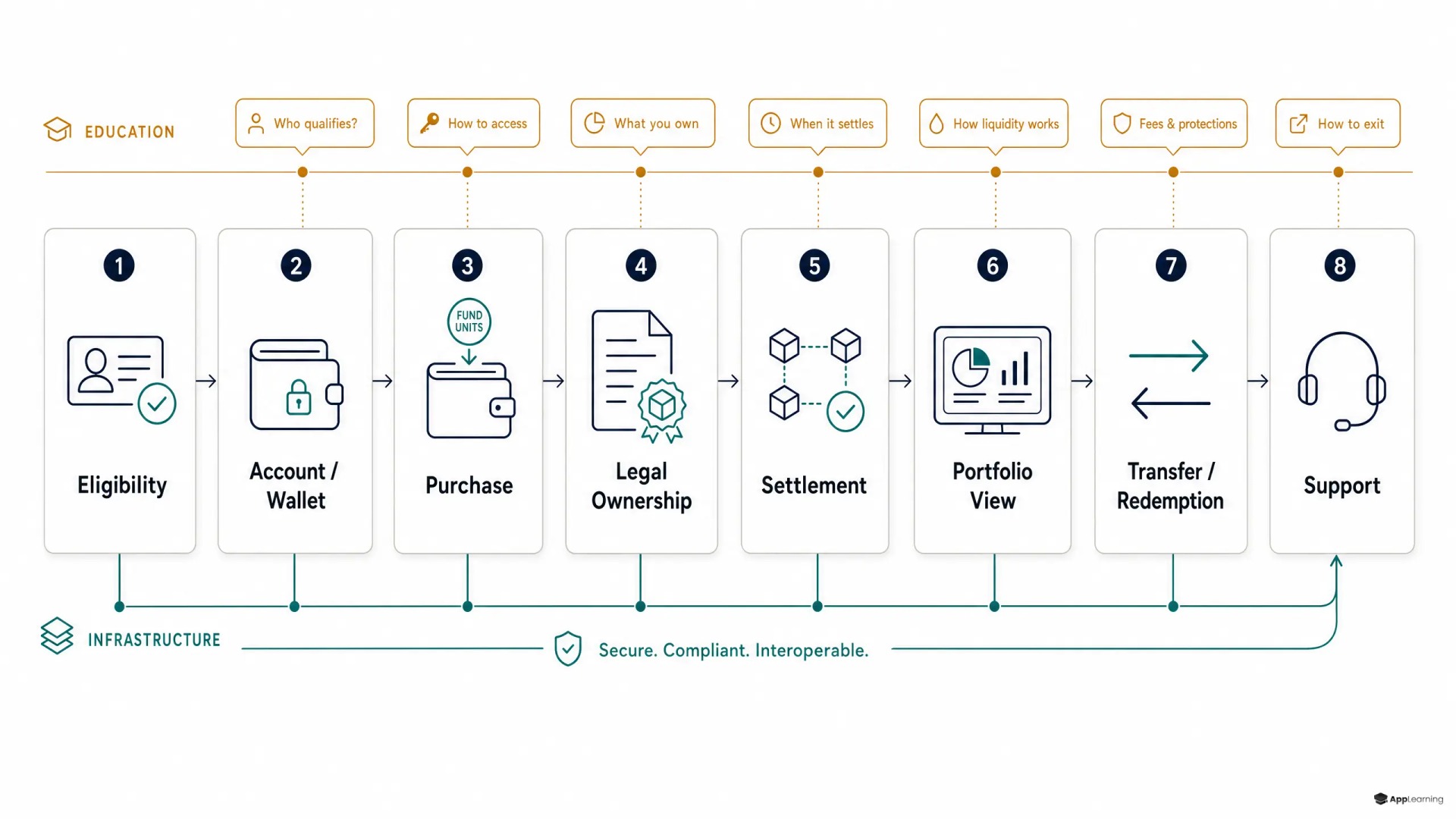
Investor education tokenization should map to decisions, not definitions. The relevant questions appear across the full journey:
- Eligibility and jurisdiction rules before an investor begins onboarding
- Wallet choice, custody model, private-key responsibility and recovery paths
- Allow-listed addresses and transfer restrictions
- The record that establishes legal ownership
- When a blockchain instruction is submitted, processed and settled
- The difference between a peer-to-peer transfer, secondary liquidity and fund redemption
- Network fees, fund fees, cut-off times and exception handling
- Protections when an address, key or transaction goes wrong
These are product-specific mechanics. For example, the same fund prospectus requires approved wallet addresses, assigns private-key responsibility to the investor or wallet provider, and describes circumstances where investors bear blockchain transaction fees. Generic explainer content will not prepare an investor to act safely inside a particular fund flow.
Good to know
Is a tokenized fund the same as cryptocurrency?
Not necessarily. Tokenization can change how a fund share is issued, recorded or transferred without changing the fund’s underlying investment strategy. The SEC’s tokenized-securities statement notes that structures and holder rights can vary, so investors must understand the specific product model.
What should tokenized-fund onboarding explain first?
Start with eligibility, the wallet or custody model, the official ownership record, transfer limits, fees and redemption mechanics. These are the decisions that determine whether an investor can use the product safely.
Can education replace fund disclosures and suitability controls?
No. Education should make disclosures and product controls usable in practice, not replace legal documentation, compliance processes or investor-protection requirements.
Education Must Sit Inside the Flow
The right model for digital asset product education is short, contextual and verifiable. Teach the next decision before the investor makes it. Confirm comprehension before an irreversible or high-friction action. Keep deeper material available for investors who need it, but do not bury essential operational facts in a help centre or a long legal document.
- Use guided modules before wallet connection, purchase and redemption
- Show scenario-based explanations for transfers, delays and lost-access events
- Use short knowledge checks to identify confusion before a transaction fails
This approach also gives product teams evidence. Completion data and quiz responses can reveal where users misunderstand custody, settlement or liquidity. That insight can improve interface copy, partner training, disclosures and support operations. It is more useful than measuring content views alone.
Turn tokenized fund complexity into informed product use.
Talk to usConfidence Is a Product Capability
For asset managers, tokenization providers and fintech distributors, onchain fund distribution needs an education layer that travels with the product. App-Learning can support branded, mobile-first learning journeys for investor onboarding and partner enablement, with multilingual content, embedded quizzes and learning analytics. The aim is not to simplify away material risks. It is to make the real mechanics understandable before investors commit capital or initiate a transfer.
The strongest tokenized-fund experience will not ask investors to trust unfamiliar rails because they are new. It will show them, step by step, what they own, what they control, what the fund controls and how to exit. That is how technical infrastructure becomes informed product use.