

Key takeaways
- Content access does not create learning outcomes or product understanding.
- Editorial material needs objectives, sequencing, practice, and assessment.
- A governed update workflow protects accuracy when source content changes.
- Learning analytics reveal which topics improve activation and retention.
Education partnerships are becoming a distribution model
Trusted publishers and financial brands already hold two scarce assets: expertise and audience attention. The next move is to make that expertise usable at the moment people need it. On May 27, 2026, NGPF and Dow Jones announced an August partnership that will bring Wall Street Journal, Barron’s, and MarketWatch material into ten personal-finance topics for a network of more than 140,000 teachers and 5 million students.
For a Head of Growth at a fintech, the same pattern matters beyond the classroom. Product complexity creates friction before signup and after activation. A strong content partnership education model can earn demand through useful explanations, then turn that attention into guided product understanding. But a feed of articles is not yet a growth system.
A library informs while a learning product changes behavior
Editorial content is designed to explain a current event, interpret a market movement, or report a fact. Learning products are designed to help a person build a capability over time. They define the starting point, the next decision, the practice required, and the evidence of understanding.
That distinction is operational. A customer who reads five articles about credit may still not know how utilization, payment timing, and loan applications affect a credit profile. A learning path can establish those concepts in sequence, use scenarios to test choices, and reveal where the learner is stuck. This is the difference between a branded academy that looks credible and one that supports activation.
- A clear learner outcome for every module
- A sequence that removes prerequisite gaps
- Practice that mirrors real financial decisions
- Assessments that distinguish completion from understanding
- Progress signals tied to activation and retention
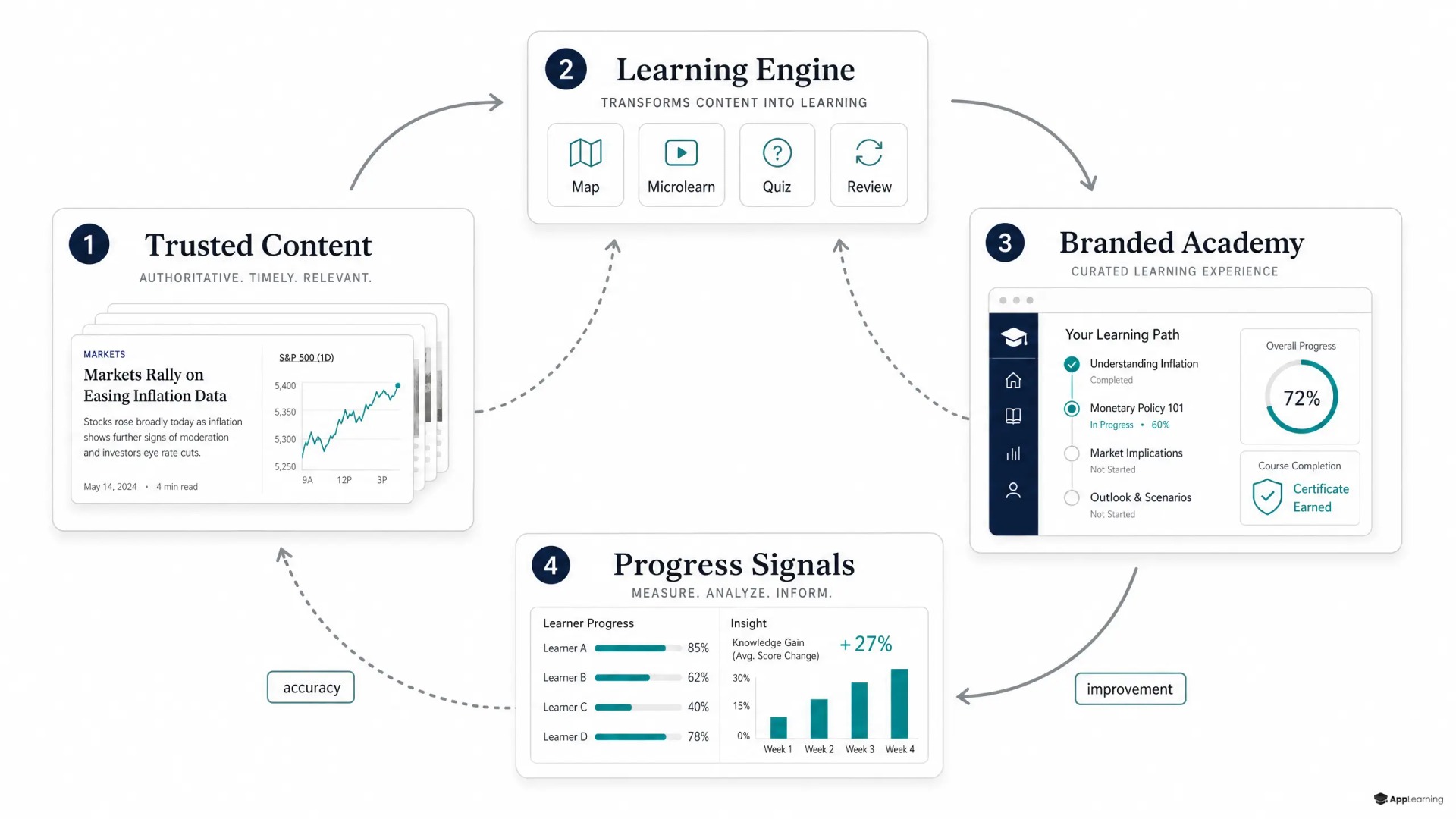
The transformation layer turns reporting into capability
Editorial content to curriculum is not a bulk conversion exercise. It is a governed workflow that treats reporting as a source asset, not as a lesson by default. The work starts by defining a capability map: the decisions a learner must make, the concepts behind those decisions, and the level of confidence required.
Then a learning team can decompose relevant articles into reusable knowledge objects. It identifies durable principles, time-sensitive examples, definitions, claims that require review, and suitable practice formats. A current article on interest rates may become a short context briefing inside a larger borrowing module. It should not become the whole module.
- Map editorial themes to learner jobs and measurable objectives.
- Tag source material by topic, audience, regulatory sensitivity, and expected shelf life.
- Build concise lessons around stable principles rather than individual articles.
- Use current reporting as examples, simulations, prompts, and update triggers.
- Add formative checks and a defined completion rule.
- Route every published learning asset through editorial and subject-matter approval.
Authority depends on update governance
Financial information changes. Rates move, rules evolve, products change, and reporting is corrected or expanded. A partner academy must preserve the source’s authority without forcing editors to manage a second publishing operation.
The answer is separation with traceability. The editorial team retains ownership of source content. The learning layer records which lessons depend on which source assets, which claims are time-bound, who approved the instructional interpretation, and when a review is due. When a source changes, the system should flag affected lessons, not ask a team to search an entire academy by hand.
This model is already visible in financial education. On March 2, 2026, FICO announced that its credit curriculum would be integrated into Banzai, combining subject expertise with an education platform that provides interactive simulations and teacher-facing delivery. The important design choice is not content placement. It is the conversion of expert material into structured practice.
Good to know
What makes a branded academy different from a content hub?
A content hub organizes information. A branded academy organizes learner progress through defined outcomes, sequenced modules, practice, assessment, and completion signals.
How can a fintech use education without turning it into product promotion?
Start with the customer decision, not the product feature. Teach durable concepts, disclose the source and purpose of content, and use product examples only where they help learners apply the concept.
How should editorial teams handle changing source material?
Maintain source-to-lesson traceability, assign owners and review dates, and flag affected learning assets whenever a source is updated, corrected, or retired.
Which metrics show whether learning supports growth?
Track progression and assessment performance alongside consented funnel metrics such as onboarding completion, feature adoption, repeat use, and retention by learning cohort.
Growth teams need evidence beyond reach
Page views, open rates, and social reach describe attention. They do not show whether education reduces uncertainty or moves a user toward a valuable action. A financial education platform should connect learning data to growth data while respecting consent, privacy, and appropriate separation from regulated decisioning.
Measure the full path: enrolment, module starts, lesson completion, assessment confidence, return rate, product onboarding completion, feature adoption, and retention by capability area. Compare cohorts that complete a learning path with those that only consume content. Then test the learning design itself. If learners finish a module but fail its scenario checks, the problem may be sequence or practice, not distribution.
Turn your expertise into measurable learner progress.
TalkThe partner academy becomes a managed growth asset
App-Learning can operate as the transformation layer between a partner’s editorial feed and its branded academy. The partner keeps its voice, evidence standards, and editorial control. App-Learning supplies the capability architecture, instructional design, interactive formats, assessment logic, update governance, and analytics needed to make knowledge usable.
That creates a more durable acquisition asset than a campaign landing page. It gives prospective customers a reason to return before they are ready to buy, helps new users understand a complex product when it matters, and gives growth teams evidence about the concepts that unlock activation. The knowledge already exists. The advantage comes from building the learning path around it.