

Key takeaways
- Aggregate events and learner records answer different operational questions.
- Course and module identity belong in tracking from day one.
- Multi-course reporting must drill from academy level to learner and quiz level.
- Retrofitting course-aware analytics creates mapping work and unreliable history.
One course leaves room for ambiguity
A first course often makes aggregate analytics look sufficient. The team can see visits, starts, completions, time in the app and broad drop-off points. For a single onboarding path, those signals may be enough to improve the experience. Product teams can spot a weak screen. L&D teams can see whether participation is moving in the right direction.
The weakness sits underneath the dashboard. Events may tell you that people watched a video or failed a quiz, but not reliably which course, module, content version or assigned cohort created that event. Learning-data standards such as the xAPI data model explicitly separate the person performing an action from the activity and its context. That distinction matters long before a team needs a formal data warehouse.
In a regulated finance or crypto business, this gap is easy to miss when compliance learning is a single annual programme. It becomes visible when the academy expands into onboarding, role-specific capability building, leadership training and updated policy modules. The questions become more specific than an aggregate chart can answer.
The second course changes the reporting unit
Once an academy contains several courses, stakeholders stop asking whether people are active. They ask where activity happened, who is struggling and whether a specific learning intervention worked. That is the moment multi-course academy analytics becomes a data-model problem rather than a dashboard problem.
A portfolio view should still show adoption across the academy. But it must also let a manager isolate one course, compare modules within it, inspect quiz results and understand progress for an individual learner. If course identity exists only in naming conventions, URL patterns or a spreadsheet maintained beside the LMS, course-level reporting becomes fragile.
- Which required course has the lowest completion rate?
- Which module causes learners to abandon a specific onboarding path?
- Which quiz item is difficult within one course rather than across the whole academy?
- Which learners have started but not completed their assigned compliance update?
- Did the latest version of a course improve understanding or merely increase clicks?
These are different questions from “How many sessions did the academy have?” They require data that retains its learning context. Caliper Analytics follows the same basic logic by defining a shared language for learning activities such as reading, media use and assessment interactions.
Two data systems with different jobs
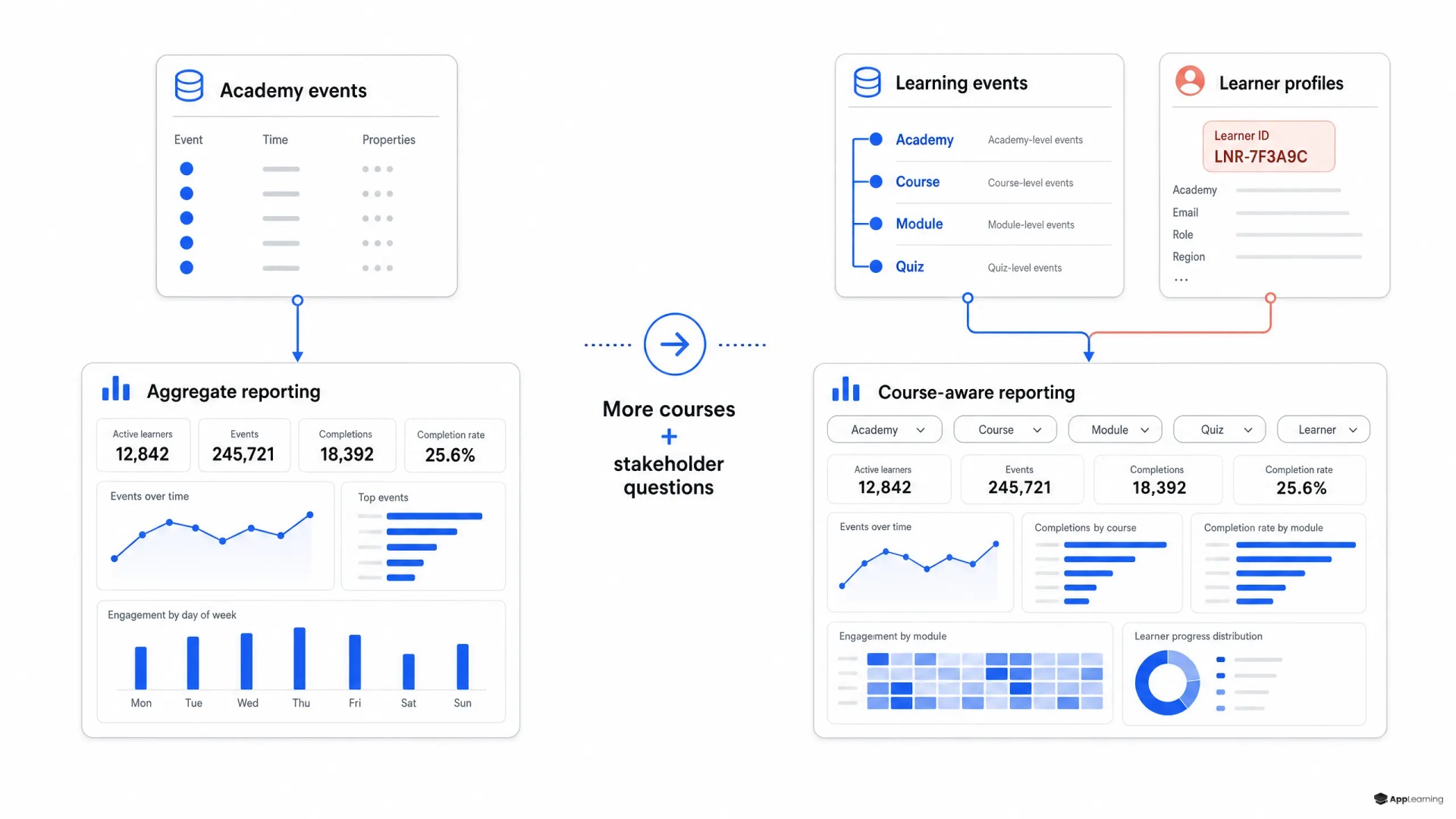
Behavioral event analytics and learner-profile analytics should work together, not compete. Event analytics is suited to product questions. It helps a team see navigation paths, feature usage, session patterns and points of friction. It is useful for improving the learning experience itself.
Learner analytics is suited to learning-performance questions. It connects a known learner with enrolment, assigned course, progress state, completion, assessment attempt and result. This record supports operational follow-up: who needs a reminder, which cohort needs support and where a course needs revision.
Trying to force one source to answer both sets of questions usually creates a compromise. A product-events tool may be fast and flexible but lack a durable learner record. A reporting database may contain authoritative completion data but not reveal every interaction pattern. A resilient LMS analytics architecture accepts the split and connects the two through stable identifiers.
Good to know
Can aggregate product analytics replace learner reporting?
No. Product analytics is useful for behaviour and experience patterns, while learner reporting connects named people to enrolments, progress, completions and assessment results.
Can course-level reporting be added later?
Yes, but historical events often need manual mapping or cannot be assigned reliably. Retrofitting also creates extra work each time content, course structure or naming changes.
Should every event include a course ID?
Every event should be attributable to a course through a reliable relationship. Direct course IDs are simplest, while module and content IDs should also resolve deterministically to the relevant course and version.
Identifiers form the reporting layer
Every meaningful learning event should carry enough context to be attributed without reverse engineering. The learning data model does not need to be complicated, but its identifiers must be stable, documented and present from the first release.
- A persistent learner ID rather than a display name or email alone
- A course ID and course-version ID
- A module or lesson ID and content-version ID
- An enrolment, cohort or assignment ID where relevant
- An assessment ID, question ID and attempt ID for quiz events
- A timestamp and a clear event definition such as started, viewed, submitted or completed
Versioning is especially important in compliance-heavy environments. When a policy module changes, reporting must distinguish learners who completed the current version from those who completed an earlier one. Without that distinction, a completion figure can look reassuring while masking an outdated learning record.
Build learning reporting that stays useful as your academy grows.
Talk to usCourse-aware reporting turns data into action
App-Learning structures reporting around this separation. The behavioural layer can show activity across the academy and help improve the product experience. A separate reporting layer based on learner-profile data can move from the full portfolio into a course, module, quiz or individual learner record.
This approach came into focus in a live multi-course academy. The existing event-analytics view showed activity across the academy, but it could not cleanly isolate one course. The learner-profile reporting layer could provide per-user progress, quiz difficulty and deeper course views. The practical lesson was clear: aggregate events and identity-linked records serve different reporting needs.
For HR and L&D leads, the operational gain is not another dashboard. It is faster answers when a compliance update changes, a role-based programme underperforms or leadership asks for evidence beyond completions. Teams can improve the learner experience without losing the traceable records needed to manage capability building.
The first course may tolerate an incomplete analytics setup. The second course exposes every missing identifier, improvised mapping and disconnected report. Build course and module identity into the model early, and the academy can grow without turning every reporting request into custom data work.