

Key takeaways
- Shared objective and concept IDs connect content, assessment results and improvement work.
- Reporting only becomes useful when results trace back to teachable content.
- A common data model removes reconciliation work and exposes real learning gaps.
- Strong platforms link authoring, delivery, assessment and iteration in one loop.
The hidden cost of disconnected learning systems
Growing startups often solve onboarding in layers. The handbook sits in a knowledge base. Lessons live in an LMS. Managers create quizzes in separate tools. Progress appears in another dashboard. At 10 people, this is manageable. At 50, it creates a system nobody can inspect end to end.
The problem is not merely too many tools. It is that each tool names the same knowledge differently, or does not name it at all. A lesson on product security may have a title. A quiz question may have a tag. A dashboard may show a score. But if these records do not share stable identifiers for the underlying concept and objective, the company cannot answer a basic operational question: what did the new hire fail to learn, and what should change?
This is the weakness in much LMS content assessment design. Completion proves attendance. A score shows an outcome. Neither reliably connects a learner’s result to a specific lesson version, concept, role or cohort. Teams then export data, reconcile spreadsheets and debate causes without a trustworthy trail.
A platform shift toward instructional coherence
The July 28, 2026 Renaissance and Discovery Education partnership is a useful market signal. It brings Science Techbook assessment content into Renaissance DnA and SchoolCity so districts can review those results alongside existing assessment data in one workflow. The value is not the integration alone. It is the tighter connection between taught curriculum, assessment items, reporting and the next instructional decision.
Corporate learning has the same structural need, even if the content is onboarding, compliance, product knowledge or manager training. A founder should not need an L&D team to determine whether new support hires struggle with one product workflow, whether the lesson is current, and whether the problem is limited to a specific office or hiring cohort.
The data model beneath the dashboard
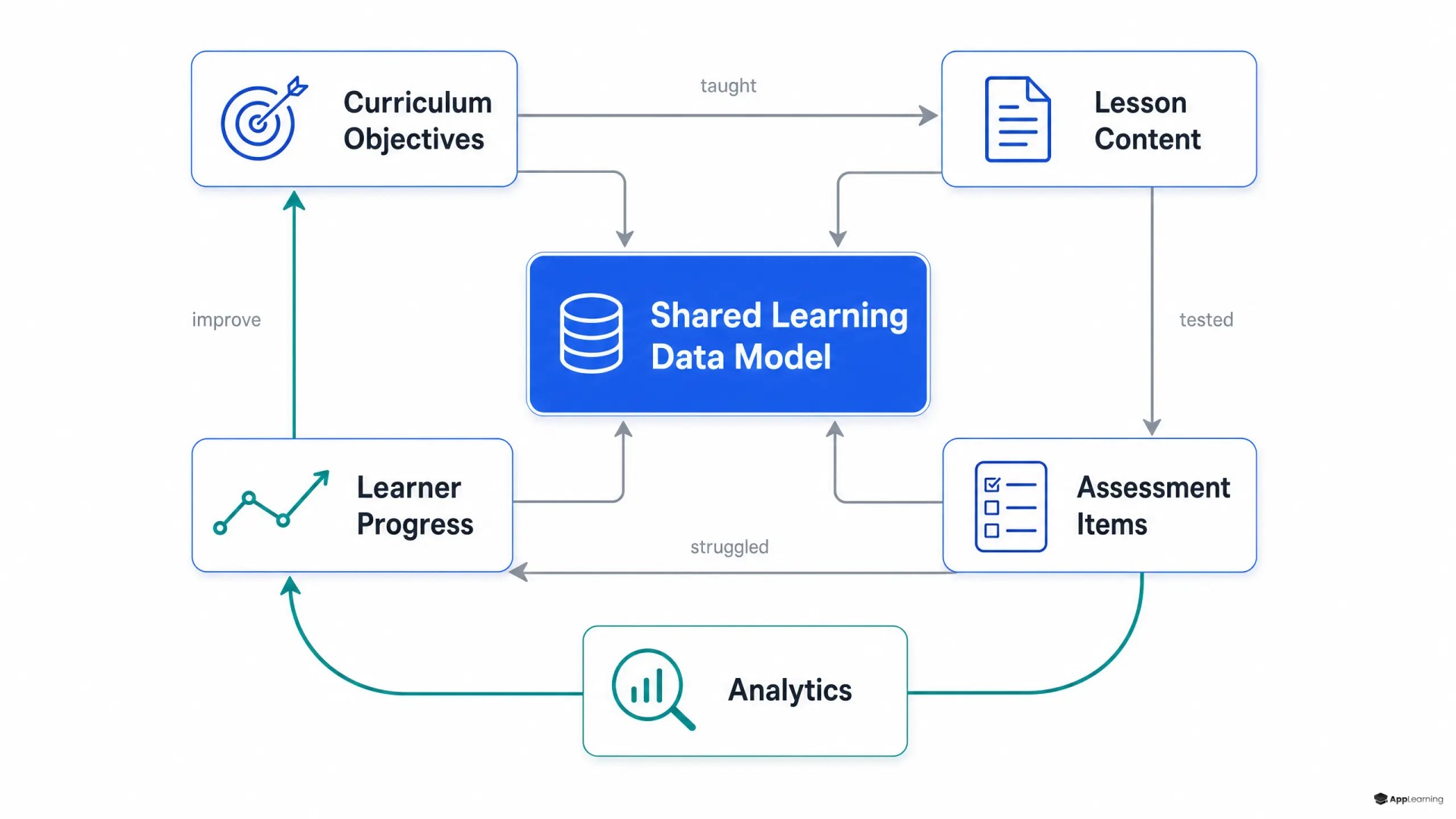
A learning data model is the controlled set of entities and relationships that makes those questions answerable. It is not a reporting layer added after launch. It is the architecture that authoring, delivery, quizzes and analytics use from the start.
At minimum, a curriculum assessment integration needs these linked records:
- Objectives and concepts with stable IDs, clear definitions and parent-child relationships.
- Lessons and learning paths linked to the concepts they teach.
- Assessment items linked to the concepts and objectives they test.
- Versions for lessons and questions so teams can separate a content issue from a learner issue.
- Learner states and events that retain the audience segment, attempt, result and time context.
- Mappings that show which content supports each objective and which items provide evidence of mastery.
This structure is consistent with the direction of assessment interoperability. 1EdTech’s standards portfolio distinguishes frameworks for competencies and curriculum alignment, assessment-item and result exchange, and learning-activity analytics. Standards do not replace product design, but they make the core principle clear: systems need common definitions before they can produce comparable data.
Good to know
What is a shared curriculum-to-assessment data model?
It is a common structure that links learning objectives, concepts, lessons, assessment items, learner activity and results through stable identifiers.
Why does this matter for startup onboarding?
It lets a small team identify which knowledge new hires lack and improve the exact training content without manual spreadsheet reconciliation.
Can a company start without adopting formal interoperability standards?
Yes. Start with stable internal IDs, version control and explicit mappings between content and questions. Standards become more important when systems or content providers need to exchange data.
From score reporting to content decisions
Once the links exist, learning analytics architecture becomes useful to operators. A low score is no longer a generic red flag. It can be filtered by objective, lesson version, role, location, start date and attempt pattern. The team can see whether one concept causes difficulty across cohorts, whether a revised lesson improved results, or whether a role-specific path needs a different example.
This also improves content quality assurance. When an item performs poorly, the owner can inspect its wording, the lesson section that precedes it, and the version learners saw. When learners repeatedly miss one concept after completing the relevant lesson, the next action might be to revise the explanation, add practice, change the question or update the process itself. That is a real improvement loop.
Consistent event data matters here as well. Caliper Analytics describes the advantage of applying the same data profile across learning technologies: aggregated data stays in one format, making comparison and analysis easier. The operational lesson applies even when a startup uses one platform. Define events and learner states consistently before growth turns exceptions into permanent reporting debt.
Build onboarding around evidence, not completion records.
Talk to usOne loop from authoring to action
For a growing company, the practical goal is not a complex enterprise data program. It is one reliable loop. A subject-matter expert creates a lesson. The lesson is mapped to the knowledge a role needs. A quiz checks that knowledge. Progress data shows where learners struggle. The owner updates the content and can measure whether the change worked.
That is the role an integrated platform such as App-Learning can play. Structured lessons, quizzes, progress tracking and analytics should operate as parts of one model, rather than as disconnected delivery features. This reduces tool sprawl, protects scarce operational time and gives founders a central view of whether onboarding is building capability rather than just distributing information.
The platform that wins is not the one with the most dashboards. It is the one where every result has a lineage: from learner and audience segment to assessment item, concept, lesson and version. That lineage turns internal training from an informal collection of documents into a system the company can improve as it scales.