

Key takeaways
- Knowledge bases answer known questions when users search for help.
- Internal LMSs manage structured training, completion, and learning records.
- Customer education platforms connect learning journeys to activation and retention.
- Tool choice should follow the product outcome, not the preferred content format.
Different systems for different customer jobs
Teams often buy the wrong education tool because they begin with format. They need articles, videos, quizzes, or certificates, so they compare feature lists. That skips the more useful question: what must change for the customer and the business? A support team may need fewer repeated questions. A learning team may need completion records. A product lead may need more users to complete a first purchase, set up a wallet, or return after a volatile week.
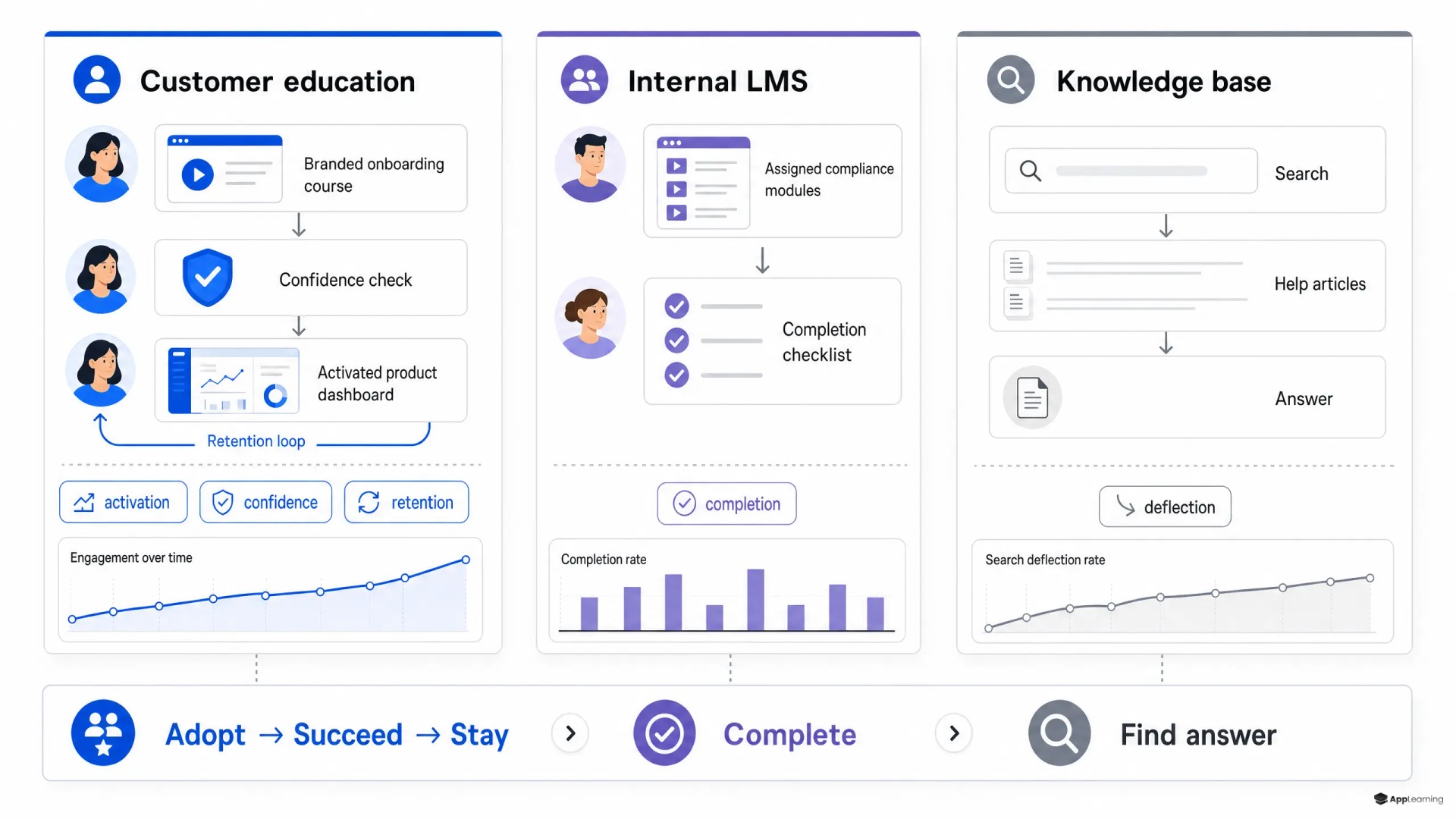
These outcomes can overlap, but the systems are not interchangeable. A knowledge base helps users solve a known problem. An internal LMS organizes formal learning. A customer education platform turns product understanding into a guided external-user journey. For a Bitcoin company, that distinction matters because uncertainty is often the real blocker behind an abandoned onboarding flow or an unused feature.
Knowledge bases resolve immediate friction
A knowledge base is the right system when a customer knows what they need and wants an answer now. Zendesk describes a help center as a self-service support option built around customer-facing articles, ticketing, and agent support. That makes this category strong for fees, verification requirements, transaction states, troubleshooting, security settings, and product documentation.
Its limit is progression. Search-based content assumes the user can name the problem. It does not reliably explain why a recurring buy matters before setup, what a recovery phrase changes before wallet creation, or which concept a beginner should understand before making a high-stakes choice. A well-run knowledge base should remain the source for live answers. It should not carry the whole burden of building confidence.
Internal LMSs create training control
An internal LMS is built to administer structured learning. It works well for employee onboarding, compliance modules, partner enablement, assessments, cohorts, and certification. For example, Moodle’s completion model tracks criteria such as completed activities, quiz results, grades, and instructor sign-off. That is useful when a manager, auditor, or enablement lead needs evidence that training happened.
An LMS can also serve customers, especially for a formal academy or certification program. The problem comes when its operating model remains internal. Completion alone is a weak success signal for a product team. A customer can finish a course and still fail to activate, misunderstand risk, or never use the feature the course was meant to support. External education needs learning data that can be read alongside product behavior.
Customer education platforms connect learning to use
A customer education platform starts with the action that unlocks value. It structures content into short paths for different user levels, places relevant lessons near product decisions, checks understanding, and measures where users progress or drop off. The goal is not to make customers consume more content. The goal is to reduce uncertainty before a meaningful product action.
For Bitcoin fintech teams, this means separating education by moment and confidence level. A beginner may need a short explanation of volatility and fees before a first purchase. A more experienced user may need a scenario-based lesson before self-custody. Both need clear, approved information, but they do not need the same pathway. Contextual delivery also reduces the gap between learning something and applying it.
- Segment paths by user knowledge, product state, market, and language.
- Trigger a lesson from the relevant onboarding or feature flow rather than a generic academy homepage.
- Use quizzes to identify misconceptions before irreversible or high-friction actions.
- Compare learning progress with first purchase, wallet setup, recurring-buy adoption, repeat use, and support contacts.
- Treat content as a maintained product asset with clear ownership across product, support, compliance, and growth.
Good to know
Can a knowledge base replace a customer education platform?
It can cover self-service support when users have a specific question. It is not designed to guide different customer segments through a sequenced journey or connect understanding to product actions.
Can an LMS be used for customer education?
Yes. An LMS can support customer academies, courses, assessments, and certification. It becomes less suitable when the main requirement is contextual, branded education embedded around product moments and measured against activation behavior.
Which metrics should a Bitcoin product team track?
Track lesson starts, completion, quiz performance, and drop-off points alongside first purchase, wallet setup, recurring-buy adoption, repeat use, support contacts, and retention by cohort. Learning metrics show engagement; product metrics show whether education supports the intended action.
Growth stage determines the sensible stack
Early-stage teams rarely need a full customer education platform on day one. If the product is simple and support demand is low, a clear knowledge base plus concise onboarding messages may be enough. The priority is accurate answers and fast iteration.
As the product and customer base mature, the signal changes. Repeated beginner tickets, weak onboarding completion, underused advanced features, new-market launches, and uneven confidence across cohorts point to a progression problem. A formal LMS may fit when certification or assigned training is the main need. A customer education platform fits when the central need is activation, trust, feature adoption, and retention across a large external audience.
Map education to the product actions your users still hesitate to take.
PlanApp-Learning makes education deployable
App-Learning fits teams that need a branded customer education platform without turning education into a separate, disconnected destination. Its web and mobile academy platform supports tailored learning paths, short courses, quizzes, learner analytics, deep links, embeds, and single sign-on. This gives product teams a practical way to place education inside the journey while giving content owners a system to update and govern it.
For a Bitcoin product, the operating model should be simple. Map the decisions that create hesitation. Build small, localized learning modules around those decisions. Route users into them from product touchpoints. Then compare quiz results and learning progress with the product events that matter. App-Learning can also turn existing documents, slide decks, and product knowledge into maintainable microlearning, so internal teams do not need to build an academy from scratch.
The choice is not really customer education platform vs LMS vs knowledge base. Most mature teams will use more than one. The important decision is assigning each system a clear job: knowledge bases resolve incidents, LMSs govern formal training, and customer education platforms help external users understand enough to take the next valuable action. When confidence is the bottleneck, education belongs in the product system.